
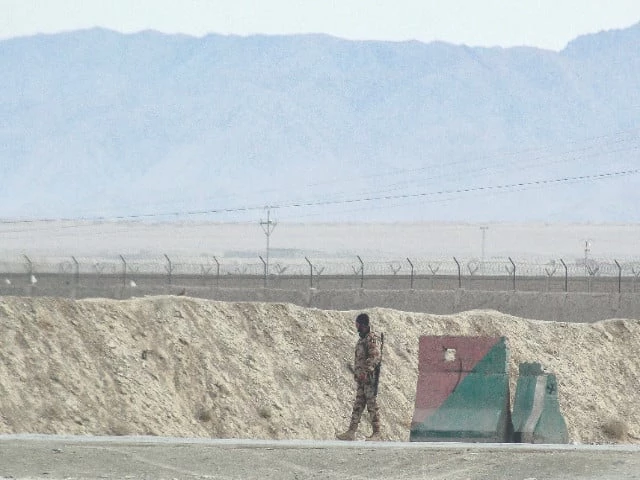
Pakistani security personnel stand guard at the Afghan border in Chaman, following nighttime clashes between forces of the two countries. Photo: AFP
The UAE Ministry of Foreign Affairs has strongly condemned the recent terrorist attacks targeting police officers in Khyber-Pakhtunkhwa and Punjab, which resulted in numerous casualties.
In a statement, the ministry reaffirmed the UAE’s “strong condemnation of these criminal acts” and its “continued rejection of all forms of violence, extremism and terrorism aimed at undermining security and stability.” He expressed his condolences to the families of the victims as well as the government and people of Pakistan, and wished a speedy recovery to the injured.
The conviction comes amid a surge in militant violence across Pakistan, particularly in Khyber-Pakhtunkhwa and Balochistan. Pakistani security forces have stepped up their intelligence operations in response to the surge in attacks.
Read: Security forces kill 5 terrorists, foil attack plot in Pishin
The military’s media wing, Inter-Services Public Relations (ISPR), said on Wednesday that security forces killed 34 militants during a series of high-tempo operations in the two provinces. Among them, 26 activists linked to what the State describes Fitna al-Khawarij — referring to the banned Tehreek-e-Taliban Pakistan (TTP) — were killed in four battles in Khyber-Pakhtunkhwa, while eight militants described as Fitna al-Hindustan were neutralized in Sambaza, Zhob district.
According to the ISPR, security forces also foiled an infiltration attempt near Hassan Khel in North Waziristan, killing an Afghan national affiliated with the militant network. Additional intelligence-led operations in Lakki Marwat, Bannu and Mir Ali resulted in the killing of more militants and the recovery of arms and ammunition.
Learn more: Pakistan wary of militant attacks after Afghanistan airstrikes
The recent surge in violence is linked to cross-border militant sanctuaries. Minister of State for Interior Talal Chaudhry said terrorists often retaliate after operations against their hideouts in Afghanistan, adding that security forces remain on high alert. Intelligence agencies also warned of a possible increase in attacks targeting urban centers, markets, security forces and places of worship.
Data from the Armed Conflict Location & Event Data Project (ACLED) shows that terrorist attacks in Pakistan have increased sharply in recent years, increasing almost fourfold to 2,425 incidents in 2025 from 658 in 2022, highlighting the growing security challenges facing the country.
Earlier, on Saturday evening, Pakistan carried out intelligence-driven strikes against terror camps in Afghanistan, which officials described as a response to a series of deadly suicide attacks during Ramazan.
The attacks included a bombing of an Imambargah in Islamabad and multiple explosions in Bajaur and Bannu.
Islamabad said it had “conclusive evidence” that the incidents were orchestrated by terrorists operating from Afghan territory, marking a sharp escalation in tensions between Pakistan and Afghanistan after Kabul summoned Pakistan’s ambassador and condemned the strikes as a violation of its sovereignty.


