
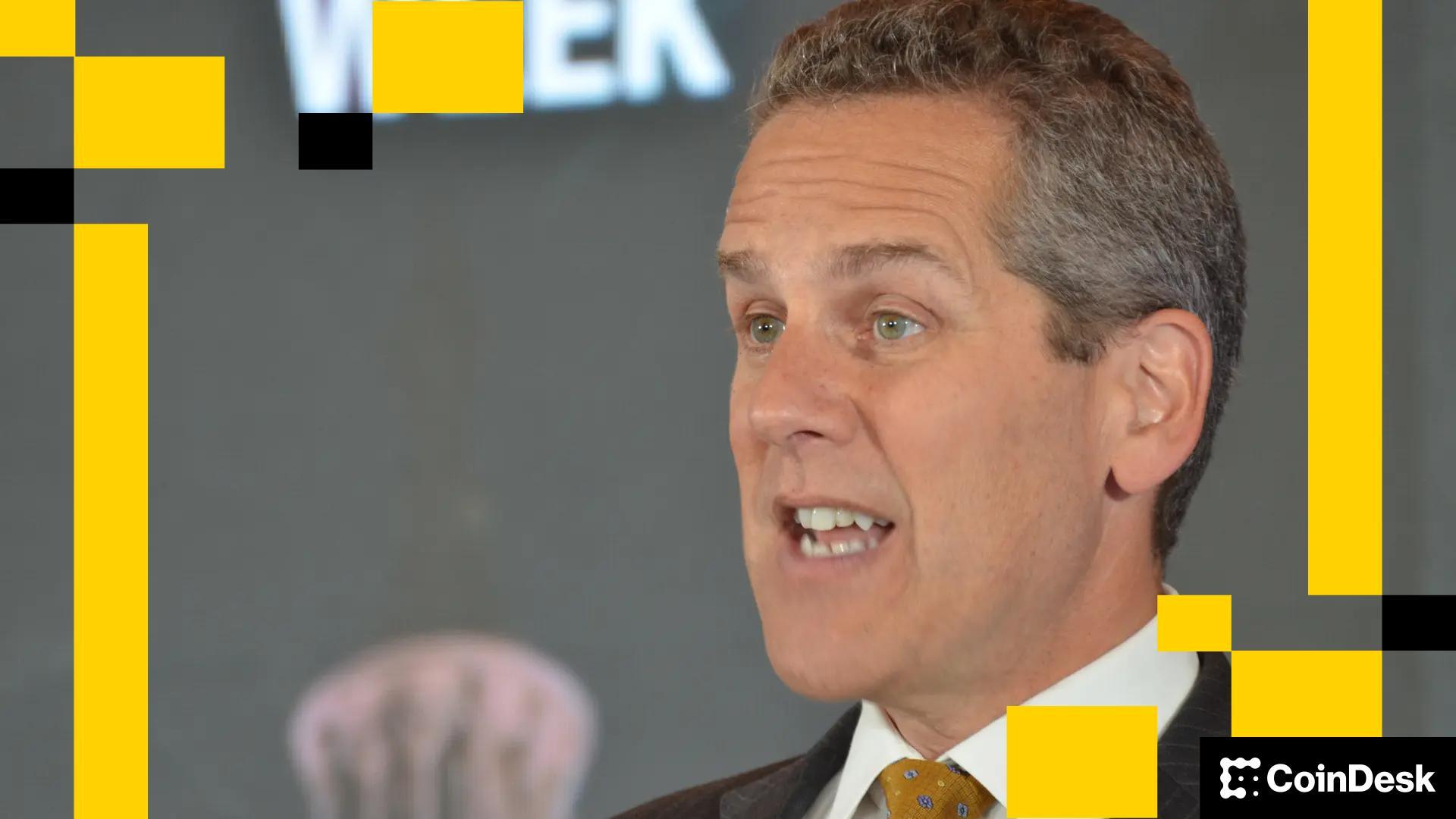
WASHINGTON, DC — The crypto industry and some of Wall Street’s financial giants have been scrambling to build stablecoin infrastructure long before U.S. watchdogs set their regulations, and Federal Reserve Governor Michael Barr took a moment Thursday to remind the industry’s legal experts of the dangers posed by the nominally safe assets.
“Issuing liquid liabilities redeemable at par but backed by even high-quality assets that creditors might have questions about makes private money vulnerable to risk,” Barr said at a DC Fintech Week event in Washington, emphasizing that permitted reserves such as uninsured deposits could present dangers.
He was the Fed’s top financial supervisor as a former vice chairman of the board in that role, but he resigned when President Donald Trump’s administration took over. The digital assets industry views Barr as part of the “debanking” trend in which industry insiders accuse banking regulators of encouraging banks to go out of business, and the Fed and other U.S. regulators have recently reversed the more restrictive crypto policy stance they took during his tenure.
But Barr remains a member of the Fed’s seven-member board and has warned the agencies that write the stablecoin’s rules — including his own — about “the long and painful history of private money being created with insufficient collateral.”
Barr gave as an example the U.S. experience with money market funds, noting how the Primary Reserve Fund “went bankrupt” – fell from its value by $1 per share – in 2008, as the global financial crisis was beginning, and how the more recent Covid pandemic put pressure on these funds again.
Despite the passage of the Guiding and Implementing National Innovation for US Stablecoins (GENIUS) Act, banking regulators have yet to write the rules they will need to implement it, leaving the industry in something of an unregulated gray area. As this continues, the world’s leading stablecoin, Tether’s USDT, is managed offshore and under a reserve approach that would not comply with the pending US standard (although Tether is also considering full entry into US markets).
“Stablecoin issuers traditionally retain profits from the investment of reserve assets and therefore have strong incentives to maximize the return on their reserve assets by extending the risk spectrum as far as possible,” Barr noted. “Expanding the limits of allowable reserve assets can increase profits in good times, but risks shattering confidence during inevitable episodes of market stress.”
“For the most part, I agree with everything he says,” said Corey Then, vice president and deputy general counsel for global policy at Circle, the issuer of USDC, the leading U.S.-based stablecoin.
“There’s a lot of work to be done in the rulemaking process,” the Circle leader said at the same event in Washington, taking the stage just after Barr. “The last thing we want at Circle is a permissive environment.”
Barr flagged the inclusion of uninsured deposits as potential reserves for issuers under GENIUS, noting that they were “a key risk factor during the March 2023 banking stresses.” He also highlighted so-called “call-a-day repos” as a reserve element that “could include potentially volatile assets.”
During the 2023 crisis among U.S. tech-focused banks, Circle held as much as 8% of its reserves with the failed Silicon Valley Bank, worth more than $3 billion, sparking a rush to buy back USDC that temporarily took it away from its dollar peg. Other high-profile stablecoins have also moved away from the peg, most notably during the implosion of Terra’s UST in 2022.
Barr proposed a GENIUS Act hypothesis, suggesting that because Bitcoin being legal tender in El Salvador, an argument could be made for bitcoin repos as an eligible reserve asset.
Federal and state regulators must draft “a comprehensive set of rules that can close important loopholes and ensure there are strong safeguards to protect stablecoin users and mitigate broader risks to the financial system,” Barr said.
Nonetheless, because issuers may be regulated by a wide range of government agencies, both at the federal and state levels, he warned of the risk of arbitrage in which issuers seek the simplest watchdog, despite the GENIUS Act’s intent that they be substantially similar.
During the 2008 collapse, American International Group’s venture financial products arm was overseen by a weaker federal regulator — the Office of Thrift Supervision — and much of its other operations by a series of state supervisors, leading to unnoticed dangers that ultimately threatened the financial system as a whole. (The OTS was later disbanded.)
Read more: Tether CEO says it will comply with GENIUS to come to the US, Circle says it’s settled now


