As Iran’s war with the United States and Israel rages across the region, a catastrophic environmental toll is emerging that threatens to undermine global climate goals.
Amid the war, a new analysis finds that the first 14 days of the U.S.-Israeli war with Iran released about 5.1 million tons of carbon dioxide, more than Iceland’s annual emissions.
This figure is also roughly equivalent to the combined annual production of the world’s 84 lowest-emitting countries.
Researchers from the Climate and Community Institute carried out the analysis in association with researchers from Lancaster University and the University of Energy and Natural Resources of Ghana.
This analysis constitutes the first comprehensive accounting of the climate cost of the conflict.
This staggering figure is also confirmed by satellite data from Bloomberg Green and investigative consultancy Data Desk, which reports a significant increase in flaring and methane releases from oil and gas infrastructure in the region.
Destruction of buildings: the hidden carbon bomb
Contrary to common opinion, the main cause of wartime emissions is not the burning of oil fields or military aircraft, but the destruction of civilian infrastructure.
According to the Iranian Red Crescent, approximately 2,000 civilian buildings, including 16,191 residential units, 3,384 commercial properties, 77 medical centers and 69 schools, were destroyed or suffered significant damage.
This combined destruction represents 2.4 million tonnes of CO2, the researchers calculated.
Attacks on oil infrastructure: black rain and burning skies
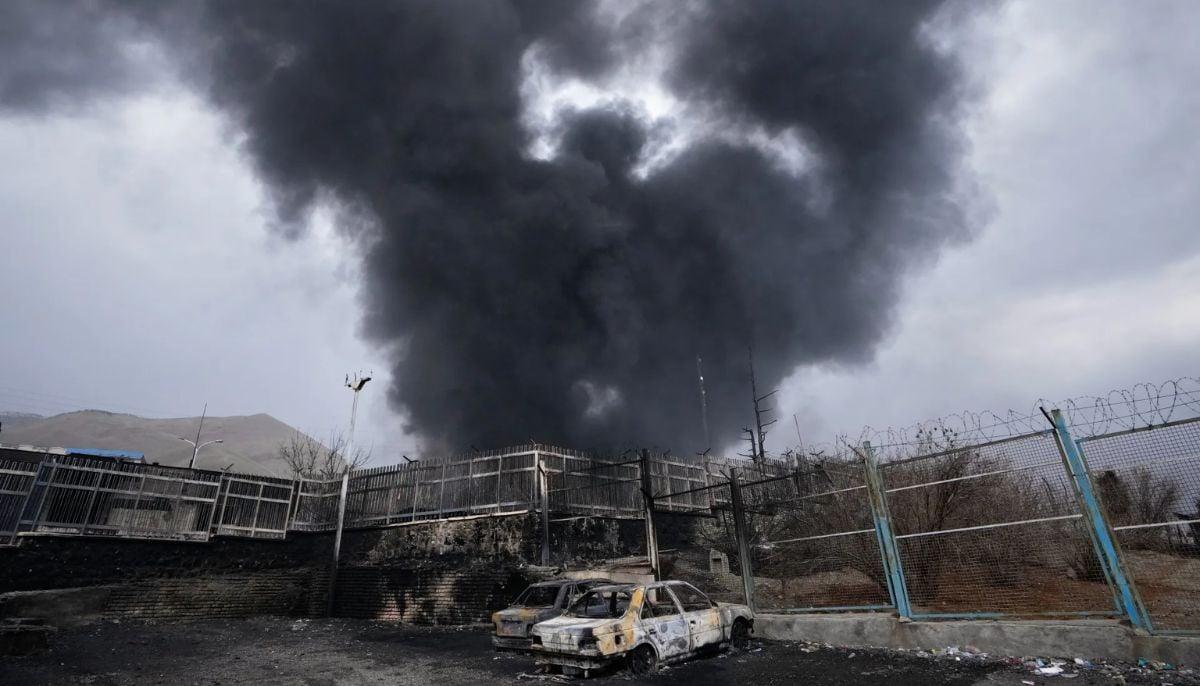
The most visually notable effect was the targeting of fossil fuel activities. Four large fuel depots around Tehran were bombed by Israeli forces. This led to the ignition of millions of liters of fuel, which formed dark clouds and toxic black rain over the capital.
Other comparable strikes in Iran and Iranian retaliation against Gulf countries cost between 2.5 and 5.9 million barrels of oil in fires, with 1.9 million tonnes of CO2 equivalent. THE Bloomberg Green Satellite analysis reveals that flaring at key facilities has increased significantly.
The Das Island liquefied natural gas plant in the United Arab Emirates released around 74,100 tonnes of CO2 equivalent into the atmosphere between February 28 and March 22, while the Ras Laffan plant in Qatar, the world’s largest LNG export hub, released around 101,300 tonnes.
Military operations: fuel, weapons and equipment
Direct emissions produced by military operations have been very significant due to the sheer scale of military operations. US heavy bombers flew missions as far away as the west of England, while fighter jets, drones, reconnaissance aircraft, cargo planes, tankers and warships consumed an estimated 150 to 270 million liters of fuel in the first two weeks alone, producing 529,000 tonnes of CO2 equivalent.
To put this into perspective, a single Lockheed Martin F-35 Lightning II fighter jet burns approximately 5,600 to 6,500 liters of kerosene during a 1.5 to 2 hour combat sortie, which equates to 14 to 17 tons of CO2, or roughly the equivalent of the lifetime emissions of an average passenger automobile. In 2024, Lockheed Martin said its products release nearly 14 million tons of CO2e during use.
The war also devastated important war equipment. The United States lost four aircraft, while Iran lost 28 aircraft, 21 ships and approximately 300 missile launchers. The total carbon involved in manufacturing substitutes for this equipment is estimated at 172,000 tonnes of CO2e.
The munitions themselves contributed an additional 55,000 tons, according to claims that U.S. and Israeli forces hit more than 6,000 targets and that Iran fired about 1,000 missiles and 2,000 drones, with about 1,900 interceptors fired in self-defense.
The global carbon budget under siege
Two weeks’ emissions during the conflict represent a huge drain on the world’s remaining carbon deposits. By June 2025, climate scientists estimate that humanity could emit greenhouse gases equivalent to 130 billion tonnes of CO2 to maintain a 50% chance of containing warming to 1.5°C above pre-industrial levels. The annual budget would be exhausted by 2028 at the current rate of 40 billion tonnes per year worldwide.
Professionals note that short-term emissions from war activities are just the tip of the iceberg regarding the conflict’s possible climate impact. Rebuilding destroyed infrastructure, cities and buildings will produce emissions for years or even decades.
The long-term carbon cost could dwarf the war’s initial footprint, as evidenced by trends in Ukraine, where reconstruction is expected to be a significant source of greenhouse gas emissions.
Aside from the climate implications, environmental impacts in the region are already having a devastating effect on the local population. Strikes against Tehran’s fuel depots have been causing toxic rain, which could have health consequences, including cancer risks, for decades. This is also being reported in other Gulf states, which have also been subject to retaliatory strikes.