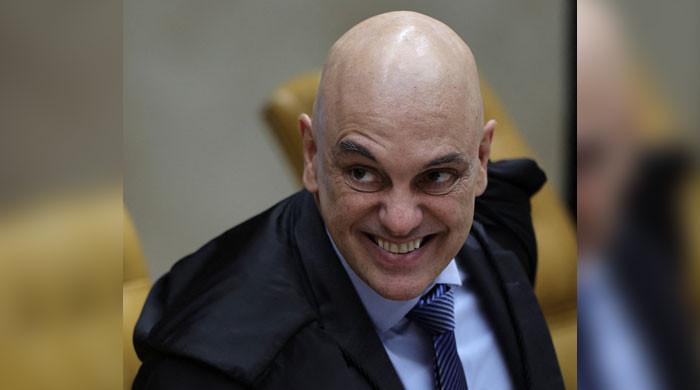
BRASILIA/WASHINGTON: The United States has lifted sanctions against Brazil’s Supreme Court justice targeted for overseeing a criminal case against an ally of President Donald Trump, the Treasury Department announced Friday.
The turnaround in less than five months, coming after the United States began reducing high tariffs on Brazilian goods, showed how quickly Trump reconciled with Brazilian President Luiz Inacio Lula da Silva and abandoned an aggressive defense of his right-wing predecessor.
The United States sanctioned Judge Alexandre de Moraes under the Global Magnitsky Act in July, punishing him for overseeing the trial that led to the conviction and imprisonment of former President Jair Bolsonaro for attempted coup after he lost his 2022 re-election bid.
Trump called the trial a “witch hunt” and his administration accused Moraes of weaponizing the courts, authorizing arbitrary pretrial detentions and suppressing free speech.
The Treasury Department on Friday also lifted sanctions imposed in September on Moraes’ wife, Viviane Barci, as well as those imposed on the Lex Institute, a financial entity controlled by Barci and other family members.
The sanctions stoked tensions between Brasilia and Washington this summer, when Trump imposed heavy tariffs on many products imported from Brazil, some of which he began reducing last month.
Lula welcomed the move on Friday, saying he had pushed for the sanctions to be lifted during a call with Trump last week.
“In my conversation with Trump last week, he asked me, ‘Is this good for you?’ I said it was good for Brazil and for Brazilian democracy,” Lula said at an event in Sao Paulo on Friday.
Moraes, at the same event, called the Treasury’s decision a “triple victory” for Brazil’s democracy, justice system and sovereignty.
“I could not help but thank President Lula for his efforts on my behalf and on behalf of my wife,” Moraes said.
Trump and Lula discussed sanctions last week in what the US leader called a “big” phone conversation, announcing what he called a “newly formed partnership” with Lula after months of tensions.
A source within the Brazilian presidency told Reuters on condition of anonymity that Brazil offered nothing in return when Lula offered to lift sanctions following the call.
“There was no quid pro quo,” the source said.
Washington supports sentence reduction
Friday’s announcement comes days after Brazilian lawmakers voted to significantly reduce the sentences of Bolsonaro and others convicted of undemocratic acts after the 2022 election.
The Trump administration has expressed support for the legislation, which now goes to Brazil’s Senate and will likely face resistance from Lula and the Supreme Court.
“The United States views the passage of a major amnesty bill by Brazil’s lower house as a step in the right direction, a sign that legal conditions in Brazil are improving,” a senior Trump administration official said Friday, calling continued sanctions against Moraes “inconsistent with U.S. foreign policy interests.”
Senator Flavio Bolsonaro, Bolsonaro’s eldest son who last week announced his candidacy for president with his father’s blessing, hailed the Trump administration’s decision as a “great gesture” to Brazil’s right and said it was a sign that the Senate should pass the bill that could reduce his father’s prison sentence.
“We will vote on the amnesty bill next week in the Senate, and if it passes, I have no doubt that the United States will completely remove the surcharges on Brazilian products exported there,” Flavio wrote on X, referring to Trump’s remaining tariffs on Brazilian products.
US Deputy Secretary of State Christopher Landau welcomed the passage of the sentencing reduction bill by the lower house of Congress.
“The United States has consistently expressed concern about efforts to use the legal process to weaponize political differences in Brazil,” Landau wrote on X, calling the approval “a first step toward combating these abuses.”
The pressure campaign on Moraes and the resulting tariffs were championed by Flavio’s U.S.-based younger brother Eduardo, drawing criticism at home, even among Brazilian conservatives.
In a statement, Eduardo expressed regret over the Trump administration’s decision to lift sanctions against Moraes, citing a lack of political unity.
“The lack of internal cohesion and insufficient support for initiatives carried out abroad have contributed to the worsening of the current situation,” said Eduardo.