
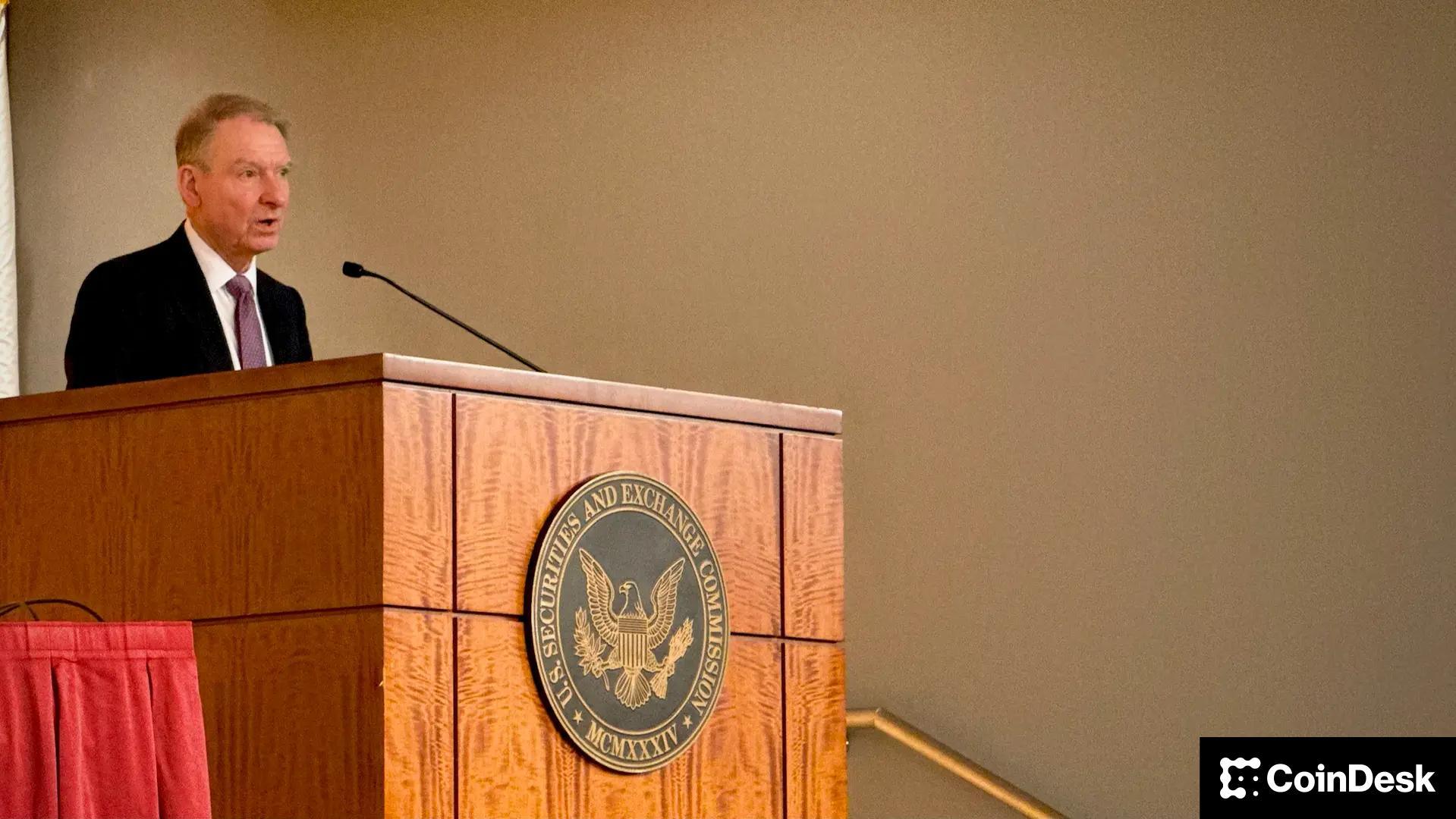
WASHINGTON, DC — The federal government could exploit the crypto sector’s potential for mass surveillance if it is not controlled by formal policies, SEC Chairman Paul Atkins said, asserting that the industry is – alternatively – also capable of designing systems that screen users for appropriate protections against illicit financing without jeopardizing their privacy.
“It’s not a big leap to imagine a steady migration to a future where government, in a constellation of intermediaries, can examine almost every dimension of individuals’ financial lives,” Atkins said during a roundtable on financial surveillance and privacy held Monday at the agency’s headquarters in Washington — the sixth crypto roundtable this year.
“While regulators may have a voracious appetite for data, this propensity is obviously and fundamentally incompatible with the kind of free society that made America great,” he said.
The president highlighted the agency’s long-running struggles over so-called Consolidated Audit Trail (CAT) technology, intended to monitor U.S. markets with more immediate insight, and rules after the 2008 financial crisis that required more reporting from investment companies to the SEC.
“Unfortunately, the federal government’s insatiable desire for data has expanded these tools in ways that increasingly endanger the freedom of American investors,” Atkins said. And the newest blockchain technology could be misused as “the most powerful financial surveillance architecture in history,” he said.
Government policies must protect the public’s lawful financial transactions from “mass surveillance.”
Oversight and privacy of digital assets have often been more closely associated with prosecutions by the U.S. Department of Justice and the Department of Treasury, particularly its Financial Crimes Enforcement Network (FinCEN) and Enforcement Unit, which seek to combat illicit financing. But the SEC will soon propose rules to regulate its industry.
The SEC under Atkins has sought to move forward to meet the crypto agenda set by President Donald Trump. His “Crypto Project” advanced several initiatives, including narrowly defining the domain of crypto securities, seeking standards for tokenizing securities, and establishing an “innovation exemption” that makes it easy for crypto companies to try new products.
He regularly talks about how closely he hopes to work with the SEC’s sister agency, the Commodity Futures Trading Commission, on joint oversight of crypto markets. It advocates a regulated system in which crypto investors can seamlessly manage their businesses in convenient, single outlets in which regulatory boundaries are not apparent. However, Atkins – unlike his predecessor Gary Gensler – has also argued that most digital assets do not check the securities box and will be beyond the reach of his agency.
The federal government has been waging a legal dispute with the crypto space for years, particularly with developers of privacy operations such as Tornado Cash. Although Trump-appointed regulators have backed away from this fight and said software developers must be protected, some of these cases have already been resolved with convictions of crypto insiders.
SEC Commissioner Hester Peirce, who led the agency’s working group on crypto issues, said that “the government should avoid imposing regulatory obligations, including obligations under the Bank Secrecy Act, on a software developer that does not have custody of users’ assets and has the ability to override users’ choices.” »
Atkins warned of the government’s next steps as crypto legislation and rulemaking is underway.
“If the government’s instinct is to treat every wallet as a broker, every software as an exchange, every transaction as a reportable event, and every protocol as a convenient surveillance node,” Atkins said, “then the government will turn this ecosystem into a financial panopticon” — a kind of constant observation conceptual prison designed by an English philosopher.


