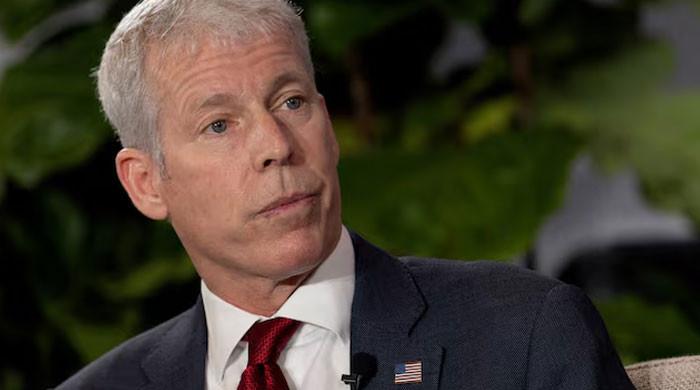
- US must control Venezuela’s oil sales, says Energy Sec Wright.
- Controlling Venezuela’s oil meant controlling the country: US Vice President Vance.
- Democrats criticize the Trump administration’s strategy, calling it oil theft.
The United States must control Venezuela’s oil sales and revenues indefinitely to stabilize that country’s economy, rebuild its oil sector and ensure it acts in the U.S. interest, senior U.S. officials said Wednesday.
The comments reflect the importance of crude oil to President Donald Trump’s strategy in Venezuela after U.S. forces toppled the country’s leader, Nicolas Maduro, in a raid on the capital, Caracas, on Saturday.
“We need to have that leverage and control over these oil sales to drive the changes that simply need to happen in Venezuela,” U.S. Energy Secretary Chris Wright said at the Goldman Sachs Energy, Cleantech and Utilities Conference in Miami.
He said the revenue would be used to stabilize Venezuela’s economy and, ultimately, to reimburse oil majors Exxon Mobil and ConocoPhillips for losses suffered when their assets were nationalized by former President Hugo Chavez nearly two decades ago.
US Vice President JD Vance said controlling Venezuela’s oil meant controlling the country.
“We control the energy resources and we say to the regime, ‘You’re allowed to sell the oil as long as you serve America’s national interest; you’re not allowed to sell it if you can’t serve America’s national interest,'” he told Fox News’ “Jesse Watters Primetime.”
“And this is how we put incredible pressure on this country without wasting a single American life, without endangering a single American citizen,” he said.
Democratic lawmakers have criticized the approach, which Connecticut Sen. Chris Murphy likened to stealing Venezuelan oil at gunpoint, while industry analysts have warned of political instability as the country walks a fine line between denouncing Maduro’s capture and appeasement of the United States.
The OPEC member country has the world’s largest oil reserves but accounts for only about 1% of global supply after decades of underinvestment eroded production.
Stored oil hits the market first
Energy Secretary Wright said the United States would first market stored Venezuelan oil and then sell current future production indefinitely, with the proceeds deposited into accounts controlled by the U.S. government.
Such sales have already begun and the United States has engaged “the world’s leading commodity traders and banks” to execute them and provide financial support, according to a statement from the U.S. Department of Energy.
Wright added that he was speaking to U.S. oil companies to find out what conditions would allow them to enter Venezuela to help boost the country’s production in the long term.
“The resources are immense. It should be a rich, prosperous and peaceful energy powerhouse,” he said.
On Tuesday, Washington announced a deal with Caracas to initially export up to $2 billion of Venezuelan crude to the United States, a sign that the government of interim Venezuelan President Delcy Rodriguez is responding to Trump’s demand to open up to American oil companies or risk further military intervention.
Trump said in an article on Truth Social on Wednesday that Venezuela had agreed to use proceeds from the sale of its oil to buy products made in the United States.
“A wise choice and a very good thing for the Venezuelan people and for the United States,” he wrote.
Venezuela’s state oil company PDVSA said it was making progress in negotiations with the United States over oil sales. Wills Rangel, PDVSA board member, said Reuters the United States will have to purchase cargoes at fair market prices.
Shares of U.S. refiners Marathon Petroleum, Phillips 66 and Valero Energy rose between 2.5% and 5%.
Meetings at the White House
Trump is scheduled to meet with executives of major oil companies at the White House on Friday to discuss ways to increase Venezuela’s oil production.
Representatives from Exxon Mobil, ConocoPhillips and Chevron – the three largest US oil companies – would be present, according to a source familiar with the matter.
Chevron Vice Chairman Mark Nelson will represent the company at the meeting, another source said.
The companies, all of which have experience in Venezuela, declined to comment.
Wright said in an interview with CNBC Wednesday afternoon that he spoke with the chief executives of the three companies immediately after Maduro’s capture and expected them to engage in the rehabilitation of Venezuela’s oil sector.
“Are they going to invest billions of dollars in building new infrastructure in Venezuela next week? Of course not,” he said. “But they want to be productive advisors and assistants in this process.”
Wright also told CNBC that some of the proceeds from Venezuelan oil sales could eventually be used to reimburse ConocoPhillips and Exxon Mobil for losses incurred while exiting the country, but only after Venezuela’s economy is stabilized.
Chevron is the only American oil major still active in Venezuela’s oil fields.
Venezuela produced up to 3.5 million barrels per day in the 1970s. But poor management and limited foreign investment have since led to a sharp decline in annual production, which averaged around 1.1 million bpd last year.
Wright said he believed Venezuelan production could be increased in a short period of time through the provision of equipment and technology, but that a broader return to past production levels would take years.