

- Volvo’s partnership with NVIDIA goes beyond chips in cars
- Gaussian Splatting creates high -fidelity 3D scenes
- The technique can recreate “edge cases” to form the models more quickly
Volvo uses a new AI technique called “Gaussian Splating” to train its vehicles and accelerate its objective of zero collisions on roads – and all thanks to its recently extended partnership with Nvidia.
Last month, we reported that the next Volvo ES90 will be the most powerful car that he has ever created in terms of basic computer capacity, due to the packaging of an NVIDIA Agx Orin configuration.
Now, the company has revealed how this type of supercalculculculculter helps him to train his advanced driver systems more quickly.
Volvo claims that it can now synthesize the incident data collected by the advanced sensors of its latest vehicles, such as emergency braking, live management or manual intervention.
This then allows the company to rebuild them and explore them with new ways to better understand how incidents can be avoided.
The new method is nicknamed Gaussian splashes and allows the company’s software to produce realistic and high fidelity 3D scenes and visuals from the real world.
Once these scenes have been created, Volvo engineers can handle them to generate a number of results. The examples of video clip provided by the Swedish brand are incredibly realistic.
It is similar to a human learning from Skateboard by playing Tony Hawk professional skater For hours and hours.
“We can select one of the rare edges and explode it in thousands of new variations in the scenario to train and validate our models,” explains Alwin Bakkenes, manager of global software engineering at Volvo Cars.
Bakkenes says that it has the potential to unlock a scale that Volvo has never had before and even to catch peak cases before they occur in the real world.
Now computers form computers
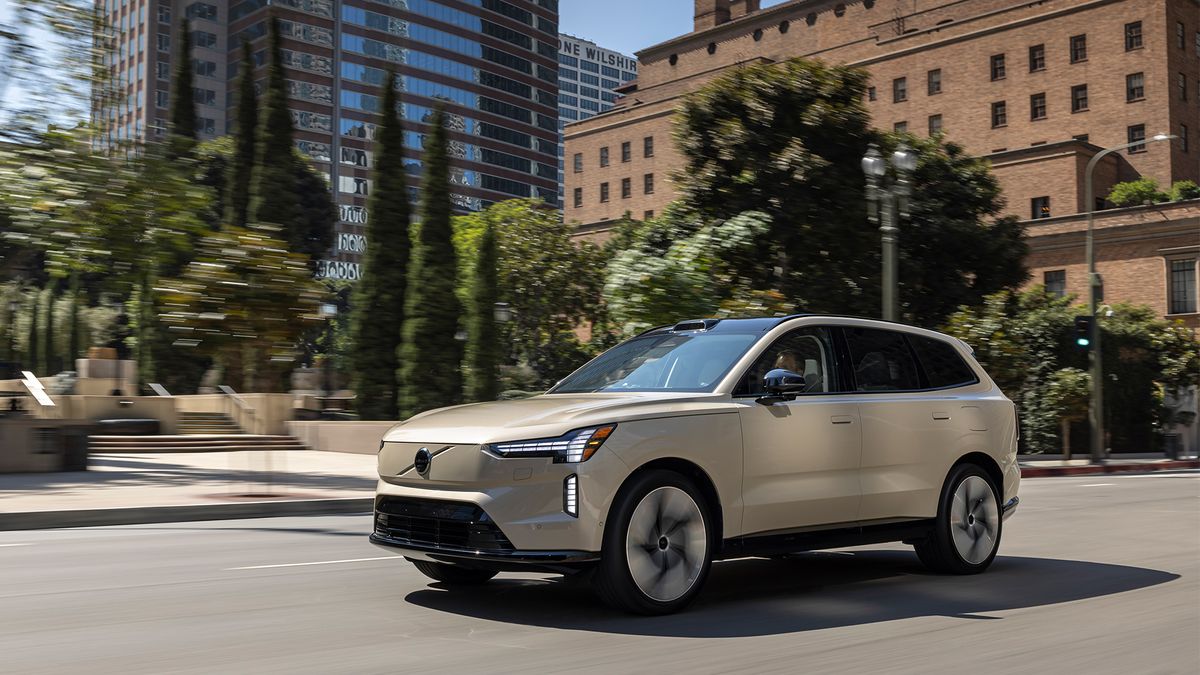
Gaussian splashes are a relatively new 3D rendering technique that was not based on neural networks, unlike more complex methods such as the neural radiance field (nerves).
This allows you to create incredibly complex 3D scenes in real time. The technique is currently explored in several industries, from the game to the development of interactive applications.
The use by Volvo of advanced LIDAR technology, the sensor and the high definition camera, as presented first in the ex90, collects data trains which can then be reproduced in a manipulable 3D model, which allows its engineers to then form the AI of the vehicle to perform better in the real world.
There has been a certain disappointment when the ex90 was launched, since its LIDAR technology would remain offline for the use of consumers, effectively banished to collect data until the computing power of Volvo is at a level where the company was happy to introduce ADAS systems which are based on the sequence of sensors and software.
Fortunately, its recently announced partnership with Nvidia will help the Swedish brand, which is synonymous with road safety, to make its vision of zero collisions and driving aid systems that really help, rather than simply NAG.
In addition, the company also said that the first EX90 models will be updated with the Dual Nvidia Agx Orin Orin on a flea configuration, so that they can also make the most of the latest developments from autonomous driving systems and ADAS.


