
.
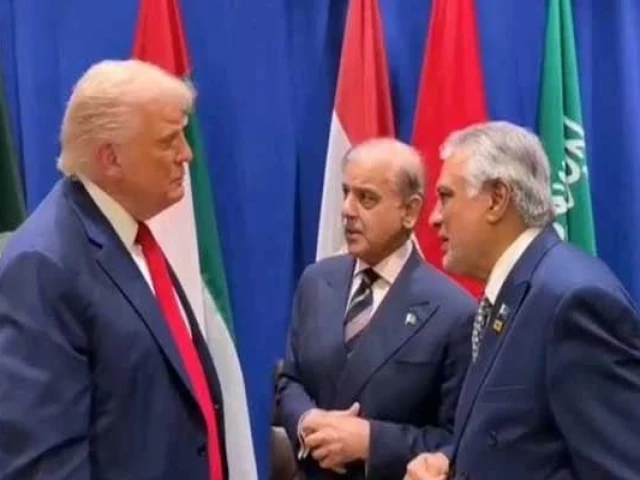
Prime Minister Shehbaz Sharif and Prime Minister Ishaq Dar interact with US President Donald Trump on the sidelines of the United Nations General Assembly on September 24, 2025. Courtesy: Foreign Office/X
ISLAMABAD:
As US President Donald Trump prepares to unveil details of a UN-authorized stabilization force for Gaza, Pakistan is deliberately keeping its stance opaque on whether it will commit troops to the proposed International Stabilization Force (ISF).
Trump announced Sunday that member states of his new Peace Council had pledged thousands ahead of his first summit.
However, officials in Islamabad offered neither confirmation nor denial of Pakistan’s potential participation, reflecting their caution at a time of high diplomatic sensitivity.
The first formal meeting of the Peace Council is scheduled for February 19 in Washington.
Trump is expected to outline a multibillion-dollar reconstruction plan for Gaza and outline the structure and mandate of the stabilization force.
Prime Minister Shehbaz Sharif is expected to attend the summit, although Pakistani officials have remained tight-lipped on whether troop deployment is being considered.
Security and Foreign Office sources declined to confirm or deny any engagement, saying discussions were ongoing and sensitive. “No decision has been made public,” said an official, speaking on condition of anonymity.
The issue was reportedly raised during talks between Army Chief of Staff Field Marshal Syed Asim Munir and US Secretary of State Marco Rubio on the sidelines of the Munich Security Dialogue on Saturday.
Although neither side has disclosed details, diplomatic sources said the proposed stabilization force and the contours of its mandate had been revised.
Pakistan had previously backed Trump’s 20-point peace initiative in Gaza alongside key Muslim countries and joined the Peace Council after its formation was backed by a UN Security Council resolution.
However, Islamabad has publicly asserted that its participation in any force would be contingent on a clearly defined and limited mandate.
Foreign Minister Ishaq Dar has previously said Pakistan would only consider joining a force in Gaza if its role was strictly limited to peacekeeping and humanitarian stabilization, not disarming Hamas or targeting any other Palestinian groups.
The United States acknowledged that several member states had reservations about the scope of the ISF mandate.
Under Trump’s proposal, Hamas fighters willing to lay down their arms and commit to peaceful coexistence would be offered amnesty, while others could be given safe passage out of Gaza.
In an article on Truth Social, Trump said Peace Council members would commit more than $5 billion to reconstruction and humanitarian efforts in Gaza.
He added that several countries had voluntarily committed thousands of troops for stabilization mission and local policing functions.
U.S. officials said delegations from more than 20 countries, including regional powers such as Turkey, Egypt, Saudi Arabia and Qatar, as well as countries such as Indonesia, would attend the summit.
Although Washington insists the initiative is limited to Gaza, critics have warned that the Peace Council could evolve into a parallel diplomatic platform competing with the United Nations.
For Pakistan, any decision to deploy troops would have considerable political and security implications, particularly given domestic sensitivities surrounding involvement in a conflict involving Hamas and Israel.
For now, Islamabad appears inclined to wait for more clarity on the force’s mandate before publicly revealing its role.


