
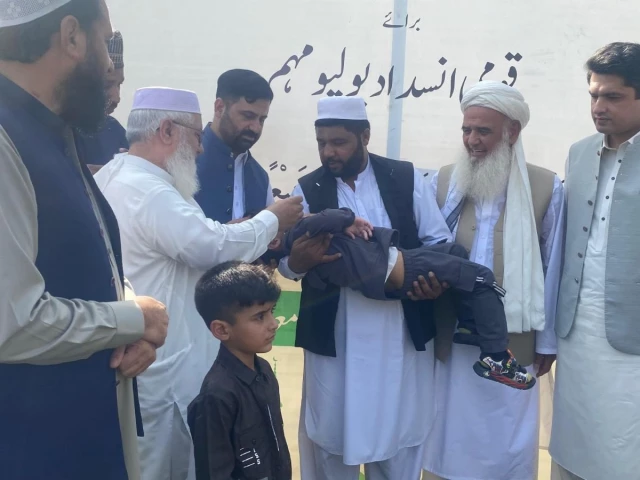
In a quiet village on the outskirts of Peshawar, Shahid Khan, 30, goes door to door to help vaccinators administer polio drops to every child in his community. For Shahid, it’s more than a campaign, it’s a personal mission born from pain and love.
“My own daughter has polio,” he said, his voice shaking as he watched her struggle to walk. “Every time I see her unable to play like other children, it breaks me. That’s why I promised that no child in my area would suffer like her. I will make sure that everyone is vaccinated.”
Shahid’s story resonates in countless homes across Khyber-Pakhtunkhwa (KP), where families still live with the lifelong scars of a disease that should have been ancient history by now. Every unvaccinated child reminds us of the challenges Pakistan continues to face in eradicating polio – a virus that thrives on neglect, misinformation and resistance.
An official with the Polio Eradication Program, who requested anonymity, said that while polio remains a “national cause” supported by all levels of government – from the prime minister to provincial leaders – the journey is far from easy. “The environment in KP and the merged districts has always been complex,” he noted. “At times our work has been targeted by activists and foreign elements seeking to disrupt a noble cause.”
Read: Pakistan launches polio campaign targeting 45 million children (NEOC)
He acknowledged that mistakes had been made in the past. “Whenever health interventions are imposed by force, communities react with suspicion,” he said. “Unfortunately, we’ve done this before. It’s time to rebuild trust and ensure people understand vaccination as a right, not an obligation.”
The official added that Pakistan must learn from its neighbors. “If Afghanistan and other countries can be on the verge of eliminating the virus, why can’t we? We need to rethink our communications strategy and make sure we reach every last child.”
“If we can beat India in war, why not beat India also in health to eradicate polio? If the same commitment was made, then polio would be eradicated from Pakistan,” he added, noting that despite conflicts in many Muslim countries, polio is not present there – so why is it still in Pakistan?
Professor Dr Muhammad Hussain, a renowned pediatrician and former president of the Pakistan Pediatric Association, said the answer lies in treating polio as part of a larger public health system rather than as an isolated mission. “Polio must be approached seriously but without sensationalism,” he said. The Express PK Press Club.
“Excessive safety protocols and large public ceremonies often overshadow the real work. The focus should be on realistic goals and the empowerment of doctors, parents, teachers and local leaders – not publicity.”
Dr Hussain suggested introducing a model similar to the COVID-19 vaccination system, where certificates are issued after completing all doses. “Ultimately,” he said, “the fight against polio must be driven by sincerity, consistency and accountability, not endless initiatives that create noise but have little impact.”
Learn more: KP reports one new polio case, Pakistan’s total rises to 30
This sincerity is visible in the work of frontline health workers and community volunteers like Shahid Khan – unsung heroes who brave harsh weather, long distances and sometimes hostility to protect the next generation.
Mr Shafi Ullah Khan, Emergency Operations Center Coordinator (EOC-KP), said the province was seeing encouraging results. “There has been a drastic drop in refusal cases,” he said. “This reflects the commitment of our teams and the government. Our vision is a polio-free KP and Pakistan, but this requires every citizen and the media to play their role.”
For more than three decades, Pakistan has been at the forefront of one of the world’s most ambitious public health campaigns: the fight against polio. What began as a global dream to protect every child from paralysis has become a deeply local struggle fought in narrow alleys, rugged mountains and crowded refugee camps.
The results speak for themselves. In 2025, Pakistan reported 30 polio cases nationwide – 19 in KP – a drop of 80% since 2019. From hundreds of cases per year in the early 1990s to just a handful today, the country has reduced polio by more than 99%. Behind each of these drops are thousands of vaccinators, many of them women, who walk from house to house with life-saving hope in tiny vials.
Yet, as health experts warn, the home stretch is always the hardest. Sporadic detections of the virus in wastewater samples remind authorities that polio remains ahead wherever sanitation is poor and awareness is low. “Even a single case means the virus is circulating,” a health official said. “We cannot relax until there is no detection, not just zero cases.”
There are, however, reasons to be optimistic. Across Pakistan, communities, clerics, teachers and journalists are uniting to dispel myths and build trust. Religious leaders now approach vaccination from the minbar and mehrab, encouraging parents to open their doors to health workers. “Every mother’s decision to get vaccinated is an act of patriotism,” a local imam said during a Friday sermon.
Ultimately, ending polio is more than a medical goal: it is a moral goal. It’s about delivering on the promise that no child anywhere in Pakistan will ever again be paralyzed by a disease the world knows how to prevent.


