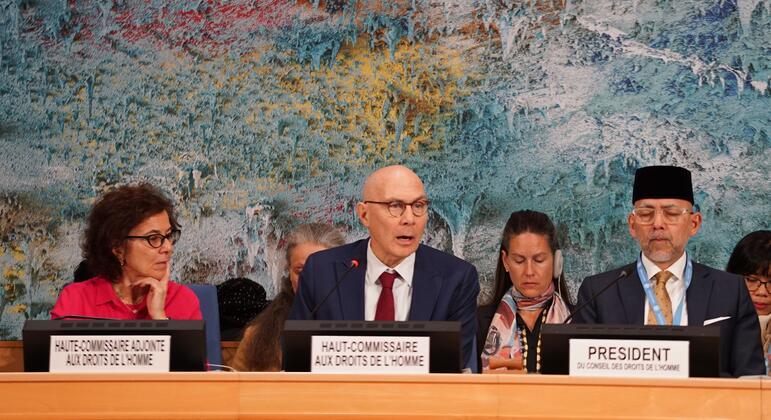
Speaking at the Human Rights Council in Geneva, Mr Türk stressed that violence against women – including femicide – had become a global emergency.
Around 50,000 women and girls around the world have been killed in 2024, most of them by family members, he said, amid ongoing hearings in the US Congress into the entourage of pedophile Jeffrey Epstein and following the shocking case of Frenchwoman Gisèle Pellicot, who was drugged by her husband and raped by dozens of men while she was unconscious for nine years:
“Does anyone think there aren’t many more men like Dominique Pellicot or Jeffrey Epstein?
Social facilitators
“Such horrific abuses are enabled by social systems that silence women and girls and shield powerful men from accountability. »
The United Nations High Commissioner has expressed deep concern over the growing number of attacks against women in public life.
“Every female politician I meet tells me they face constant misogyny and hatred online,” he told the Council, which is the UN’s main human rights forum.
Denmark eradicates mother-to-child transmission of syphilis and HIV
Denmark made a significant breakthrough in health care with the announcement Friday that the country has eradicated mother-to-child transmission of syphilis and HIV.
Without treatment, the risk of HIV transmission is 15 to 45 percent, while untreated syphilis can lead to stillbirth or neonatal death in half of all pregnancies, according to the United Nations World Health Organization (WHO).
Evidence of “sustained commitment”
Welcoming Denmark’s announcement, the UN agency called it an important step because of the Scandinavian country’s “sustained commitment” to tackling the problem, which constitutes a major global health challenge.
WHO chief Tedros Adhanom Ghebreyesus identified strong political commitment and consistent investment in primary care as key factors in Denmark to eradicate mother-to-baby transmission of the two diseases.
With integrated maternal and child health services, “countries can protect every pregnant woman and newborn from these diseases,” Tedros insisted.
Prisoner releases welcomed in Belarus, but hundreds remain imprisoned in ‘alarming’ conditions
The United Nations group of independent experts monitoring Belarus on Friday welcomed the release of more than a hundred political prisoners there, but issued a warning over “alarming” release conditions, which include forced deportation.
More than a thousand people remain in prison for political reasons, said experts appointed by the U.N. Human Rights Council, who receive no pay for their work and are not U.N. staff.
Forced and arbitrary evictions constitute a flagrant violation of international human rights standards, they continued.
“We urge the government of Belarus to respect its human rights obligations and immediately and unconditionally release all prisoners detained for political reasons,” said Karinna Moskalenko, Chair of the Group of Independent Experts.
Silencing dissent
Their report, which documents violations carried out by Belarusian authorities since May 2020, highlights a state-led strategy to silence dissent through arbitrary arrests and detentions and by subjecting detainees to torture, ill-treatment and inhumane conditions.
The deaths of at least eight people in detention were also reported, “evidence of the harsh conditions of detention and the denial of adequate medical care.”
The report warns that “a culture of impunity allows these violations to persist and speaks of “a complete lack of accountability within the national legal system.”
“In the absence of domestic justice, she called on the international community to take decisive action… to ensure that those responsible for these systematic violations are finally brought to justice,” the experts said in their statement.