
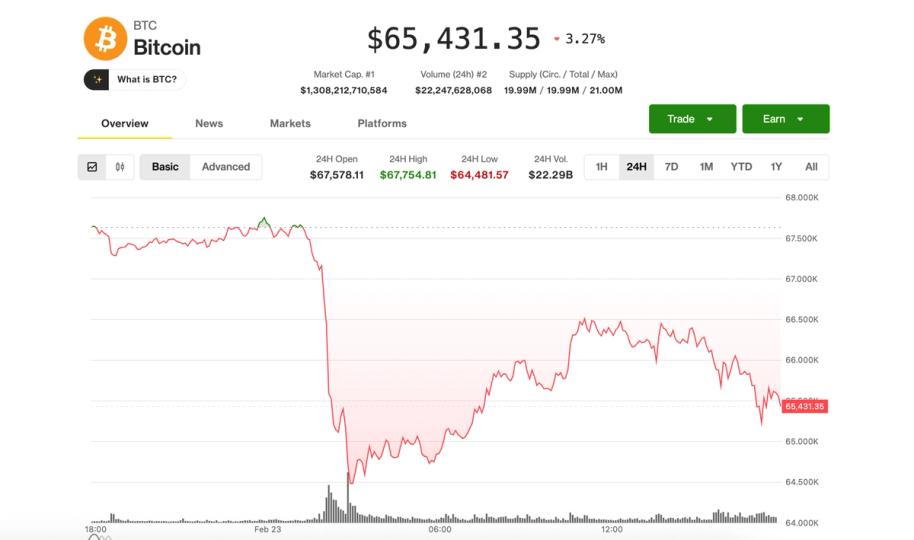
Bitcoin The very modest rebound after the sharp overnight sell-off quickly faded during the morning session in the United States on Monday as broader risk markets fell sharply.
Trading at $65,400 around midday on the East Coast, bitcoin has fallen 35% in the past 24 hours.
The action came as U.S. stocks fell. The tech-heavy S&P 500 and Nasdaq 100 each fell more than 1%, led by further weakness in software stocks and private equity firms.
The iShares Expanded Tech-Software ETF (IGV) fell another 5% to a 52-week low and is now down nearly 35% since October on concerns that generative AI tools will disrupt traditional software business models. Whether true or not, current market thinking is that crypto is just software, and the price movements of Bitcoin and IGV have recently been almost perfectly correlated.
Adding to this bearish theme are ongoing concerns that AI could lead markets to the brink of a major negative credit event similar to that of the 2008 global financial crisis. This is currently reflected in private equity stock prices. These companies have significant exposure to the software sector mentioned above. Blow Owl Capital (OWL) – which sold assets last week in an attempt to appease cash-starved investors – is down another 3.5% on Monday and 32% year to date. BlackStone (BX), Ares Management (ARES), and Apollo Global Management (APO) all added to their recent significant losses, falling between 6% and 8%.
Crypto often trades as a high-beta proxy for technology and broader liquidity conditions, and Monday’s weakness reflects this dynamic. Although BTC has so far held above the worst of its early February lows, it is still trading in a tight range between $60,000 and $70,000 as risk appetite remains fragile.
Adding to all that is uncertainty over global tariffs after the Supreme Court struck down President Trump’s previous use of massive levies, Joel Kruger, market strategist at LMAX Group, said in a note.
“This triggered a classic risk-averse environment,” Kruger said. “Investors have been pulling out of speculative assets like crypto, with bitcoin behaving more like a high-beta risk play than digital gold.”


