The escalation comes amid growing risks to the protection of civilians and aid workers, with three humanitarian staff killed between February 7 and 16 in Jonglei and Upper Nile states, according to the UN relief coordination office, OCHA.
Access to some of the worst-hit areas remains patchy despite renewed promises from authorities to allow relief operations.
Last Friday, emergency relief coordinator Tom Fletcher arrived in the country on a five-day mission aimed at drawing international attention to what he described as a worsening and underreported crisis.
“So here in South Sudan you have this perfect storm of climate change, conflict, inequality and poverty.” Mr Fletcher said upon his arrival. “Right now, people here in South Sudan feel like no one is listening. “
Tom Fletcher, emergency response coordinator (left) at Akobo County Hospital, Jonglei State, South Sudan.
Increased travel
Clashes between the South Sudan People’s Defense Force – the national army – and elements of the opposition Sudan People’s Liberation Army (SPLA-iO), which resumed in late December, triggered large-scale displacement in central and northern Jonglei.
According to South Sudanese authorities, nearly 280,000 people have fled their homes in eight countiesmany of whom are moving to Upper Nile and Lakes States.
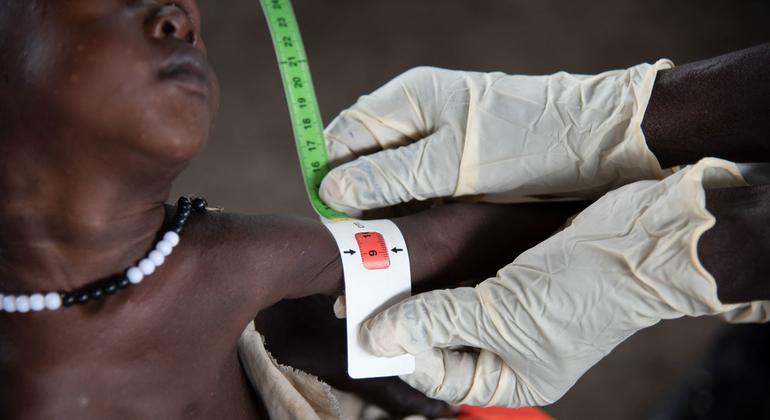
Families are sheltering in the open air or in makeshift structures, with urgent needs for food, health care and basic necessities. Markets and agricultural activities have been disrupted, leaving several communities with little or no access to food.
The United Nations World Food Program (WFP) has stepped up its food aid, but fighting and insecurity – including looting of humanitarian convoys – are hampering the response.
Caught in the crossfire
In Akobo, in the southern state of Jonglei, Mr. Fletcher visited a local hospital, where at least 93 patients with gunshot wounds had been treated as of February 18.
“Civilians should never be a target,” he said after meeting victims including an 18-month-old child and a 70-year-old grandmother.
At the hospital, a humanitarian said: “The father was shot. The mother was kidnapped.“The grandmother had walked seven days for help. When asked if she had received any food, Mr. Fletcher observed: “There is no food.»
He added that communities are spending “weeks without the support they need”, describing “devastating stories of sexual violence, hunger and starvation, of children arriving who have lost everything”.
Cholera on the march
The fighting has had serious consequences on health services. Thirteen facilities were reportedly damaged or looted, leaving three health workers dead and one injured. In some counties, most facilities were destroyed or their operations suspended.
Meanwhile, cholera continues to spread. Between February 11 and 17, 106 new cases and three deaths were reported in five counties. Since the outbreak began in September 2024, more than 98,000 cases and 1,624 deaths have been recorded across the country.
Access and Accountability
Although authorities have reiterated their directives for unhindered humanitarian access, their implementation remains inconsistent. Humanitarian convoys faced refusals in certain areas and operational constraints limited movements.
Mr. Fletcher said the challenge extends beyond immediate relief, asking: “How can we have a peace process? How can we end this conflict? How can we keep people here safe?”
“But also, how can we reduce the noise, the noise of distraction and apathy?