
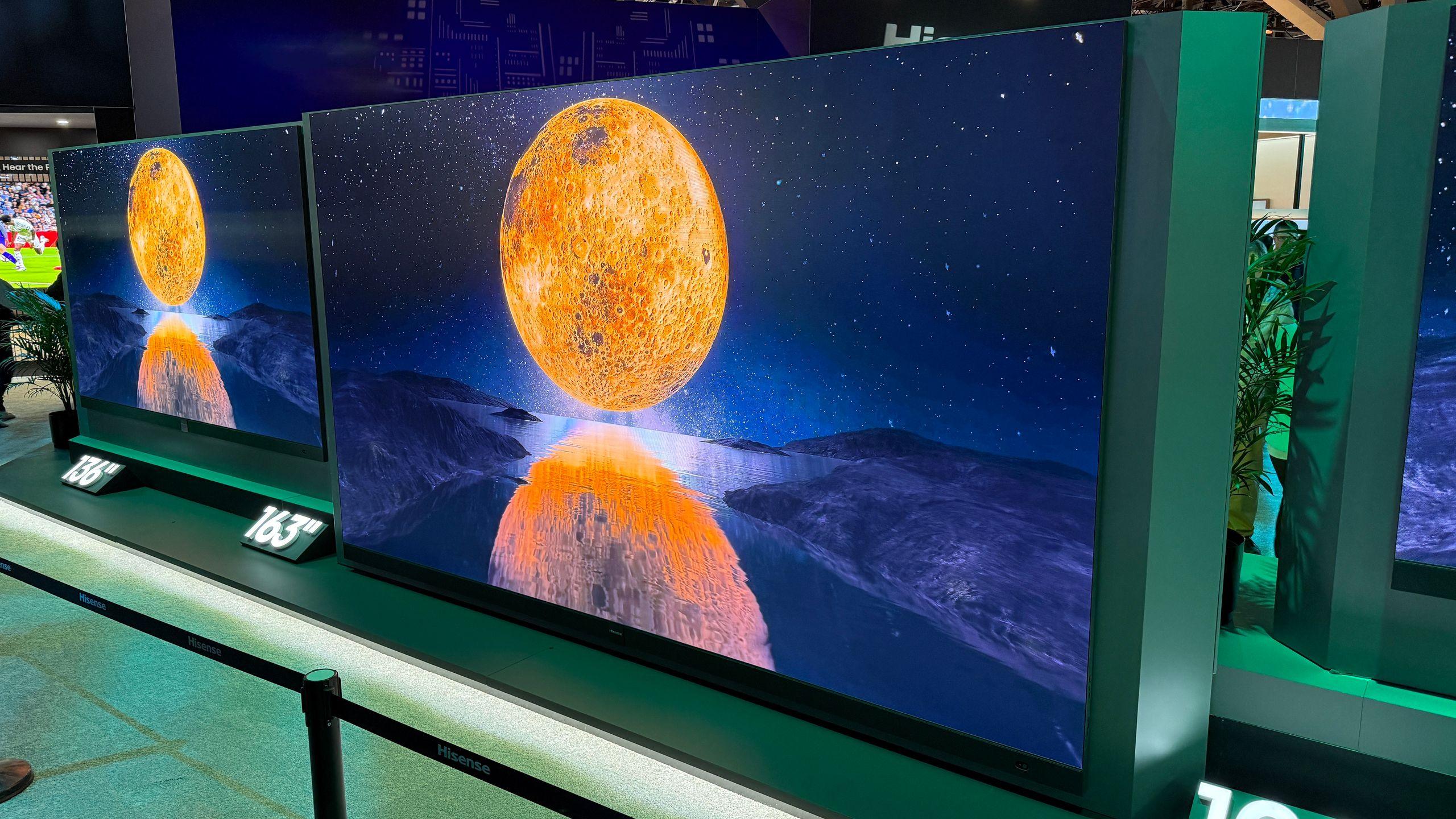
- Making a 101-inch micro-LED can cost more than $50,000… according to a report…
- …and that’s just the pure manufacturing cost
- The cost is entirely up in the air, so don’t expect it to change imminently
We’re very excited about the potential of micro-LED TVs, the high-end TV technology currently being showcased by companies such as Hisense with its spectacular 163-inch micro-LED and Samsung’s genius idea for a micro-LED TV whose frame is also a screen.
However, we’ve always been a little less enthusiastic about the cost of each model released, as they routinely run into or into the six figures – and that hasn’t changed much over time. Now, a new analysis of the cost of manufacturing these TVs today has made us wince and clearly shows that we shouldn’t expect much change, because the hardest and most expensive part is that specific to micro-LEDs.
The new report comes from respected firm UBI Research and is titled “101-inch Micro-LED TV Bill of Materials Analysis Report… Signaling a Game Changer for the Consumer Electronics Market.”
BOM stands for Bill of Materials, and the report suggests that there is nothing micro about the nomenclature of a micro-LED TV.
According to UBI, the bill of materials for a 101-inch micro-LED TV will be in the region of $52,000 (around £38,550 / AU$73,815). And that’s just the manufacturing cost. Added to this are all other costs, as well as the manufacturer’s profit: in the best case, the BOM is often around half the cost of a TV, although it can be less.
That’s why we’re looking at around $100,00 for a 100-inch Micro-LED, and compare that to $5,999 for the 98-inch TCL QM9K Mini-LED, $24,999 for the 97-inch LG G5 OLED TV, or $29,999 for the 116-inch Hisense 116UX Next-Gen RGB TV.
Why do micro-LEDs cost so much?
The analysis breaks down the BOM into 46 different elements and calculates that in a 101-inch TV, panel materials that include micro-LED pixels will make up 86.2% of the total BOM.
In dollars, the backplane costs $15,932 and the pixel layer costs $28,913. The motherboard costs $4,188, the control circuit module costs $1,168, the backplate costs $1,325, the front plate costs $501, and the frame costs $9.
One of the reasons key panel components cost so much is manufacturing efficiency and scale: established technologies such as OLED and mini-LED panels are manufactured in large numbers and production has become much more efficient with less waste. (Although OLED still struggles with this much more than mini-LEDs.) So prices have come down.
According to Dr. Joohan Kim, Principal Analyst at UBI Research, “For micro-LED TVs to become mainstream in the large premium market, it will be essential to improve process efficiencies and reduce costs through vertical integration. »
However, TechRadar has been told that micro-LEDs have had a similar problem as OLED for years, in that the base materials are very difficult to produce and have not significantly improved in terms of cost reduction and difficulty to produce – so the necessary changes, according to Dr Kim, appear to be a long way off.
But when that happens, the future of technology looks very bright indeed. As UBI explains, the micro-LED’s self-emitting structure offers “virtually unlimited scalability beyond 100 inches while delivering perfect black performance.”
Micro-LEDs are ideal for very large displays because they lend themselves well to modular designs, with several smaller panels assembled together to create something much larger.
This modularity is probably what will ultimately reduce manufacturing costs: it is much easier to manufacture smaller modular panels than simple, massive panels.
TV makers still tell us it will be about five years before micro-LEDs become mainstream, but some team members are skeptical that those costs can be brought down quickly enough. If, like me, you have much more modest ambitions and purchasing power, you may prefer to stick with the technology in today’s best TVs.
Are you planning to buy a new television?
Try our TV size and model finder! You tell it how far you’re sitting from your TV, we’ll tell you what size to buy based on viewing angle advice from picture quality experts, and we’ll recommend our three best TVs of that size at different prices.
Follow TechRadar on Google News And add us as your favorite source to get our news, reviews and expert opinions in your feeds. Make sure to click the Follow button!
And of course you can also follow TechRadar on YouTube And TikTok for news, reviews, unboxings in video form and receive regular updates from us on WhatsApp Also.


