
Envoy Asim Iftikhar says critics ignored terror threats from Afghan soil, defends Pakistan’s counterterrorism actions
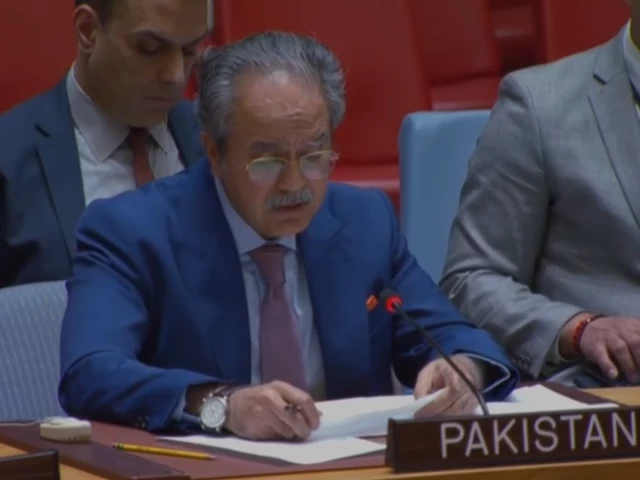
Pakistan’s Permanent Representative Ambassador Asim Iftikhar Ahmad speaking at the United Nations Security Council on Afghanistan PHOTO:
Pakistan’s Permanent Representative to the United Nations, Asim Iftikhar Ahmad, sharply criticized remarks made by Afghan and Indian representatives at a United Nations Security Council meeting on the situation in Afghanistan, accusing them of ignoring the threat of cross-border militancy targeting Pakistan.
Speaking at Monday’s council session, Naseer Ahmad Faiq, Acting Charge d’Affaires of the Permanent Mission of Afghanistan to the United Nations, spoke about civilian casualties caused by tensions between Pakistan and Afghanistan and highlighted the importance of fighting terrorism.
However, Faiq made no mention of Al-Qaeda or Tehreek-e-Taliban Pakistan.
Asim Iftikhar Ahmed said he was “forced to speak again” after listening to the statements of the Afghan and Indian delegations.
One can feel India’s pain as its heavy investment in the Afghan terror franchise goes to waste due to Pakistan’s precise and effective action against terror camps and support bases in Afghanistan. And the world doesn’t need lessons from a serial offender… pic.twitter.com/4u7PLaMV3q
— Permanent Mission of Pakistan to the UN (@PakistanUN_NY) March 10, 2026
Referring to the Afghan representative, he said the “so-called representative of Afghanistan…represents no one but himself” and should not “abuse this forum to pursue his personal agenda.”
Afghanistan’s de facto authorities, the Taliban, are not represented at the UN and do not recognize Faiq.
The envoy added that the diplomat, who he said was “sequestered in New York,” was “completely out of touch with ground realities” and had selectively commented on developments while criticizing Pakistan.
“Pakistan’s legitimate counter-terrorism operations are not directed against the brotherly people of Afghanistan,” he said, adding that these actions were aimed at “neutralizing the persistent threat of terrorism emanating from Afghan soil” and were carried out in accordance with the right of self-defense and international humanitarian law.
Additional statement from Ambassador Asim Iftikhar Ahmad,
Permanent Representative of Pakistan to the UN,
In response to remarks from the representatives of India and Afghanistan
At the United Nations Security Council meeting on the situation in Afghanistan
(March 9, 2026)
************Thank you Madam President,… pic.twitter.com/h3GZLl5sCn
— Permanent Mission of Pakistan to the UN (@PakistanUN_NY) March 10, 2026
He said the Afghan representative failed to respond to attacks carried out from Afghan territory that caused casualties among Pakistani civilians, security forces and infrastructure.
Regarding India, Ahmad said the Indian representative’s comments were “not a surprise”, accusing India of pursuing a policy aimed at destabilizing Pakistan.
Read: US designates Afghanistan as ‘state sponsor of wrongful detention’
Earlier, India’s Permanent Representative Parvathaneni Harish, according to his post on X, also delivered a speech at the UN Security Council meeting. The envoy said India “strongly condemns the airstrikes which constitute blatant violations of international law, the United Nations Charter and state sovereignty”, adding that it was “hypocritical to adhere to the high principles of international law and Islamic solidarity while mercilessly carrying out airstrikes during the holy month of Ramazan”.
Delivered India’s statement at the UN Security Council meeting on the situation in Afghanistan. Obtained the following 1️⃣0️⃣ points:
1️⃣The history of India’s close ties with its contiguous neighbor Afghanistan guides us today, in a situation where the proud people of Afghanistan need the world’s help.
2️⃣With… pic.twitter.com/QJFmaxqrlp
– Parvathaneni Harish (@AmbHarishP) March 10, 2026
He also raised concerns over what he called “commercial and transit terrorism,” warning that vulnerabilities faced by landlocked developing countries should not be exploited.
Regarding the fight against terrorism, the representative called for coordinated global action against militant organizations operating in the region. He said groups such as the Islamic State (ISIL), Al-Qaeda, Lashkar-e-Taiba and Jaish-e-Mohammed, as well as their affiliates and facilitators, must be prevented from carrying out cross-border attacks.
Asim, in his speech, hit back, alleging that India was supporting militant groups operating from Afghan territory, including the Tehreek-e-Taliban Pakistan (TTP) and the Balochistan Liberation Army (BLA).
“We have provided irrefutable evidence of India’s collusion with terrorist groups who are orchestrating violent attacks against Pakistan,” he told the Council.
Ahmad also criticized India for what he described as violations of international law and accused it of carrying out a crackdown in India’s illegally occupied Jammu and Kashmir.
Despite the criticism, the Pakistani envoy said Islamabad remained committed to promoting peace and stability in Afghanistan.
He added, however, that these goals required the country’s current leaders – the Taliban – to fulfill their commitments to counter-terrorism, inclusive governance and protecting the rights of Afghan women and girls.
“Though India has been playing this dangerous game for a long time, we will not allow its sabotage and subversion from Afghan soil to feed and harm Pakistan,” Ahmad concluded.


