
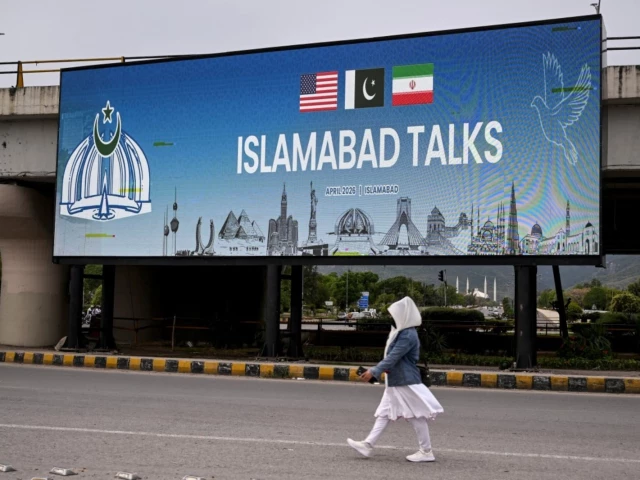
Spokesman said “if negotiations take place”, date and time will be officially announced, warning against speculation
The Foreign Office (FO) clarified on Thursday that no date has been decided for the second round of talks between the United States and Iran and that, “if talks take place”, the date and time will be officially announced.
Speaking at a weekly press briefing, FO spokesperson Tahir Andrabi warned against speculation about the next round of “Islamabad talks”, calling on media to avoid unverified reports. “We ask that speculation on the timing of future negotiations be avoided,” he said.
Andrabi said Pakistan was recognized for its “constructive diplomatic engagement” in supporting de-escalation and ceasefire efforts between the United States and Iran.
🔴LIVE: Weekly press briefing by the spokesperson 04-16-2026 at the Ministry of Foreign Affairs, Islamabad
— Ministry of Foreign Affairs – Pakistan (@ForeignOfficePk) April 16, 2026
“As part of sustained interaction with Washington and Tehran, Islamabad has sought to encourage dialogue, facilitate the exchange of messages and help create conditions and space for meaningful negotiations,” the spokesperson said.
He added that Pakistan’s approach reflects “a constant commitment to regional stability and international peace” and a preference for “principled and dialogue-oriented diplomacy.” “Pakistani media played an exemplary role and did not rely on speculation-based reporting,” he added.
On April 11, the American and Iranian delegations arrived in Pakistan for conclusive negotiations after an immediate two-week ceasefire “everywhere, including Lebanon”, announced by Prime Minister Shehbaz, who then invited the two countries’ delegations to Islamabad.
The two sides failed to reach an agreement to end their war despite marathon negotiations that lasted around 21 hours in Islamabad over the weekend. The protracted talks, aimed at ending hostilities that have left thousands dead and sent global oil prices soaring over the past six weeks, have resulted in both sides blaming each other for the impasse.
The United States and Israel launched a joint offensive against Iran on February 28, killing thousands of people in Iran, including then-supreme leader Ayatollah Ali Khamenei, and injuring tens of thousands, including civilian areas, including residential buildings and religious sites.
The conflict has also expanded geographically. Iran responded with drone and missile strikes targeting Israel as well as Jordan, Iraq and Gulf countries hosting US military assets. It also restricted the movement of ships through the Strait of Hormuz.
“Under the leadership of Prime Minister Muhammad Shahbaz Sharif and with the active engagement of Deputy Prime Minister and Foreign Minister Ishaq Dar and Chief of Defense Forces and Chief of Army Staff Field Marshal Syed Asim Munir, Pakistan has maintained open channels of communication with relevant parties,” Andrabi noted.
CDF Munir is currently in Iran as part of the ongoing peace negotiation efforts in the Middle East. Inter Services Public Relations said in a statement that he was part of a delegation that also included Interior Minister Mohsin Naqvi.
The spokesperson said the prime minister also made visits to key countries in the region, while military leaders engaged directly with their counterparts in Tehran as part of ongoing diplomatic efforts.
He added that the Prime Minister held several telephonic conversations with world leaders, including the leaders of Austria, Qatar, Germany, Italy, the United Kingdom, Japan and Canada, who expressed their support for Pakistan’s efforts.
“The German Chancellor expressed strong support for Pakistan for its role in these peace efforts,” the statement said, adding that the Italian and British prime ministers appreciated Islamabad’s role in facilitating the dialogue. Japan and Canada also “expressed their full support for the peace process and its importance for regional stability.”
FO also said that recent discussions in Islamabad between the US and Iranian delegations were “intensive and in-depth”, lasting around 21 hours of negotiations and more than 30 hours in total, including breaks and informal interactions.
“Talks continued for 21 hours,” the spokesperson said, adding that senior Pakistani officials “helped mediate several rounds of intense and constructive negotiations.” The spokesperson stressed that Pakistan would continue to play its role in facilitating dialogue between the two sides.
“It is imperative that the parties continue to respect their commitment to the ceasefire,” said the FO spokesperson.
The briefing also highlighted Pakistan’s broader diplomatic reach, including its engagements with Saudi Arabia and Qatar, participation in regional forums and coordination with multiple international partners.
Andrabi said these efforts reflect Pakistan’s goal of promoting stability in the Middle East and supporting peaceful resolution of conflicts through dialogue rather than confrontation.
Addressing speculation about relations with the UAE, the spokesperson rejected any negative speculation, saying: “The UAE is our brotherly country and long-time friend. Financial matters are not linked to any political dispute.”


