
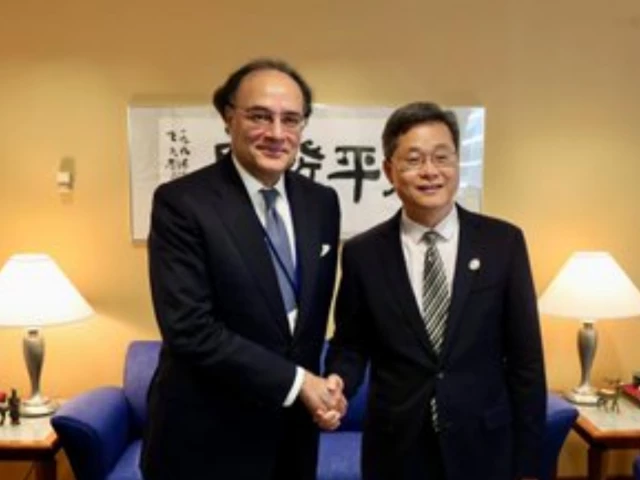
Both sides reaffirm commitment to strengthening economic cooperation and strategic partnership
Finance Minister Muhammad Aurangzeb meets Chinese Finance Minister Lan Fo’an in Washington DC. PHOTO:
Finance Minister Muhammad Aurangzeb on Friday expressed gratitude for China’s continued bilateral support to the International Monetary Fund (IMF), as well as the constructive role played by its executive director in facilitating Pakistan’s commitments to the programme.
According to an article by Pakistan’s Ministry of Finance on
During his visit, Aurangzeb met with Chinese Finance Minister Lan Fo’an, where both sides reaffirmed their commitment to strengthening economic cooperation and deepening their strategic partnership.
The finance minister updated his counterpart on Pakistan’s progress under the IMF program, saying the country had “successfully concluded a staff-level agreement for the third review of the Extended Fund Facility (EFF) and the second review of the Resilience and Sustainability Facility (RSF), with approval of the IMF Executive Board expected in early May.”
Finance Minister Meets Chinese Finance Minister, Reaffirms Strategic Partnership, Economic Cooperation
Federal Minister of Finance and Revenue, Senator Muhammad Aurangzeb, held an important meeting with HE Lan Fo’an, Minister of Finance of the People’s Republic of… pic.twitter.com/NfZTOB3jfG
– Ministry of Finance, Government of Pakistan (@Financegovpk) April 17, 2026
He further noted that Pakistan had successfully repaid its $1.4 billion Eurobond and secured “significant additional financial support” from Saudi Arabia to strengthen its external position.
On Wednesday, the Finance Ministry said Saudi Arabia had committed $3 billion in additional deposits, with disbursement expected in the coming week. The existing $5 billion Saudi deposit, the minister added, would no longer remain subject to the old annual rollover agreement and would instead be extended for a longer period.
On external financing initiatives, Aurangzeb briefed the Chinese side on the progress regarding Pakistan’s planned inaugural Panda bond issuance, aimed at diversifying sources of financing and broadening engagement with international capital markets.
Learn more: SFD signs agreement to extend $3 billion deposit with SBP
Highlighting the growth in bilateral trade, he noted that the share of trade between Pakistan and China settled in Renminbi (RMB) had increased significantly, and stressed the need for an expanded currency swap agreement to support increased trade volumes. He also welcomed China’s recognition of Pakistan’s role in facilitating dialogue and promoting regional stability.
Reaffirming Pakistan’s commitment to multilateral cooperation, Aurangzeb expressed his “full and unconditional support” for the establishment of the Shanghai Cooperation Organization (SCO) Development Bank, especially as Pakistan prepares to assume the SCO chairmanship in September.
The statement added that the meeting ended with mutual appreciation for the continued support provided by China’s executive directors to the IMF and the World Bank.
Separately, Aurangzeb held talks with People’s Bank of China Governor Pan Gongsheng, during which discussions focused on financial cooperation, market access and IMF-related developments. According to the Ministry of Finance, the minister once again expressed his appreciation for China’s support for the IMF, especially in the Executive Board.
Finance Minister Meets Governor of People’s Bank of China, Discusses Financial Cooperation, Market Access
Federal Minister for Finance and Revenue, Senator Muhammad Aurangzeb, held a productive meeting with Dr. Pan Gongsheng, Governor of the People’s Bank of China (PBOC),… pic.twitter.com/mQCksJ4sD8
– Ministry of Finance, Government of Pakistan (@Financegovpk) April 17, 2026
He also informed the Chinese central bank governor about the proposed issuance of Panda bonds by Pakistan and sought expedited approval from the National Association of Financial Market Institutional Investors (NAFMII).
Referring to economic pressures arising from regional development, Aurangzeb said the government had activated targeted subsidies and demand management measures to mitigate the impact of the current situation.
The meeting ended with Pan inviting the finance minister to visit Beijing soon.
In a separate engagement, Aurangzeb met Abdulhamid Alkhalifa, director general of the OPEC Fund for International Development. He expressed interest in taking full advantage of the fund’s three complementary financing windows, including public sector sovereign loans, private sector financing and Islamic finance instruments.
Read also: NA panel approves land transfer in SEZ
The Finance Minister also encouraged the OPEC Fund to deepen its engagement with Pakistan’s private sector and explore policy-based budget support operations. Radio Pakistan reported.
The spring meetings take place against the backdrop of the current conflict in the Middle East, which has caused a significant shock to the global economy. This issue was also highlighted at the Pakistan Conference, where participants noted that the regional crisis had created a difficult economic environment for many countries.
IMF and World Bank officials have indicated that global growth forecasts could be revised down, while inflation projections could rise, warning that emerging markets and developing economies would likely be hardest hit by rising energy prices and supply chain disruptions.


