
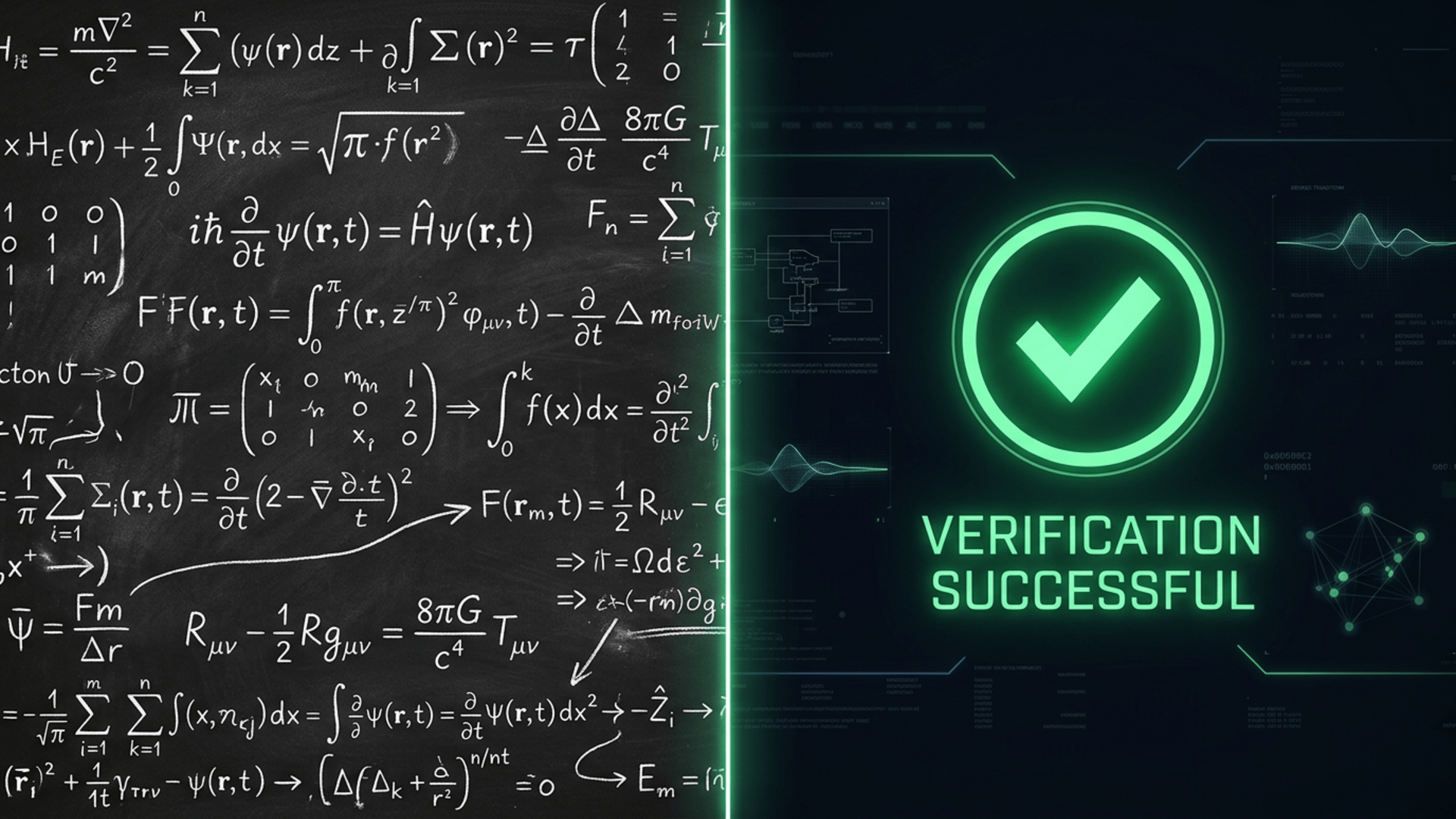
- Dual-agent AI system autonomously solved Anderson’s 2014 conjecture
- Rethlas explores problem-solving strategies like a human mathematician would
- Archon turns potential evidence into projects for the Lean 4 verifier
A research team led by Peking University has developed a dual-agent AI system capable of solving advanced mathematical problems while verifying its own results.
The system solved a conjecture proposed in 2014 by Dan Anderson, completing the process within 80 hours of its execution.
“Using this framework, we successfully solved an open commutative algebra problem and automatically formalized the proof with virtually no human intervention,” the researchers wrote in a preliminary paper published on arXiv.
Article continues below
How the dual agent framework actually works
The AI tool applies a reasoning system called Rethlas, which leverages a mathematical theorem search engine called Matlas to explore problem-solving strategies.
When Rethlas produces a potential proof, a second system called Archon uses another search engine called LeanSearch to turn that proof into an interactive theorem proof project.
Theorem prover, Lean 4, is also a programming language with a community-maintained library of hundreds of thousands of theorems and definitions.
The researchers noted that no mathematical judgment was required from the human operator during the problem-solving process.
The AI system performed mathematical tasks faster than any human, including performing independent work that would normally require collaboration between experts from different fields.
However, the team also discovered that a mathematician could speed up the process by guiding Archon when needed.
“This work provides a concrete example of how mathematical research can be significantly automated using AI,” the researchers said.
Mathematical proofs require complete rigor, but even proofs written by experts can contain subtle flaws.
Likewise, evidence produced by large language models is prone to hallucinations and is much less reliable than formal verification methods.
The Chinese team’s framework bridges the gap between natural language reasoning and formal machine verification, allowing the AI system to solve problems and verify its own conclusions.
“Our work illustrates a promising paradigm for mathematical research in which formal and informal reasoning systems work in tandem to produce testable results,” the researchers noted.
The document has not yet been reviewed by experts, so independent verification is still pending.
Anderson’s conjecture was a relatively obscure problem in commutative algebra, which makes AI’s achievements remarkable.
However, this feat is not comparable to solving a millennium challenge like the Riemann hypothesis or the P vs NP problem.
It remains to be seen whether this approach will adapt to more difficult mathematical problems.
That said, for a field that has resisted automation for centuries, this represents a significant milestone.
Via The Independent
Follow TechRadar on Google News And add us as your favorite source to get our news, reviews and expert opinions in your feeds. Make sure to click the Follow button!
And of course you can too follow TechRadar on TikTok for news, reviews, unboxings in video form and receive regular updates from us on WhatsApp Also.


