
Expresses appreciation for Pakistan’s constructive role and declares that the EU is ready to support the process in all possible ways
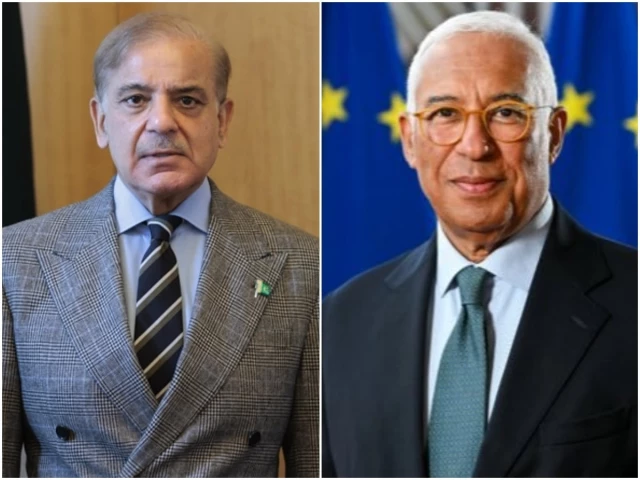
Prime Minister Shehbaz Sharif (left) and European Council President Antonio Costa. Photos: File
European Council President Antonio Costa expressed hope for a deal between the United States and Iran on Monday in a call with Prime Minister Shehbaz Sharif, saying “the world is watching with high hopes” for the next round of talks in Islamabad.
According to a statement released by the Prime Minister’s Office (PMO) on X, Prime Minister Shehbaz received a phone call from Costa this evening.
“During their cordial conversation, the two leaders exchanged views on the current situation in the Middle East,” the statement said.
According to the statement, the Prime Minister shared the latest updates on Pakistan’s diplomatic relations and peace efforts with Costa.
“Costa expressed deep gratitude for Pakistan’s constructive role in promoting dialogue and stability in the region and said the EU was ready to support this process in every possible way,” the statement said.
He further added that both leaders stressed the need for continued dialogue and diplomacy to ensure sustainable regional and global security. In this regard, the two leaders also agreed to stay in touch.
ISLAMABAD: April 20, 2026.
Prime Minister Muhammad Shehbaz Sharif received a telephone call this evening from HE António Costa, President of the European Council.
During their cordial conversation, the two leaders exchanged views on the current situation in the Middle East.… pic.twitter.com/bNnqILfE1x
– Prime Minister’s Office (@PakPMO) April 20, 2026
Costa later shared on X that speaking with Prime Minister Shehbaz was a “pleasure.” He expressed his “sincere gratitude to Pakistan for its tireless efforts” towards peace and extended his best wishes for the important times ahead.
Costa added that the world was “watching with great expectation the next meeting” between the United States and Iran, which is expected to take place in Islamabad as soon as possible.
“We hope that an agreement will be reached to end the conflict and lead to the full reopening of the Strait of Hormuz. The European Union supports all ongoing efforts towards peace in the Middle East,” he said.
It was a pleasure to speak with the Prime Minister of Pakistan, @CMShehbaz .
I expressed my sincere gratitude to Pakistan for its tireless efforts and extended my best wishes for the crucial period ahead.
The world is watching with great expectation the next meeting between…
– António Costa (@eucopresident) April 20, 2026
Prime Minister Shehbaz expressed appreciation for the EU’s appreciation for Pakistan’s peace efforts and its willingness to support dialogue and diplomacy for regional peace and stability.
I received a call this evening from HE António Costa, President of the European Council.
During our cordial exchange, I shared with President Costa updates on Pakistan’s ongoing diplomatic efforts and peace efforts in the Middle East.
Grateful to the European Union…
– Shehbaz Sharif (@CMShehbaz) April 20, 2026
Last month, the European Council chief reaffirmed his diplomatic support for Pakistan’s Middle East peace efforts in a call with Prime Minister Shehbaz, saying only dialogue and diplomacy could bring peace to the region.
After 40 days of airstrikes, U.S. and Iranian negotiators began negotiations in Islamabad earlier this month, once again focused on the usual compromise between nuclear restrictions and economic relief.
When American and Iranian negotiators met last weekend in Islamabad, the United States proposed a 20-year suspension of all Iranian nuclear activity, while Iran suggested a three- to five-year halt, according to sources familiar with the matter.
Although negotiations have yet to officially begin, US President Donald Trump earlier said that Vice President JD Vance and a US delegation were expected to land in Pakistan in a few hours for talks on Iran and asserted that a deal would be signed “today”, adding that he would be willing to meet Iranian leaders himself if progress was made.
On the other hand, Iranian President Masoud Pezeshkian expressed deep distrust of the United States, saying that honoring commitments was essential for meaningful dialogue amid growing uncertainty over further peace talks.
Diplomats said a schematic deal could be feasible, built around a nuclear package and an economic package. But they warned that the nuclear component remained by far the most controversial.
The discussions focus on Iran’s stockpile of around 440 kilograms of 60% enriched uranium, a material that could be used for several nuclear weapons if further enriched.
Beyond the stockpiles lies the deeper dispute over Iran’s right to enrich uranium. Trump has publicly advocated zero enrichment, while Iran insists it has the right to enrich uranium for civilian purposes and denies it wants a bomb.
The war has hardened Iran’s position, diplomats said, demonstrating that it can absorb pressure even as it seeks financial relief.
Tehran’s main demand is a guarantee of non-aggression after being attacked by the United States and Israel in previous diplomatic efforts.


