
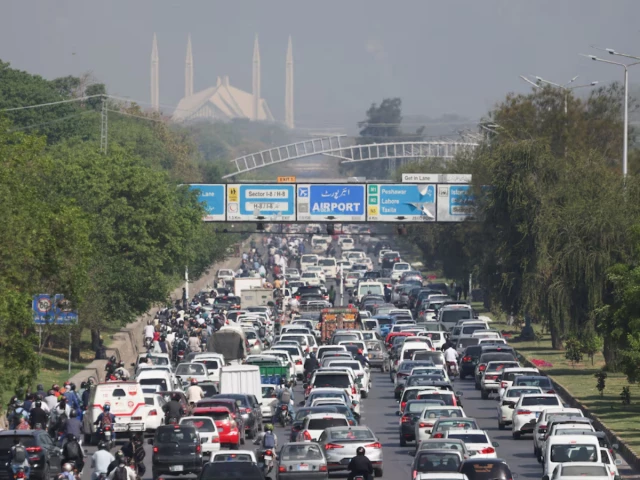
With main roads closed, markets deserted, no service at bus stations and weekend travelers struggling to get home.
Traffic jams due to road closures implemented by authorities, following the suspension of transportation and closure of markets due to security restrictions, as Pakistan prepares to host the United States and Iran for the second phase of peace talks in Islamabad, Pakistan, April 24, 2026. PHOTO: REUTERS
For almost a week, the federal capital has been awaiting peace talks between the United States and Iran, and although there is no indication that the two sides will meet, large parts of the city remain cordoned off by authorities.
The main roads leading to Islamabad are closed and a strict security cordon surrounds the administrative center, called the “red zone”. In the adjacent “Blue Zone,” cafes are out of fruit, markets are deserted and, without service at bus stations, weekend travelers struggle to get home.
Government officials say the measures will not end anytime soon and that they are still ready to welcome delegates, including US President Donald Trump, at any time. “We were told the talks could happen any day,” one official said.
The current confinement is the second in two weeks. Islamabad was first sealed off on April 11 for negotiations between the American and Iranian delegations which ended without an agreement. The city briefly reopened, then was locked down again as Pakistan waits to host a runoff that has yet to take place.
For residents, the uncertainty has become the hardest part. Islamabad is a city of passage, where many residents work during the week and return to their families on weekends. Today, this pattern has been interrupted.
Learn more: Edge of agreement or slide towards conflict?
Rizwana Raees, 35, arrived at the intercity bus terminal on Thursday with a weekend bag, hoping to reach her hometown of Abbottabad for the first time in two weeks. The terminal was empty, no buses, no departures.
“Sometimes the government and the media say the delegations are coming, sometimes they say they are not,” she said after calling on her family for help. “No one knows and at this point, even if they come, no one will believe it until they see photos and videos of them here.”
Eventually, her brother was able to rent a shared vehicle through an online group to take her home.
Abdur Rehman Irshad, a manager at the bus station, said the terminal had been closed for five to six days, cutting off more than 1,000 passengers every day. “People come here because it’s a popular resort,” he said. “But they are fired.”
No strawberries and no news
In the lobby of an upscale hotel in Islamabad, journalists who had come to the city from around the world to report on the negotiations settled into their own emptiness. The film crews remain ready. The equipment is ready. Phones are checked and rechecked.
But after a week of waiting, there’s not much to report.
“I don’t know how many times I’m going to have to ask for laundry,” said Fadi Mansour, Al Jazeera’s White House correspondent, who had come from Washington on what he thought would be a short trip. “We really don’t know where we’re going.”
The disruptions also affected the city’s food supply. Saif-ur-Rehman Abbasi, 36, a fruit and vegetable seller, said trucks carrying produce had been held up for days outside the city’s closed perimeter.
Learn more: Retail losses climb to Rs200 billion in two weeks
“You can’t leave fruits and vegetables stuck in transport vehicles outside the city. They are sensitive and perishable,” he said. “We have rent to pay and a business to run.”
At a popular Blue Zone cafe, staff said they were out of strawberries and other ingredients were also in short supply.
The surrounding market was eerily quiet, with residents choosing to avoid the long detours around the closed red zone to get to the shopping area.
“When Islamabad opens, Hormuz closes,” said a waiter at the cafe, referring to the Strait of Hormuz, a sticking point in the negotiations. “When Hormuz opens, Islamabad closes.”
As of Friday, both remained stuck, with no end in sight for either.


