
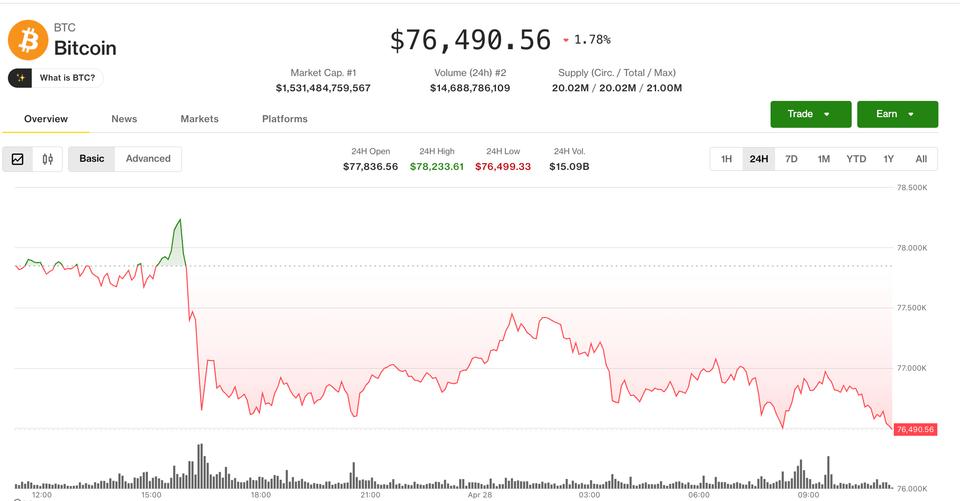
Crypto market fell for a second day Tuesday with bitcoin and ether (ETH) have both lost around 0.75% since midnight UTC.
This decline comes after Bitcoin twice failed to move above the $80,000 resistance level over the past week, with the most recent attempt occurring during Asian hours on Monday.
Jubilation over last week’s jump to $79,500 from $70,000 is beginning to subside as several key price indicators turn bearish, including the Coinbase Premium Index turning negative, a sign of waning demand from U.S. investors.
US stocks are also expected to open lower on Tuesday, with Nasdaq 100 futures trading down 0.5% since midnight UTC while the US Dollar Index (DXY) is up 0.25%.
The impasse in peace talks between Iran and the United States continues to boost traditional markets, and Brent crude oil is now firmly above $105 per barrel.
Positioning of derivative products
- Across the market, open interest (OI) cryptocurrency futures fell more than 1% to $120 billion in the past 24 hours. This is accompanied by a 3% drop in trading volume and an 8% drop in liquidations, suggesting a slight slowdown in market activity. Fewer open positions, lower participation, and reduced forced liquidations indicate less aggressive trading overall.
- The options open interest ratio on Bitcoin futures fell to 57.5%, the lowest since January 31. This is a sign of a renewed preference for directional bets and higher volatility in the short term.
- Bitcoin futures OI fell to 723.54 BTC, down more than 9% from the recent high of 796.71 BTC. This decline is accompanied by persistently negative funding rates, which are generally a sign of bearish positioning. However, this time they come from institutional hedging and not outright bearish bets.
- DOGE’s open interest stands out, having climbed 6% in the last 24 hours, outpacing other major cryptocurrencies. The OI, at 14.39 billion tokens, is the highest since October 10, indicating strong capital inflows. Positive funding rates and a rising 24-hour cumulative volume delta suggest traders are increasingly positioning themselves for upside potential.
- SOL and ADA have the most negative 24-hour cumulative volume deltas (CVDs), indicating that more trades are initiated by market sellers reaching bids than by market buyers lifting their bids. This shows aggressive selling pressure, even though a buyer matches every seller.
- Bitcoin and Ether’s 30-day implied volatility indexes are hovering at three-month lows, indicating subdued risk pricing in the market amid macroeconomic pressures such as rising oil prices and unresolved peace talks between the United States and Iran. As Deribit puts it, “Middle East trading game theory has put the BTC spot market into a deep sleep.”
- On Deribit, risk reversals in options show BTC and ETH trading higher, with BTC puts significantly more expensive than ETH puts. Prices indicate a bullish outlook for the ether/bitcoin ratio.
- In terms of flows, the $80,000 strike bitcoin was the most actively traded in 24 hours, both by volume and open interest. Meanwhile, block flows featured risk reversals and put spreads in BTC and put spreads and straddles in Ether.
Symbolic discussion
- The altcoin market underperformed bitcoin on Tuesday, as CoinDesk’s Memecoin Select (CDMEME) and DeFi Select (DFX) indices fell 1.6% and 1.2%, while the bitcoin-dominated benchmark CoinDesk 20 (CD20) lost just 0.8%.
- Privacy token zcash (ZEC) was the worst performing altcoin on the CoinDesk 100 (CD100), losing 5.6% since midnight UTC, followed closely by CHZ and HYPE, down 3.9% and 3.5%, respectively.
- While the broader crypto market is down, apecoin (APE) bucked the downtrend, rising over 17% as traders capitalized on a negative long/short ratio, liquidating a $1 million short position.
- CoinMarketCap’s “Altcoin Season” indicator remains in a neutral zone at 39/100, suggesting investors are focused on bitcoin and whether it can break out above $80,000 or continue its fall into the $70,000 region.


