
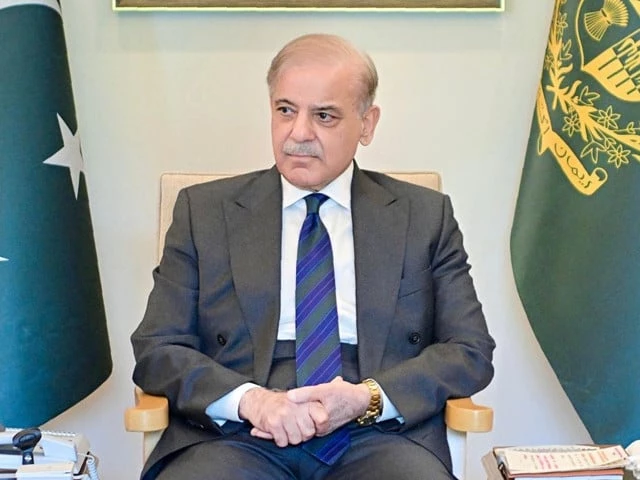
Prime Minister Shehbaz Sharif. Photo: APP/File
Prime Minister Shehbaz Sharif on Sunday renewed his government’s commitment to press freedom, saying efforts would continue to protect, promote and strengthen an enabling environment for journalism.
In a statement issued by the Prime Minister’s Office on the occasion of World Press Freedom Day, the Prime Minister paid tribute to journalists, columnists, reporters, editors, broadcasters and all those associated with journalism in Pakistan and around the world for their selfless services.
Reaffirming his government’s commitment, the Prime Minister said all possible measures would continue to be taken for the protection, promotion and creation of an enabling environment for press freedom.
Learn more: Erosion of press freedom
“Let us renew our collective resolve that the government continues to play its role in safeguarding press freedom so that, in an enabling environment, the media can honestly discharge its responsibilities. Together, we will continue to work towards building a strong, peaceful, confident and globally respected Pakistan,” he said.
Read: Media freedoms in Pakistan face a sharp decline
He said professional discharge of duties of media personnel was a guarantee of an informed and conscious society, adding that timely publication and dissemination of authentic, unbiased and unbiased information was the true foundation of journalism.
Terming journalists as guardians of social values, the Prime Minister stressed that it is the duty of every journalist, in accordance with professional ethics, to prevent the spread of propaganda, fake news and unverified or unauthenticated information.
This year, World Press Freedom Day is being celebrated under the theme “Shaping a peaceful future”, which the Prime Minister said reflects the needs of the current times. He said journalists have the right to a working environment that is dignified, safe and conducive to the exercise of their duties.
“In the modern era, an environment of peace and security cannot be achieved through diplomacy alone; authentic information, responsible journalism and public opinion play a decisive role in its formation,” he said, adding that the media has the capacity to play a constructive role in making international relations and political, economic and social ties between countries more positive, meaningful and effective.
He stressed that accurate representation of viewpoints often helped resolve complex issues, calling it a hallmark of responsible journalism.
“Pakistan is a peaceful country and prefers dialogue and negotiations, from differences of opinion to long-term resolution of tensions,” he said, highlighting the country’s approach.
Read also: Missing women in journalism
Referring to the recent diplomatic efforts amid tensions between the United States and Iran that have engulfed the region and severely disrupted the global economy due to the closure of the Strait of Hormuz, the Prime Minister said Pakistan was playing a positive role in diplomacy to reduce tensions, promote dialogue and restore peace in the region, adding that the country had been appreciated by the international media in this context.
While appreciating the role of media in Pakistan’s historic success against India in May last year and in the backdrop of the hostile actions of the Afghan government and the Taliban this year, the Prime Minister said the media also played an important role during ‘Marka-e-Haq’ and ‘Operation Bunyanum Marsoos’, in presenting the national response, defense of sovereignty and national unity with clarity and restraint.
“The media kept the public informed and fought misinformation. These moments reflect not only the capabilities of the armed forces but also the national collective strength, in which responsible media played their due role. The role of the journalistic community is commendable,” he said.
The Prime Minister also paid tribute to journalists who lost their lives in the line of duty, saying their courage was a reminder that press freedom was an invaluable asset.
Speaking on the rapidly changing media landscape brought about by modern innovation, he said digital platforms play an important role in shaping public opinion at national and international levels, while also highlighting their role in projecting national identity and perspectives globally.
While urging media organizations to adapt to digital transformation with speed and responsibility, Prime Minister Shehbaz warned against the spread of fake news and organized disinformation campaigns.
“The spread of fake news and organized disinformation campaigns pose a real threat to national cohesion and global reputation,” he warned, adding that it was essential to prioritize rapid access to information and credibility.
“I urge all journalists to uphold the highest standards of verification, integrity and professionalism so that the truth is not compromised in the rapidly evolving digital age,” he said.
He added that the media not only reflected social, political and economic diversity, but also promoted national unity and stability, while playing a constructive role in highlighting issues of public importance and raising awareness on social and economic issues.
This statement comes as Pakistan improves its position in the World Press Freedom Index established by Reporters Without Borders (RSF), moving from 158th in 2024 to 153rd in 2026.
But RSF also expresses its concern about what it describes as “incessant waves of restrictions” in a tense political climate, where authorities seek to control and, in some cases, repress the dissemination of journalistic content.
A day earlier, media watchdog Freedom Network, in its latest annual report, had also raised concerns over Pakistan’s media landscape, which it said has witnessed a significant contraction in free expression space over the past year, due to, among other things, escalating legal, regulatory and economic pressures.
The report, titled “Regulatory Crackdown on Free Speech – Legal Controls and PECA Harm Media and Journalism in Pakistan”identified the amended Prevention of Electronic Crimes Act (Peca) as the “most consequential instrument” used to restrict journalists and freedom of expression practitioners.
Initially enacted in 2016 to combat cybercrime, the report said, amendments made in 2025 were increasingly used in 2025-2026 to criminalize lawful expression, target dissent, and intimidate journalists, lawyers, and political commentators.
In terms of journalist safety, the report documented at least 129 verified incidents of violations between April 2025 and March 2026. Legal threats and physical violence accounted for almost two-thirds of these cases.
These included two murders, five threats of murder, 58 court cases (mostly under Peca), 16 assaults, 11 threats of harm and two cases of kidnapping and enforced disappearance.
Punjab and Khyber-Pakhtunkhwa emerged as the most dangerous regions for journalists, while incidents in Sindh and Balochistan highlighted continuing risks. State authorities were identified as the main perpetrators, responsible for more than 60 percent of violations, mainly through legal actions and detentions. Non-state actors, including militant groups and criminal networks, have also been implicated in threats, attacks and killings.
The detention of three female journalists in Islamabad while attempting to cover Aurat March in March 2026 highlighted the gender dimension of these risks. Across the country, journalists also faced economic pressures, including salary delays, job insecurity, and reliance on government advertising, which further undermined their editorial independence.
Read: Media in Pakistan still stifled by censorship and threats in 2025
Women journalists, the report says, remain particularly marginalized in the media sector, with harassment, online abuse and discrimination in the workplace contributing to a hostile environment. Cases involving deepfake abuse and detention further illustrate these challenges.
The report calls for urgent reforms, including a review of Peca’s restrictive provisions, stricter implementation of journalists’ safety laws and effective enforcement of RTI frameworks to ensure transparency. He also called for legal and institutional support for journalists and the promotion of ethical use of emerging technologies.


