
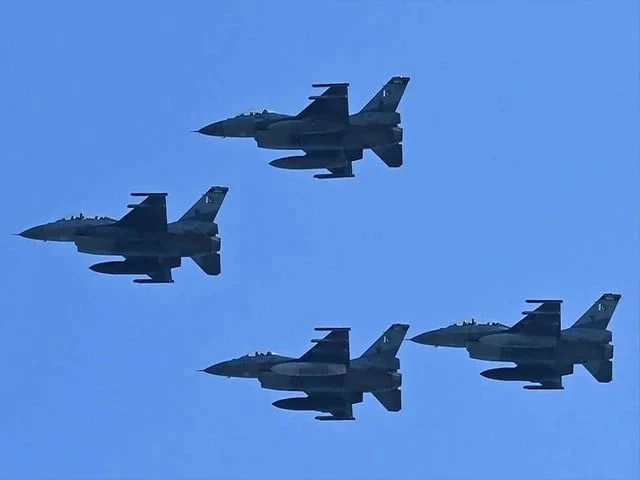
The story of the Pakistan Air Force in recent years is not one of slow evolution but of decisive transformation. Operating under the shadow of numerical inferiority, the PAF has become a force shaping South Asia’s strategic environment through its professionalism, precision and restraint. At the heart of this transformation is Marka?e?Haq, a defining chapter in Pakistan’s defense history that showcased not only tactical excellence, but also strategic maturity and moral clarity.
On that critical night, when a numerically superior adversary sought to impose its will in Pakistani airspace, the Shaheens’ response was composed, calibrated and undoubtedly firm. This was not a knee-jerk reaction, but the visible culmination of a far-reaching transformation carried out under the leadership of Chief of Air Staff Air Marshal Zaheer Ahmed Baber Sidhu. Under his leadership, the PAF was recast from a largely platform-centric service to a capability-centric, next-generation air and space power, integrating fighters, air defense systems, electronic warfare, intelligence, surveillance and reconnaissance, and cyber and space assets into a cohesive operational whole.
Marka?e?Haq did more than repel an intrusion; he translated years of doctrinal refinement, intelligent integration, and indigenous innovation into an operational performance that recalibrated regional perceptions of airpower. The ascendancy symbolized by Marka?e?Haq did not appear in a vacuum. For decades, the PAF Shaheens lived with the reality of an adversary larger in size, budget and inventory. This structural imbalance has become a catalyst rather than a crutch, forcing the Force to internalize a demanding principle: that which cannot be matched in numbers must be surpassed in quality. Under the leadership of Air Marshal Sidhu, this philosophy has crystallized into a clear transformation agenda. The priority has shifted from simply expanding the fleet to strengthening the full kill chain, investing in indigenous electronic warfare, unmanned systems, secure data links, long-range precision strikes, and aerospace and technology initiatives such as the National Aerospace Science and Technology Park that connect the PAF with academia and industry.
Over time, this evolution from a platform-centric organization to integrated air and space power has changed both the way the PAF fights and its way of thinking. The Shaheens that took flight during Marka?e?Haq were supported not only by their individual flight skills, but also by a network of sensors, shooters and decision support tools merged into a single operational picture. The oft-invoked triad of “first look, first shot, first kill” was no longer aspirational jargon; it was the lived reality of crews and commanders who had rehearsed complex, cross-domain scenarios long before they were tested in combat.
At Marka?e?Haq, the display of air superiority was as calculated as it was convincing. High-intensity, beyond-visual-range engagements and carefully choreographed multi-axis maneuvers underscored a harsh truth for the adversary: mere possession of advanced platforms and long-range weapons does not guarantee dominance. The S-400s and Rafales, once touted as regional “game changers,” have proven fragile when faced with a disciplined, networked, and tactically agile adversary. In this battle of nerves and numbers, it was the quiet confidence of an institution that knew its doctrine, trusted its training and believed in its leadership that made the decisive difference.
Yet the most significant aspect of Marka?e?Haq was not limited to the geometry of aerial combat. This lay in the choices made by the current leadership of the PAF once superiority was acquired. At several points, the tactical situation could have allowed deeper and more punitive options. Instead, the use of force remained measured, proportionate and deliberately restrained. This restraint reflected a credo that ACM Sidhu has repeatedly expressed: Pakistan seeks peace with honor, while retaining both the will and the ability to respond decisively when its sovereignty is challenged. In a region where miscalculations can trigger uncontrollable escalation, this fusion of strength and sobriety is perhaps the PAF’s most valuable asset.
Subsequently, the laurels awarded to PAF personnel offered a glimpse of the human dimension behind radar tracks and combat air patrols. Valor awards and recognitions for leadership, technical excellence and operational brilliance recognize not only the courage of pilots in the air, but also the composure of controllers, the dedication of engineers and the quiet competence of planners. Each decoration represented countless hours spent in simulators, nights on the flight line, careful maintenance and moments of difficult judgment under pressure. Honors weren’t just about embellishing uniforms; they codified a collective memory of how a smaller Force, under visionary leadership, rose up to face a moment of truth.
These laurels also resonated beyond the bases and briefing rooms. For many Pakistanis, the recognition of PAF Shaheen following Marka?e?Haq became a focal point for national confidence. The image of the Shaheen once again came to symbolize not only daring in battle, but also a philosophy based on discipline and duty. On Memorial Days, when the nation revisits milestones in its air history, Marka?e?Haq now stands alongside previous chapters as a reference point for what a determined, professionally led air power can accomplish.
Marka?e?Haq is more than an operation name. It encapsulates a national lesson about how power should be exercised. He asserts that courage must go hand in hand with responsibility and that superiority only makes sense if it is governed by restraint. It is also a testament to how a top-level institutional vision can reshape an entire department: emphasizing integration over inertia, innovation over imitation, and maturity over melodrama. In the contested skies of South Asia, the Shaheens have already shown that destiny is dictated not just by size, but by clarity of purpose, mastery of the air, and the quiet confidence of those who know they are watching over a just cause.


