
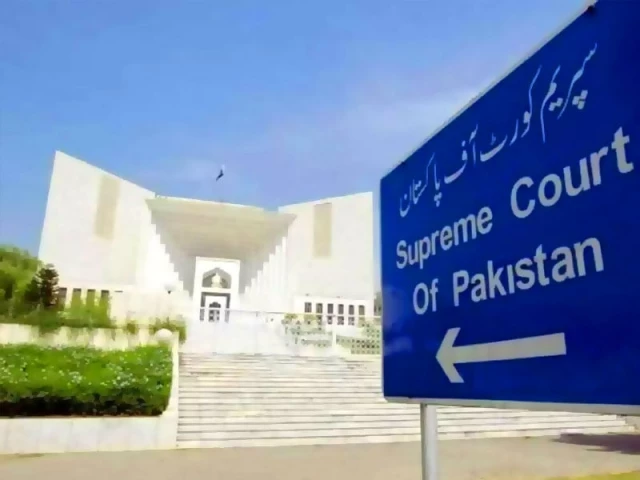
ISLAMABAD:
In a development that has reignited the debate on the evolving constitutional architecture of Pakistan, the Supreme Court (SC) has ruled in its latest judgment that it is not subordinate to the Federal Constitutional Court (FCC), despite the latter’s consistent position that constitutional adjudication now lies exclusively with it following the 27th Constitutional Amendment.
The ruling, authored by Chief Justice of Pakistan (CJP) Yahya Afridi, interprets the amended constitutional framework as establishing two equal apex courts with separate jurisdictions, rather than a hierarchical structure placing one above the other, a position that stands in stark contrast to the FCC’s multiple judgments asserting binding authority over all courts, including the SC.
The amended Article 189(1) of the Constitution provides that any decision of the Federal Constitutional Court, to the extent that it decides a question of law or enunciates a principle of law, is binding on all other courts of Pakistan, including the Supreme Court.
However, CJP Afridi, in his recent judgment, held that the text of Article 189(1) must deliberately be read in conjunction with the overall post-27th Amendment framework, which intentionally organizes jurisdiction between the Supreme Court and the Federal Constitutional Court in distinct areas.
He added that this provision gives each court exclusive jurisdiction over different categories of proceedings, rather than establishing a vertical hierarchy.
“In this context, Article 189(1), while ensuring consistency in the exposition of legal principles, does not supersede the independent jurisdiction of either court to finally decide the issues before it.”
“As the Constitution requires, the application and scope of Article 189(1) is limited to questions of law, as evidenced by the ratio decidendi, and does not extend to the result obtained in a particular case by the Federal Constitutional Court. The routes of appeal to the Supreme Court and the Federal Constitutional Court are, ultimately, constitutionally distinct and operate independently, insofar as the results of individual cases are concerned.”
The constitutional regime does not position either of the two supreme courts as an appeal body in relation to each other; rather, it treats them as coordinated tribunals exercising clearly delineated jurisdiction over distinct categories of matters.
Any broader interpretation of section 189(1) would have the effect of subordinating one supreme court to the other in respect of proceedings constitutionally assigned to fall within its jurisdiction; an outcome for which there is no guarantee in the constitutional text,” says CJP Afridi in his 13-page judgment while ruling on two issues raised after the 27th constitutional amendment.
The SC division bench, headed by CJP Yahya Afridi, heard the case in which a writ petition, civil review and contempt petition were clubbed.
The court held that, considering the constitutional framework introduced by Section 175F, the civil review and contempt cases would be heard by the SC itself, while the writ petition would be transferred to the FCC for judgment.
The judgment has since sparked a vast legal debate.
A senior legal official believes that SC and FCC have different jurisdictions, but that FCC has the authority to withdraw from any case. So overall it is superior to SC,” he adds.
Former Attorney General Waqar Rana states that the Constitution, as amended by the 27th Amendment, places the Supreme Court as subordinate to the FCC in constitutional matters, while in other matters it remains the court of final instance.
“After authorizing Parliament to amend the main features of the 1973 Constitution without any hesitation, the SC lost its jurisdiction to the FCC. It could only regain it if it declared the amendment unconstitutional,” he adds.
Waqar Rana believes that the opportunity was lost when CJP Afridi failed to form a full court to hear the challenge to the 26th Amendment.
Lawyer Umer Gilani says the judgment reflects an attempt by the chief justice to ensure an equal position in the Supreme Court, but argues that this interpretation is untenable.
“Both the text and the context of the 27th Amendment make it clear that the apex court of Pakistan is the FCC. The Supreme Court is now one of the subordinate courts. If I were to put it simply – and some truths can only be uttered with childish simplicity – Humpty has taken a great fall, and no amount of interpretive sleight of hand can put it back together,” Gilani further states.
In several rulings, the FCC has held that its decisions are binding on all courts, including the Supreme Court, and clarified that the SC no longer retains the power to interpret the Constitution and law after the 27th Amendment.
In the Riaz Hussain case, FCC Judge Rozi Khan Barrech pointed out that Article 189 states that any decision made by the SC is binding on all other courts of Pakistan except the FCC.
This exception, according to the FCC, arises from the 27th Amendment, which establishes that its decisions are binding on all courts, including the SC itself.
Similarly, Justice KK Agha held in a separate ruling that while the SC’s judgments are not binding on the FCC, they can be considered persuasive or treated as obiter opinions.
Justice Aamer Farooq of the FCC also observed that while the decisions of the SC are binding on the subordinate courts, the decisions of the FCC are binding on all courts in the country, including the SC and higher courts.
Recently, the FCC further clarified that the SC’s power to strike down legislation on constitutional grounds no longer rests with it under the current framework.
In another ruling, the FCC reiterated that Section 189 must now be interpreted in light of the changing constitutional architecture.
The FCC further clarified that the binding force of precedent derives not from institutional seniority but from constitutional hierarchy.


