
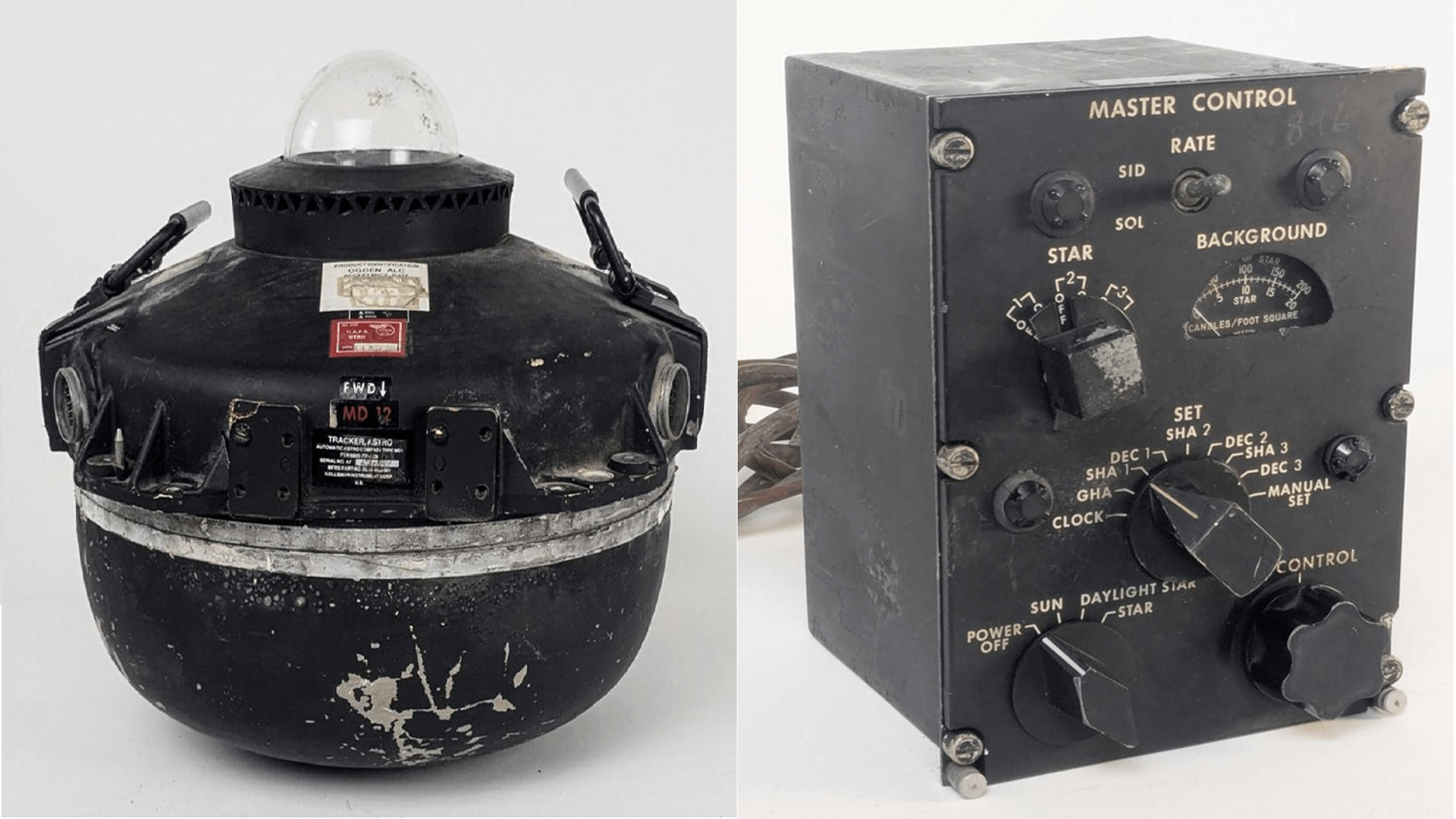
- The Angle computer solved navigational calculations entirely through moving mechanical components.
- Massive solar storms could cripple satellite navigation systems, but the Angle computer will survive
- B-52 bomber navigators relied on celestial measurements long before modern GPS infrastructure existed
A massive coronal mass ejection from the sun would send charged particles crashing into Earth’s magnetic field, an event that could induce Earth currents powerful enough to destroy unshielded electronics on satellites within hours.
However, the Angle Computer, an electromechanical device on the B-52 bombers, offers a functional alternative that requires no signals from space.
This vintage technology solved spherical trigonometry problems by physically modeling the celestial sphere with moving mechanical parts.

How the B-52 navigated without GPS
Before satellites existed, B-52 navigators used a system called the Astro Compass to find their heading with remarkable accuracy.
The Angle computer was at the heart of this system, performing calculations that would normally require advanced mathematics.
Inside the device, a U-shaped declination arm swung up and down to match the angle of a star above the celestial equator.
The arm constantly rotated around a polar axis driven by local hour angle input.
A separate latitude arm moved the entire mechanism up or down depending on the viewer’s position on Earth.
These three entries positioned a star pointer on a physical half-sphere of only 2 and 5/8 inches in radius.
The star pointer is connected to a semi-circular azimuth arc which represents the sky from the horizon to the zenith.
A cursor moved along this arc as the star pointer changed position, thus generating the altitude output.
The entire azimuth arc rotates around the zenith point, producing the azimuth output via a gear train.
Synchro transmitters then converted these shaft rotations into electrical signals for the aircraft’s navigation system.
The device contained differential gear assemblies to subtract unwanted movements that would otherwise corrupt the calculations, and this mechanical approach proved impervious to the electromagnetic pulses that would destroy modern solid-state electronics during a CME event.
Analog precision from Angle Computer
The Angle computer performed these calculations without vacuum tubes, transistors, or semiconductor components.
Military documents show the system was accurate enough to generate position lines that allowed bombers to navigate across oceans.
A navigator would measure the altitude of a star, compare it to the expected value and draw a line on a map – and three of these measurements from different stars would intersect at the plane’s actual location.
This technique, called the celestial position line, has guided ships and planes since 1837 without any external infrastructure.
The original Angle computer was sealed in a pressurized cylinder with dry nitrogen to ensure reliability at high altitudes.
Reproducing such a device today would require rebuilding manufacturing capabilities that have not existed for decades.
A digital backup hardened with selective shielding might prove more practical than resurrecting this analog relic.
The elegance of vintage engineering should not obscure the difficulty of saving it from extinction.
Via Ken Shirriff’s blog

Follow TechRadar on Google News And add us as your favorite source to get our news, reviews and expert opinions in your feeds.


