
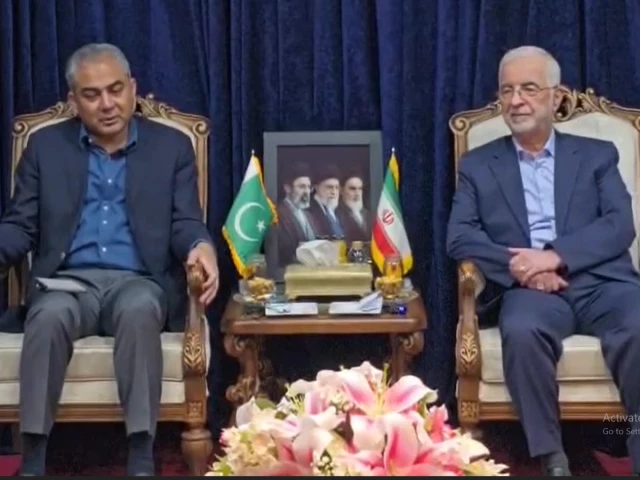
Naqvi and his Iranian counterpart reaffirm their efforts for stability. Tehran welcomes Islamabad’s role in easing tensions.
Interior Minister Mohsin Naqvi meets his Iranian counterpart Eskandar Momeni in Tehran while he is on a two-day visit to Iran. SCREENSHOT
ISLAMABAD:
Interior Minister Mohsin Naqvi and his Iranian counterpart Eskandar Momeni on Saturday reaffirmed their commitment to strengthening bilateral engagement and addressing common regional challenges, as Pakistan continues its mediation efforts between Tehran and Washington amid ongoing tensions in the region.
Naqvi arrived in Tehran for a two-day visit and was received by Momeni, marking the start of discussions aimed at facilitating dialogue and examining evolving regional developments.
The visit comes at a critical time as Pakistan remains engaged in diplomatic efforts aimed at restarting direct talks between Iran and the United States after months of conflict and failed negotiations.
Iranian news agency WANA reported that the two ministers held in-depth discussions on regional stability and bilateral cooperation.
“Both sides reaffirmed their commitment to deepening interactions to address common regional challenges,” the report said.
During the meeting, Momeni reportedly praised the efforts of Chief of Defense Forces (CDF) and Chief of Army Staff General Asim Munir, describing his role in seeking a resolution to the current regional tensions as “sincere and committed”.
He also appreciated Pakistan’s efforts to promote regional peace and stability.
Both sides further reaffirmed their commitment to strengthening the long-standing brotherly ties between Iran and Pakistan, while emphasizing the importance of continued cooperation to advance peace, security and prosperity in the region.
Several senior Iranian officials and representatives of the Pakistani embassy in Tehran also attended the talks.
Earlier, an Interior Ministry spokesperson told Anadolu that the visit was already scheduled.
The visit marks Naqvi’s second consecutive trip to Iran in as many months. Last month, he had also visited the country alongside Field Marshal Asim Munir.
During the visit, Iranian Foreign Minister Abbas Araghchi, who received the Pakistani delegation, expressed gratitude for Pakistan’s role in facilitating dialogue efforts with the United States, saying it reflected the “deep and great bilateral relationship” between the two countries.
“Our commitment to promoting peace and stability in the region remains strong – and shared,” he said.
The latest diplomatic engagement comes as Pakistan continues to mediate between Washington and Tehran in an attempt to bring a lasting end to the conflict that began with U.S. and Israeli strikes against Iran on Feb. 28, followed by Iranian retaliation against Israel and other regional countries harboring U.S. assets.
Pakistan had earlier brokered a two-week ceasefire between the United States and Iran on April 8, followed by critical talks in Islamabad in the presence of senior delegations from both countries on April 11 and 12.
However, the talks failed to produce a breakthrough and neither side was able to reach an agreement to end the conflict.
Since then, the two sides have continued to exchange proposals and counter-proposals in an effort to find common ground and resume a second round of direct negotiations aimed at ending the crisis, which has already disrupted global energy supplies and affected daily life in the region.
Although Pakistan remains hopeful that direct negotiations could resume, sources said there had been no “significant” change in Iran’s previous position on the nuclear issue in its latest response to the US proposals.
According to the sources, Tehran’s response, delivered to the United States via Islamabad last week, focused primarily on an “immediate” end to hostilities, with “little [in it] in terms of Washington’s fundamental demand regarding Iran’s nuclear program.
Iran, the sources add, has proposed “broader and separate” talks on the nuclear issue due to its “complexity.”
However, Tehran “reiterated” its desire to stop uranium enrichment for a period of five years, while rejecting Washington’s request for a 20-year moratorium, according to the sources.


