
Indian envoy reiterates Afghan Taliban claims over alleged strike on hospital in Kabul
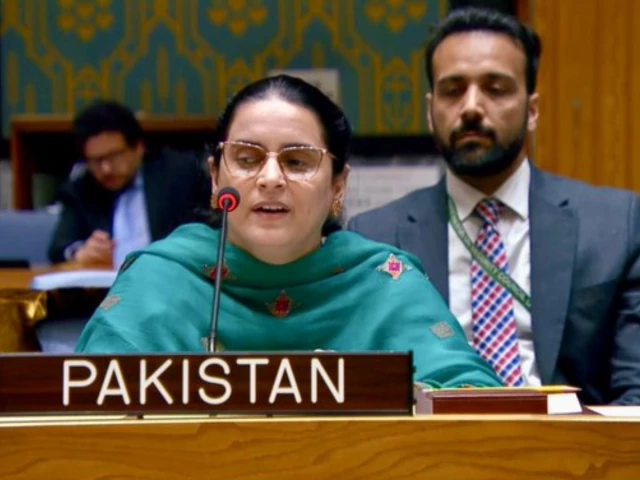
Pakistani advisor Saima Saleem speaking at the United Nations Security Council. PHOTO:
Pakistan on Wednesday hit back at India’s allegations at the United Nations Security Council (UNSC), with Pakistani diplomat Saima Saleem calling New Delhi “a state that exports terrorism abroad, forcibly occupies people, persecutes minorities at home, uses water as a weapon and commits aggression in the region.”
His remarks came as part of a right of reply at the UN Security Council’s annual debate on the protection of civilians, after India accused Pakistan of ignoring its international humanitarian obligations and targeting civilians.
Pakistan had raised concerns over the situation in Indian Illegally Occupied Jammu and Kashmir (IIOJK) during the session. Saima criticized India’s remarks and said New Delhi had appeared before the council “wearing the mask of a victim”. “But the world can see the face behind that mask,” she said.
Earlier in the debate, India’s permanent representative to the UN, Harish Parvathaneni, accused Pakistan of failing to meet its international humanitarian obligations and alleged that it had targeted civilians. He also spoke about what he described as a “record long tainted by genocidal acts,” according to Indian media.
Right of reply of the Advisor, Ms. Saima Saleem
In response to India’s remarks at the annual Security Council debate on the protection of civilians
(May 20, 2026)
****Mr President,
Today, India has once again come to this Council wearing the mask of a victim – but the world… pic.twitter.com/KAICgoYeUl
— Permanent Mission of Pakistan to the UN (@PakistanUN_NY) May 21, 2026
The Indian envoy further reiterated allegations made by the Afghan Taliban regarding an alleged strike on a Kabul hospital earlier this year.
Responding to the accusations, Saima said “state sponsorship of terrorism against Pakistan” had caused significant civilian casualties through militant groups operating from Afghan territory.
“Its terrorist proxies – including the TTP, BLA and Majeed Brigade – have killed thousands of civilians, including women and children, in our mosques, markets, schools and streets,” she added.
Saima further said that Pakistan’s counter-terrorism operations were carried out based on credible intelligence and targeted militant hideouts, training camps and logistics networks involved in attacks on Pakistani civilians, security personnel and infrastructure.
Read also: Tehran reviews US response to latest proposal: Foreign Ministry spokesperson
“These operations were directed only against terrorists and their infrastructure, and not against the brotherly people of Afghanistan or civilian installations,” she said.
Saima also dismissed allegations raised by the Taliban administration and echoed by India, calling them a “disinformation campaign” aimed at covering up attacks on Pakistani civilians.
On the IIOJK, the Pakistani diplomat said India could “neither conceal nor deny its occupation of Jammu and Kashmir”, describing the issue as “an internationally recognized dispute which remains on the agenda of this Council”.
“In the occupied territories, civilians are killed, detained, dispossessed and silenced; houses are demolished, freedoms are crushed and an entire people is denied their right to self-determination,” she added.
India is a country that exports terrorism abroad, forcibly occupies the population, persecutes minorities at home, weaponizes water, commits regional aggression, and then tries to teach others about protecting civilians.
While Pakistan advocates peace, dialogue, peace… pic.twitter.com/vMPmALtNO4
— Permanent Mission of Pakistan to the UN (@PakistanUN_NY) May 21, 2026
She also criticized India’s treatment of minorities, particularly Muslims, saying the situation should “alarm the conscience of the world.”
“Under state-sponsored Hindutva extremism, Islamophobia was normalized as policy, hate speech rewarded in politics, mob violence with impunity,” she said, adding that Muslims, Sikhs, Dalits and Christians faced discrimination.
Referring to the Indus Waters Treaty, Saima said India’s decision to keep the agreement “on hold” reflected a disregard for international law. “A state that threatens the water, food security and livelihoods of millions of Pakistanis certainly cannot talk about protecting civilians,” she said.
Concluding her speech, she said Pakistan remained committed to “peace, dialogue, peaceful resolution of disputes and respect for international law”, while accusing India of “terrorism, occupation, aggression, repression and disregard for international law”.


