
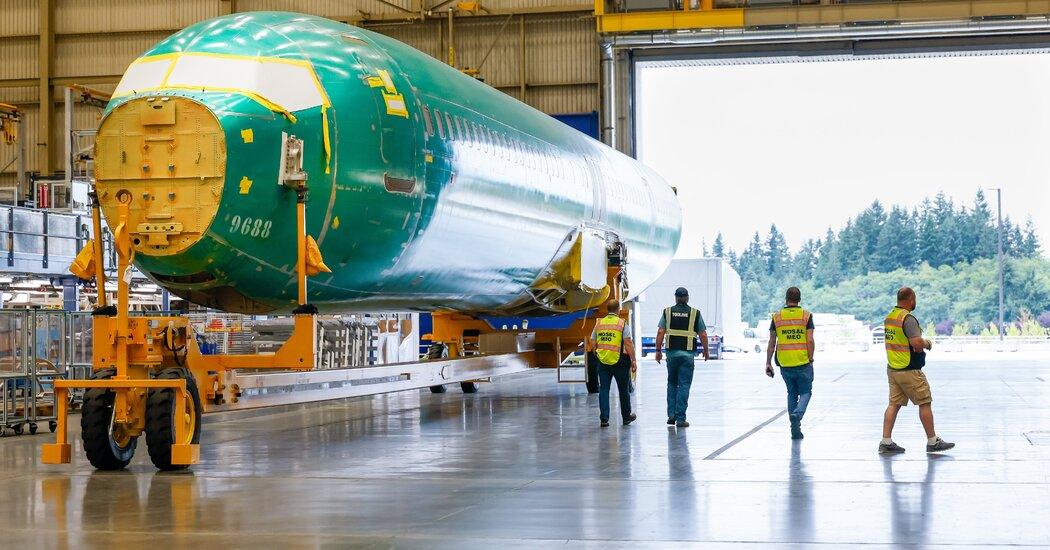
One morning this month, a bay door opened at a massive Boeing plane factory north of Seattle, where workers rolled into an emerald green fuselage.
This was only the second 737 Max to enter production at this Everett, Washington, factory, and it was something of a milestone for Boeing.
Since the 737’s debut in 1967, the plane has been almost exclusively produced at a factory in Renton, a suburb of Seattle. But Renton is nearing maximum capacity, and adding a second production site in Everett will help Boeing realize its ambitions to build more 737 Max, by far its most popular plane.
More broadly, the 737 production expansion is a sign of progress Boeing is making in its turnaround efforts, more than two years after its last major crisis. In January 2024, an improperly installed panel caused a 737 Max plane to explode during a flight, triggering new federal oversight and public scrutiny of Boeing. At the time, the company was just beginning to significantly recover from a much more serious crisis brought on by Max’s crashes in 2018 and 2019, in which 346 people died.
The panel episode caused Boeing to once again shake up its leadership, culture and practices, and those changes appear to be paying off. Boeing delivered 314 planes in the first half, its best performance for that period since 2018. Earlier this year, the company booked $576 billion in commercial plane orders, its highest level on record.
“Boeing is on a very upward trajectory,” said Jerry Lundquist, an industry consultant whose firm, the Lundquist Group, advises aerospace company executives but does not currently work for Boeing. “Cruise is certainly not yet smooth, stable and sustained, but it continues to do well. It’s a very good story.”
It helps that airlines are desperate for new jets to satisfy the growing global demand for travel. Hundreds of additional plane orders are expected in the coming days as Boeing and other companies gather at an airport near London for one of the world’s biggest aerospace events, the biennial Farnborough International Airshow.
“There has been a particularly strong ordering frenzy,” Stuart Hatcher, chief economist and head of data at IBA, an aviation consultancy, said during a webinar this week.
In most cases, a plane order placed today for a jet made by Boeing or its European rival Airbus is not expected to be fulfilled until the 2030s. Boeing nevertheless lags behind Airbus, which has received more than twice as many plane orders this year and has a larger order backlog.
Despite this disparity, Boeing manages its own order backlog of approximately 6,200 planes. This is good news for its results. But Boeing executives have warned that its commercial aircraft division won’t generate consistent profits for some time, in part because of investments such as the $1 billion the company spent to increase production of the Max at Everett.
Approximately 1,000 employees support this effort. Half of the mechanics building the plane previously worked in Renton, while the other half are new hires, according to Jennifer Boland-Masterson, senior director overseeing the expansion.
The Federal Aviation Administration audits the process and must approve the production line, known as the North Line, before planes built here can be delivered. But work has already begun, slowly, and Boeing says almost every step of the process mirrors that of the three Max production lines in Renton.
The work is being done in space formerly used to build the much larger 787 Dreamliner, a twin-aisle plane whose production was consolidated at a factory in South Carolina. Boeing also manufactures the 777, 767 cargo planes and the KC-46A Pegasus military tanker in Everett. The factory, which Guinness World Records describes as the world’s largest by volume, was also once home to the iconic 747, the last of which was delivered in 2023.
The 737 Max represents about 70% of Boeing’s commercial aircraft order backlog. Deliveries of the plane were frozen for nearly two years after the fatal crashes. Meanwhile, regulators required Boeing to make several changes to the plane, which began flying again in late 2020.
After the 2024 panel explosion, in which no one was seriously injured, the FAA capped Max production at 38 planes per month until the agency was satisfied that Boeing had improved manufacturing quality. The company then implemented a quality control regime that it described as a “war on defects,” and the FAA authorized Boeing late last year to produce 42 jets per month, and 47 per month this year.
Boeing is working to achieve a steady pace of 47 planes per month, and the Everett line was added to help the company reach its next goal of making 52 planes per month and possibly more.
“It’s pretty significant,” said Sheila Kahyaoglu, an equity analyst at financial services firm Jefferies, which focuses on aerospace and defense companies. “Raising prices is very helpful.”
Ms. Kahyaoglu estimates that each 737 delivered can generate between $10 million and $20 million in cash after accounting for costs and necessary investments.
Although Boeing has made progress on production of the Max, it has been hampered by three long-delayed planes. But the company now says it is close to certifying all of them.
Boeing said certification work on the smallest and largest Max variants, the Max 7 and Max 10, was very advanced. The company also said it was making substantial progress on the 777-9, a giant designed for long-haul international travel. All three planes are years behind schedule, but Boeing said it expects to begin deliveries of all of them next year.
“The path is clear,” Mike Sinnett, Boeing’s senior vice president, told reporters this month. “We know what we have to do. We meet with the FAA very, very regularly.”
The Max 10 will come with a new system required following the crashes. This system, known as enhanced angle of attack, is designed to simplify the alerts pilots receive when an error is detected through a sensor that measures the plane’s angle relative to oncoming airflow, called angle of attack.
Investigators said several alerts linked to erroneous data from that sensor made it harder for pilots to respond during fatal crashes. Once certified, the new system is expected to be added to all Max aircraft within two years.
The Max 7 and Max 10 will also feature a fix for the engine’s anti-icing system to address overheating issues in certain conditions.
The 777-9, a twin-aisle plane capable of carrying more than 400 passengers over long distances, is also making progress, the company said. The plane has completed more than 1,700 test flights and Boeing has said it plans to deliver its first 777-9 next year.
On land near the Everett factory, Boeing is putting a 777-9 plane through tests that simulate real flight, including flexing its wings and body and repeatedly pressurizing and depressurizing its cabin. So far, this plane has endured the equivalent of nearly twice as many flights as the company expects it to operate without major structural defects.
Since the 2024 panel incident, Boeing has also worked to revamp manufacturing quality and corporate culture. The company replaced several senior managers, expanded training and inspections, simplified documentation and reduced allowances for some work done out of order. Boeing said that as a result, during the first three months of the year, employees spent nearly 20% less time fixing defects or repairing or replacing parts on the 737 line than during the same period last year.
Boeing has also intervened more in its supplier operations to improve quality and capacity issues. In 2025, it bought a struggling supplier, Spirit AeroSystems, which manufactured the Max fuselage. Boeing said the number of defective fuselages arriving this year was down 40% compared to 2025.
And in an effort to improve its culture, the company solicited feedback from tens of thousands of employees for several months. This process resulted in the company developing five guiding values and 15 recommended behaviors for employees.
These guidelines are mostly simple and conventional, such as “follow” and “collaborate respectfully.” But we speak bluntly of the frustrations of workers who have endured repeated crises and of the company’s efforts to regain public trust: “Who cares!


