
Kaja Kallas, the European Union’s top diplomat, recently suggested that ending the continent’s dependence on China was like trying to cure a disease. “Chemotherapy” might be necessary, she said, and it would probably be painful.
The comments are an example of the tone that Europe is increasingly adopting towards China, the 27-member European Union’s second-largest goods trading partner, after the United States.
As Beijing adopts more aggressive trade policies and imports from China to Europe soar, European leaders and businesses worry about their dependence on Chinese goods — and debate how to exit. As China becomes increasingly dominant in manufacturing, Europe sees an existential threat to its own industries.
“The tone is basically panic,” said Jeromin Zettelmeyer, director of Bruegel, an economic think tank in Brussels. “There is a feeling of imminent collapse of the industry, of imminent danger.”
Concern in Brussels is met with hostility in Beijing, where officials warn that China will retaliate against any protective measures. The fighting is expected to intensify further in the coming weeks.
World leaders will discuss global economic imbalances at a Group of 7 meeting in Evian, France, next month. China is then expected to be on the agenda at a meeting of the European Union’s 27 top leaders soon after.
On Friday, the European Union’s executive branch is expected to hold a first debate on China policy, which could help set the tone for future discussions.
European officials still express hope that they can work cooperatively with China to change trade imbalances, which have become more pronounced as Beijing has increased exports to boost economic growth. But they are also mulling stronger trade and industrial measures to curb China’s growing dominance in sensitive areas.
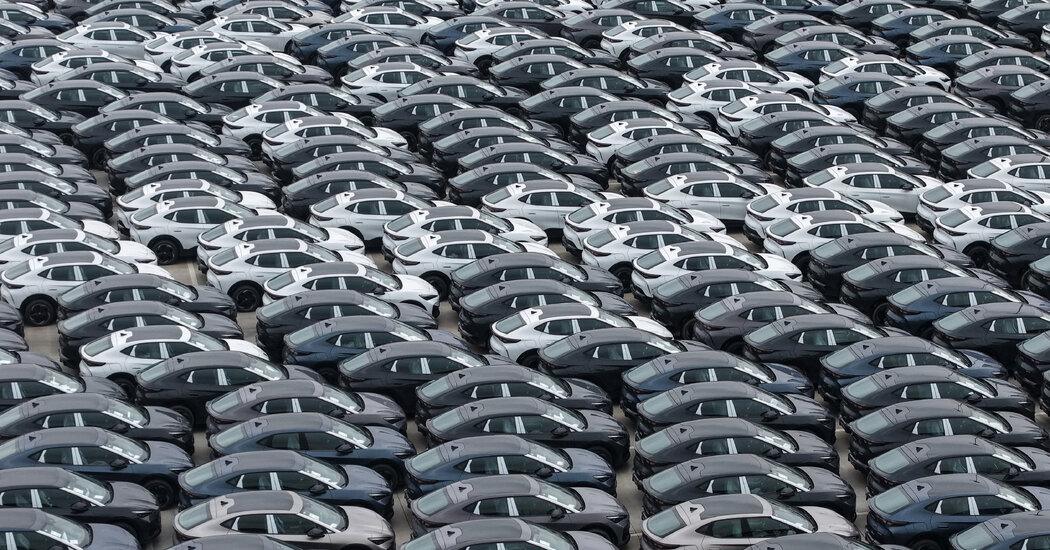
Reducing China’s contribution could prove extremely difficult for Europe. Politicians and businesses fear retaliation, and consumers are addicted to what China sells. Europeans continue to buy cheaper Chinese products, especially electric vehicles, which the European Union has already tried, unsuccessfully, to prevent from flooding their market.
“We are not in a good position,” said Rebecca Arcesati, who is based in Brussels for the Mercator Institute for China Studies, a think tank. She noted that European leaders must deal with voters and shorter-term political considerations – making it difficult to combat the flow from China, especially if Beijing retaliates.
“Our systems were not designed to meet such a challenge,” Ms Arcesati said.
China has government subsidies and programs that have strengthened the position of the country’s factories and businesses. Beijing’s government has leaned on the industry after a real estate crisis left policymakers needing another growth engine. And as U.S. tariffs made it more difficult for Chinese producers to export to the United States, these factories increased their exports to markets like Europe.
In the first quarter of this year, imports from China to Europe increased sharply. An analysis of 2026 customs data by online newsletter Soapbox and the Mercator Institute for China Studies found that China’s trade imbalance with the European Union reached record levels earlier this year, with the influx of electric vehicles.
The jump came as Chinese automakers faced falling domestic demand and expanded into Europe. At the same time, European consumers turned to greener alternatives as war in the Middle East drove up fuel prices.
This followed a goods trade deficit in 2025 of around $418 billion, according to EU figures.
This combination threatens European manufacturers and their employees, especially in countries like Germany, which has always been a large automobile and chemical manufacturer and is now struggling to compete.
As concerns grow, Europe has turned to tougher rhetoric and bolder ideas.
Emmanuel Macron, French President and long critic of China, has called on the European Union to create measures that protect strategic industries, similar to those the United States has and uses.
Pedro Sánchez, the Spanish prime minister who is often seen as one of Europe’s most pro-Beijing leaders, said during a recent trip to Beijing that the continent needs China to “open up so Europe doesn’t have to close down.”
Spain recently joined France, Italy, Lithuania and the Netherlands in preparing a document urging the European Union to respond aggressively, including by implementing new trade tools. Although the newspaper did not mention China by name, it criticized its trading partners for their “systemic and structural industrial overcapacity.”
Brad Setser, an economist at the Council on Foreign Relations, a think tank, said many European leaders must tread lightly with China for fear of retaliation. But, he added, their fear of manufacturing losses could eventually outweigh that fear, including in countries like Germany.
Europe is already taking some steps to protect itself, including with the European Union Industrial Acceleration Bill, a wide-ranging policy intended to rebuild the bloc’s manufacturing base. The plan’s design would effectively block Chinese companies from benefiting from some key subsidies, particularly for electric vehicles made in Europe.
The policy sparked outrage from Beijing, which denounced the plan as protectionist and warned of retaliation.
But China’s increasingly aggressive stance on trade has contributed to the intensification of the European reaction.
Last year, China twice banned exports of rare earth minerals and magnets in retaliation for U.S. tariffs. The bans hit Europe, which uses both materials in high-tech and green energy production.
The disruption in supply has exposed European businesses to the extent to which they are dependent.
In April, Beijing unveiled rules giving officials the power to review company records, question employees and even block executives from leaving China if they were determined to help move supply chains out of the country.
According to a recent assessment by the European Chamber of Commerce in China, the move “could now inflict an unprecedented level of damage on the European economy.”
China’s pushback is partly because Beijing senses a less unified front against its trade policies as Washington and Brussels clash, said Noah Barkin, an expert on Euro-China relations for the Rhodium Group, a research firm.
Beijing’s “message to Europe is: ‘Your ‘best friend forever’ is gone and even the Americans are looking for stability with us, so don’t test us,'” Barkin said.


