
The cryptocurrency market is picking up the wrong signals, and a massive shift in the way global financial networks operate is quietly happening behind the scenes.
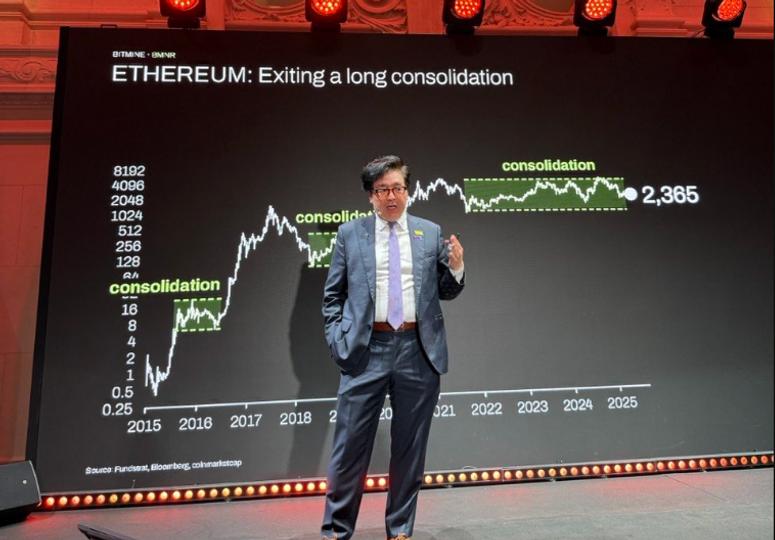
In a speech at the Proof of Talk conference in Paris, Tom Lee, head of research at Fundstrat and president of Bitmine Immersion Technologies (BMNR), told his audience that ether (ETH) is experiencing significant changes that will eventually push its price to $250,000. Although Lee did not provide a specific timeline for the goal, he mapped out the infrastructure changes leading the network toward that value.
Ether was changing hands Tuesday at $1,906, down 6% in the last 24 hours.
Lee’s company Bitmine is one of the largest holding companies in Ethereum. Bitmine increased its ETH purchases last week, making it the largest since December. He purchased 111,942 ether (ETH) worth approximately $237 million at current prices. This brought the company’s holdings to nearly 5.4 million ETH, or approximately 4.47% of the circulating ether supply.
“If a thesis is correct and Ethereum is going to come out of this consolidation, and the consolidation is tokenization and AI, you know, I think that’s probably about 50 times, a significant upside for Ethereum. If Ether realizes, that’s correct, and Ethereum goes to $250,000, that values Bitmine stock at $5,000. That’s a bargain at $18.”
Multi-billion dollar growth
Lee explained that this multi-billion dollar growth will be driven by artificial intelligence. As advanced software and automated computing take over the Internet, machines will need a way to pay themselves instantly without relying on traditional, slow bank transfers.
“Bots will already dominate most of the traffic on the Internet,” Lee said. “And that’s why Andreessen Horowitz and others have talked about this as a big unification, because if you have robot systems, you’re going to have to control them. And that’s where blockchain is much more effective than traditional rails in controlling what the robots do. Whether it’s authentication, identity, or payment speed, all of that works better on crypto systems.”
Because of this machine-to-machine economy, Lee believes Ethereum will evolve from a speculative digital asset to the primary global currency for paying for automated computer processing power.
Death of the Ethereum Foundation
This systemic growth completely changes the way underlying blockchain networks are managed. Lee pointed out that the nonprofit Ethereum Foundation has spent years shrinking its own footprint, bringing its network holdings down to just 100,000 ETH, which represents a tiny 0.1% of the total supply.
Instead, huge public companies step in to run the network as corporate validators. Companies like Bitmine and Sharklink now collectively control 7% of the entire circulating supply of Ethereum. Instead of relying on foundation grants, these corporate treasuries now generate $500 million in awards each year to self-fund the ecosystem.
To demonstrate the value of this model, Lee announced a major regulatory milestone for Bitmine, which trades on the New York Stock Exchange under the symbol BMNR.
“Bitmine also meets the eligibility criteria to be added to the Russell 1000,” Lee revealed. “The inclusion date is June 26. Why is this important? Well, the Russell 1000 is the most widely followed index in the world… Every money manager in the world who is benchmarked against the Russell 1000 – and that’s over $4 trillion – will have to decide if they want to own Bitmine.”
Lee explained, with charts behind him, that holding active corporate validation stocks significantly outperforms purchasing crypto for spot. Over a six-month reporting period, holding regular spot ETH generated a modest return of 22%, while Bitmine’s staking architecture returned 500% to its investors.
For Lee, the massive structural growth in business staking and AI utility completely outweighs any temporary market panic. “If you are bearish today, you are selling low,” Lee concluded. “And again, I can’t stress that if you’re bearish today, you’re bearish deep down on Bitcoin and Ethereum.”


