
According to interfaith harmony, diversity, peaceful coexistence and dialogue, the drivers of Pakistan’s foreign policy
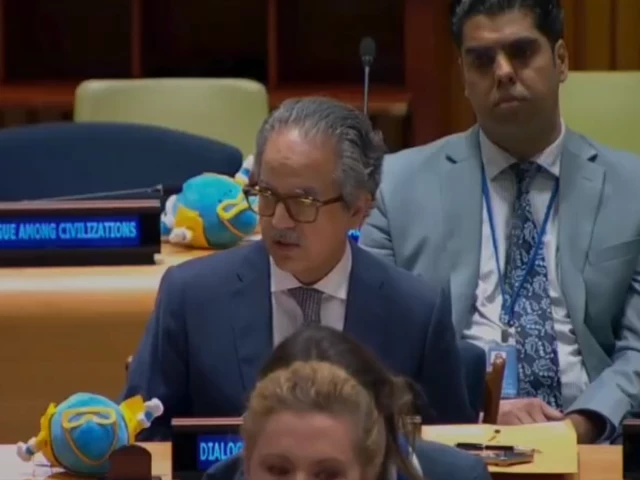
Pakistan’s Permanent Representative to the UN, Ambassador Asim Iftikhar Ahmad, addressing a high-level UN event marking the International Day for Dialogue Among Civilizations. SCREENSHOT
Pakistan’s Permanent Representative to the UN, Ambassador Asim Iftikhar Ahmad, on Thursday called for deeper international engagement through diplomacy, cross-cultural exchanges and mutual understanding, describing dialogue as “the most effective tool to transcend differences and foster mutual understanding and cooperation.”
Speaking at a high-level United Nations event marking the International Day for Dialogue among Civilizations, the ambassador joined other delegations in praising the event’s organizers, saying he wanted to “join many of my colleagues who are here in the room in congratulating you… for organizing and co-sponsoring this very important event,” adding that it had been “a very interesting and exciting discussion.”
He highlighted remarks made by senior global figures, including Chinese Foreign Minister Wang Yi, UN Secretary-General António Guterres, the President of the General Assembly and the High Representative, welcoming what he described as “the messages we have heard” from international leaders.
Dialogue and diplomacy remain the most effective tools for transcending differences and fostering mutual understanding and cooperation. It is the spirit of dialogue that has enabled human civilization to forge mutual respect and trust and chart the path to shared progress and development.… pic.twitter.com/ehrqgppyuM
– Permanent Mission of Pakistan to the UN (@PakistanUN_NY) June 10, 2026
The Pakistani envoy said the discussion highlighted a growing global consensus on the importance of dialogue, noting that “dialogue and diplomacy remain the most effective tools to transcend differences and foster mutual understanding and cooperation.”
He said the United Nations itself was founded on this principle, recalling that its creation after the Second World War reflected the recognition of “the interdependence that exists between international peace and dialogue among civilizations.”
Warning about contemporary global tensions, he said that at “this critical moment in history, when myriad challenges jeopardize global peace and harmony,” the importance of cross-cultural engagement “cannot be overstated.”
Read: Pakistan urges all parties to give ‘a little more chance’ to diplomacy at UN Security Council
The ambassador also drew on Pakistan’s historical and cultural heritage, saying the country’s civilizational roots date back thousands of years, including the Indus Valley and Harappa civilization, which he said dates back “5,000 years.”
He described Pakistan as being “located at the crossroads of the Middle East and West, South and Central Asia”, and said it had long been “a melting pot of many civilizations and religions”.
He added that values such as interfaith harmony, peaceful coexistence, diversity and dialogue were “not only defining features of Pakistani civilization, but also a driving force of our foreign policy.”
In this context, he referred to Pakistan’s co-sponsorship, along with the Philippines, of a UN General Assembly resolution titled Promotion of Interreligious and Intercultural Dialogue, Understanding and Cooperation for Peace, which he said was adopted by consensus.
Concluding his speech, he reaffirmed Pakistan’s commitment to the United Nations system, saying: “Pakistan will continue its engagement with the UN and all Member States to advance our common goals of dialogue among civilizations, cultures and faiths for global peace and prosperity. »


