
States that the situation in AJK is being handled within a democratic and constitutional framework
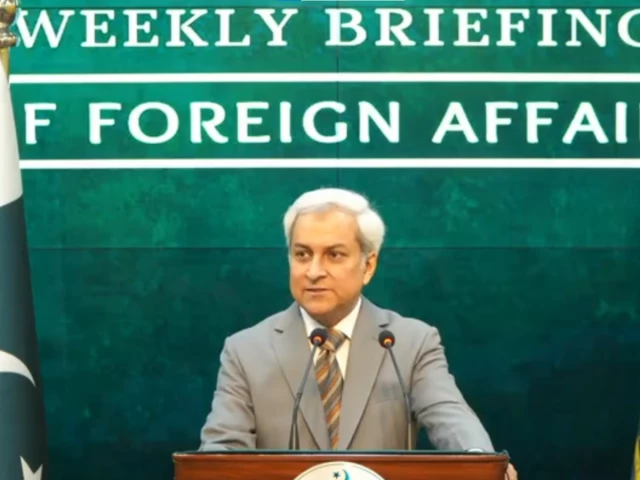
Foreign Ministry spokesperson Tahir Andrabi speaking at the Foreign Ministry’s weekly press briefing. SCREENSHOT
Pakistan on Thursday strongly rejected recent statements by Indian officials on the situation in Azad Jammu and Kashmir (AJK), with the foreign ministry saying New Delhi was trying to divert attention from the unresolved Kashmir conflict and its own record in the Indian-administered territory.
At the weekly press briefing, Foreign Ministry spokesperson Tahir Andrabi said Pakistan had “seen these statements” from India and “rejects India’s remarks in their entirety.”
He said it was “untenable for a state like India, which has consistently denied the Indian people of Illegally Occupied Jammu and Kashmir (IIOJK) their right to self-determination, to raise concerns over the rights of Kashmiris.”
He added that India, through such comments, was trying to “divert attention from the unresolved status of Jammu and Kashmir and its own appalling record in Indian illegally occupied Jammu and Kashmir.”
The spokesperson rejected any comparison between the two sides of the Line of Control (LoC), saying Pakistan also “rejects any insinuation of false equivalence between the IIOJK situation and AJK-related issues”.
He said the IIOJK was “an illegally annexed and internationally recognized disputed territory,” where people had “suffered systemic abuse under draconian laws” and had been denied their right to self-determination under UN Security Council resolutions.
In contrast, he said, “the situation in Azad Jammu and Kashmir… [is being] addressed within a democratic and constitutional framework. He added: “Any attempt to conflate the two is misleading and does not stand up to objective scrutiny.”
Read: The United States and Iran trade attacks for a second day, undermining a tenuous ceasefire
Reiterating Pakistan’s position, he said Islamabad would continue to support “the human rights of Kashmiris, including their inalienable right to self-determination”, and pursue a “peaceful resolution of these eight-decade-old disputes in accordance with international law…and the wishes and aspirations of the Kashmiri people”.
He also urged India to agree to a UN-supervised plebiscite, saying: “If India sincerely believes that the wishes of the Kashmiri people…must prevail…it must uphold their right to self-determination.” »
Nuclear concerns
Responding to questions on a recent report by the Stockholm International Peace Research Institute (SIPRI), the spokesperson said Pakistan had reviewed the findings and was not surprised.
He said Pakistan “does not wish to endorse or give credence to the SIPRI methodology”, but that its findings “are nevertheless not surprising”.
Andrabi noted that the report “largely corroborates the concerns that Pakistan has consistently raised regarding India’s continued vertical proliferation.” The spokesperson added: “We also believe that open source estimates such as those from SIPRI may not fully reflect the true scale of India’s nuclear arsenal, which may actually be higher.” »
He warned that India’s evolving nuclear posture, including missile systems and submarines, could “enhance operational readiness, complicate stability in a crisis, and have implications that extend beyond South Asia, with serious consequences for international peace and security.”
Pakistan, he said, “does not seek to wage an arms race,” but remains “aware of the evolving security environment” and will take “all essential measures to preserve strategic stability.” He urged the international community to “closely monitor the developments and deployments of India’s nuclear arsenal.”
Water rights
The spokesperson also strongly reacted to comments reported by the Indian Minister of Water Resources, suggesting that “not a single drop of water will flow to Pakistan in the coming years.”
Learn more: Dialogue remains ‘most effective tool’ to resolve differences, Pakistan tells UN
He said Pakistan had taken note of the statement and warned that any attempt to restrict water would be “deeply irresponsible” and violate international obligations and bilateral agreements.
Andrabi said Pakistan strongly rejects any notion that water can be treated as a “political tool or an instrument of coercion or a weapon.” He warned that such actions would threaten regional stability and said the responsibility would “fall squarely on India”.
Andrabi reiterated: “Pakistan’s rights and interests… are non-negotiable. ” He said Islamabad would defend its water rights with “all available diplomatic, legal, political, economic and other measures.”
He further warned that any attempt to block vital water for the Pakistani population could be considered “an extremely serious act” and “perhaps amounting to an act of war”.
Citing Article 51 of the United Nations Charter, he said Pakistan retained the right of self-defense and would take “all necessary measures to safeguard its economy…and the lives of its 250 million people.”
Hostage situation in Somalia
Andrabi also provided information on Pakistani citizens held hostage on a cargo ship by Somali pirates, saying they had been in captivity for “nearly 50 days.”
He said Pakistan was in contact with Somali authorities, the ship owner and relevant tribal stakeholders in Puntland to secure their release.
The FO spokesperson also noted that Deputy Prime Minister (DPM) Ishaq Dar had recently held talks with Somalia’s foreign minister, while Pakistan’s ambassador to Somalia was also engaged. He said the efforts included “inter-ministerial and inter-departmental meetings” and continued diplomatic engagement.
Andrabi also said Pakistan was working to improve the living conditions of hostages of several nationalities, including Indonesians, Indians, Myanmar and Sri Lankans. He added that Pakistan “compassions with these individuals” and their families, but called the situation “operationally difficult”.
Conflict in the Middle East
On the Middle East, the spokesperson said Pakistan remained “deeply concerned” about the recent escalation and urged all parties to adhere to ceasefire agreements.
He said Pakistan believed that “diplomacy and dialogue should be the guiding principles” in resolving differences. Andrabi highlighted Pakistan’s engagement with regional players, including Iran, the United States and Turkey, saying these contacts were aimed at de-escalation.
He noted that Pakistan had facilitated diplomatic engagement, which contributed to a ceasefire agreement between Israel and Lebanon, describing it as a “positive development” achieved with US participation.
The spokesperson added that Pakistan would continue its efforts towards peace and stability in the region under the leadership of Prime Minister Shehbaz Sharif, who had stressed that it remained on the “path of peace and diplomacy”.


