
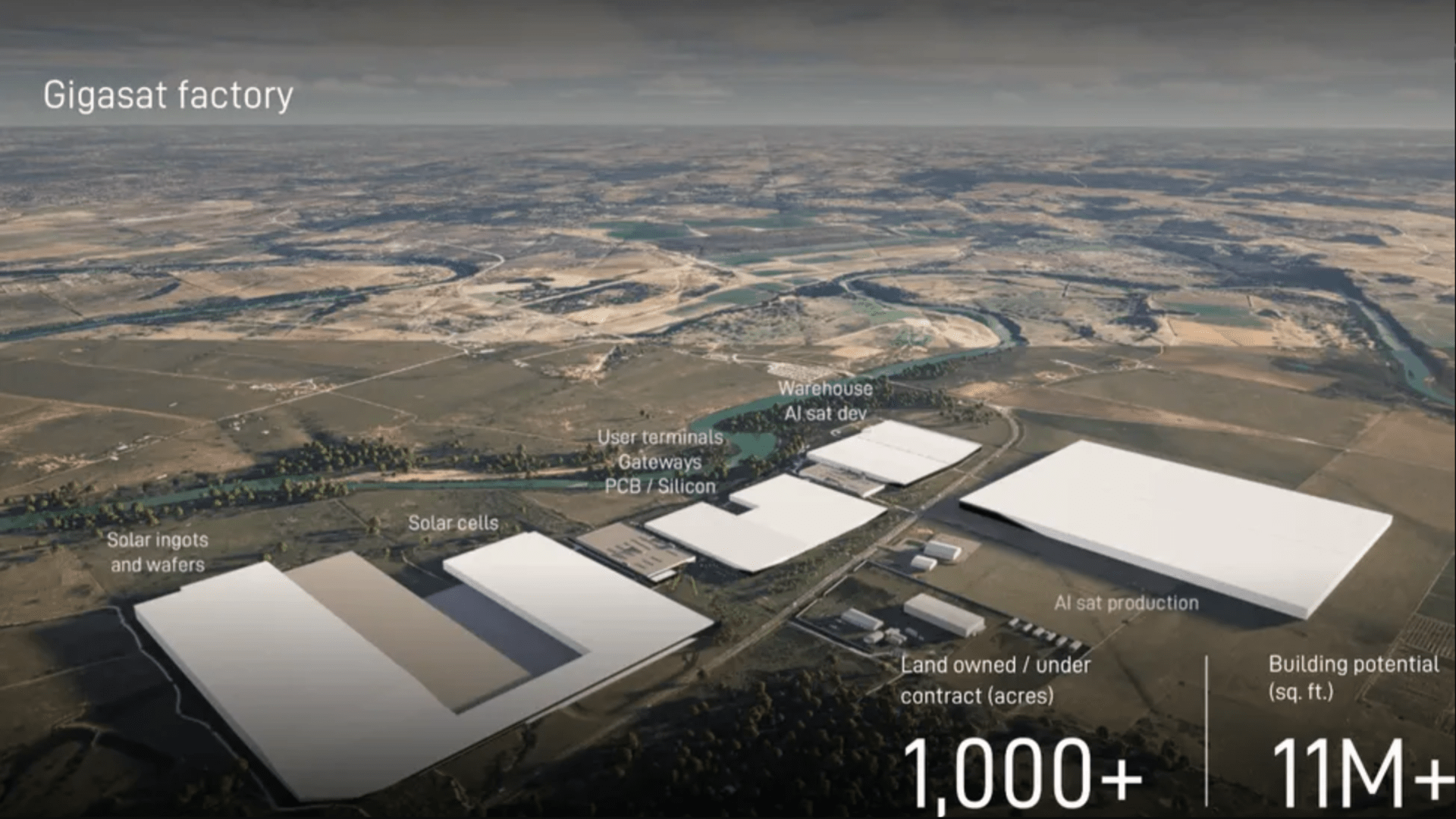
- SpaceX plans a huge factory dedicated to the production of AI satellites.
- The new AI1 spacecraft could put computing power directly into orbit.
- Musk wants orbital computing capacity measured in gigawatts per year.
SpaceX has unveiled plans for a massive manufacturing complex in Bastrop, Texas, which could become central to its space AI infrastructure ambitions.
The proposed Gigasat facility would cover approximately 11 million square feet and focus on producing satellites designed to function as on-orbit data centers.
SpaceX CEO Elon Musk says the Bastrop factory will make much of the hardware needed for a new generation of AI satellites.

SpaceX factory dedicated to orbital AI infrastructure
The site will include production lines for solar components, printed circuits, electronic systems, communications equipment and the satellites themselves.
SpaceX also plans to include testing facilities, logistics infrastructure, warehousing capacity and dedicated development areas throughout the facility.
At the center of the project is a new spacecraft called AI1, which the company intends to manufacture in large numbers as a space computing platform.
Musk said each satellite would carry a computing payload capable of delivering about 150 kW of processing capacity while relying on vast solar panels for power generation.
The satellite is also expected to be around 70 meters long, with solar panels generating power at a density of around 250 watts per square meter.
Its design also incorporates large radiator structures intended to manage the significant heat generated by on-board computer systems.
SpaceX expects solar manufacturing activities at the site to begin first, while construction of the main satellite production building is expected to follow.
The company estimates that the facility could begin producing a significant number of AI satellites before the end of 2027.
Achieving the stated goal of 1 GW of annual orbital computing capacity for AI would require the deployment of thousands of satellites operating collectively in orbit.
“That’s what we’re going to try to do and think we can probably do, which is get to an annualized rate of about a gigawatt per year by the end of next year,” Musk said in discussing the company’s goals.
Ambitious growth plans
The long-term vision extends well beyond the initial 1 GW target, and Musk has expressed his aspiration to increase production in the following years, reaching tens of gigawatts.
He also discussed the possibility of reaching even larger scales if future technological developments support such expansion.
These ambitions emerge as big tech companies continue to invest heavily in conventional AI installations.
Meta’s planned Hyperion data center in Louisiana is expected to reach 5 GW and house approximately 2 million GPUs.
Similarly, xAI’s Colossus 2 facility in Memphis has expanded to nearly 2 GW with approximately 555,000 GPUs.
Some of the largest announced projects require enormous power capacity and investments ranging from tens of billions to more than $100 billion in infrastructure.
In this context, orbital data centers are attracting increasing attention as a possible alternative approach to meet future computing demand.
SpaceX may have some advantages because many of the technologies needed for large-scale satellite production already exist within its broader operations.
Much of this experience comes from the company’s extensive work designing, manufacturing and deploying the Starlink spacecraft over several years.
The production of solar panels, satellite structures, communications equipment and associated systems relies largely on established aerospace manufacturing processes.
The Gigasat facility is also expected to be more than 10 times larger than Starfactory, currently SpaceX’s largest spacecraft manufacturing complex.
These requirements differ significantly from those of advanced semiconductor manufacturing, making certain aspects of the project more achievable within the proposed time frame.
It remains uncertain whether the company will ultimately achieve its long-term goals, especially given the immense scale involved in future expansion plans.

Follow TechRadar on Google News And add us as your favorite source to get our news, reviews and expert opinions in your feeds.


