
Creation of a high-level committee to provide political oversight and start of new technical negotiations
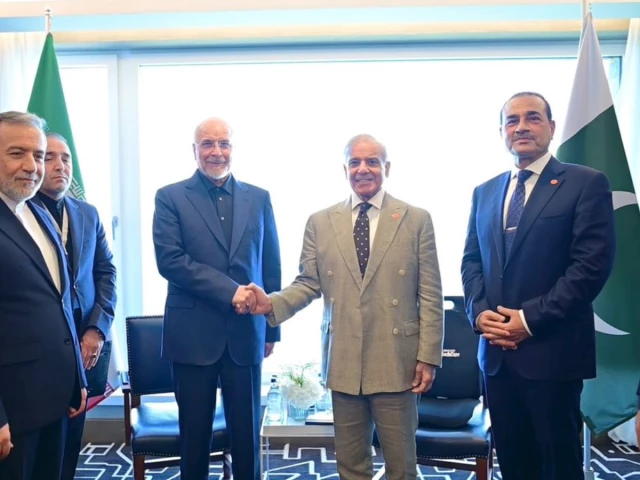
Prime Minister Shehbaz Sharif alongside the Iranian delegation in Bürgenstock, Switzerland, for technical talks between the United States and Iran. PHOTO: SHEHBAZ SHARIF/X
Prime Minister Shehbaz Sharif on Monday welcomed the “successful conclusion” of the first meeting of the High-Level Committee held under the Islamabad Memorandum of Understanding in Bürgenstock, Switzerland, saying the talks produced “encouraging progress” and a roadmap towards a final agreement within 60 days.
The first round of four-way talks involving Iran and the United States, mediated by Qatar and Pakistan, concluded in Switzerland, marking the first formal follow-up engagement since the deal was signed earlier this week.
In an article on »
He added that the discussions took place in a “positive and constructive atmosphere” and “resulted in encouraging progress”, including “agreement on a road map towards a final agreement within 60 days”, the creation of a “High-level committee to provide political oversight” and the start of new technical negotiations.
Alhamdulillah, the first meeting of the high-level committee under the Islamabad MoU concluded successfully in Bürgenstock, Switzerland.
The discussions took place in a positive and constructive atmosphere and resulted in encouraging progress,… pic.twitter.com/uvA0SBKfvf
– Shehbaz Sharif (@CMShehbaz) June 22, 2026
The prime minister said he “commends the leaders of the United States as well as Iran for their continued commitment to constructive engagement,” adding that he appreciated their “continued commitment to dialogue and diplomacy.”
He also thanked “all brotherly and friendly countries” for what he called their “valuable support in moving this historic process forward.”
Sharif praised Qatar in particular, saying: “I would like to express my gratitude to our brotherly country, Qatar, for its essential support in creating the necessary conditions for these negotiations to move forward.”
He further recognized Switzerland’s role “for its facilitation in hosting these talks.”
Prime Minister Shehbaz paid “special tribute to Field Marshal Asim Munir” for his “untiring efforts” which made the talks possible, adding that his “dedication, commitment and perseverance are indeed commendable without which there would have been no progress”.
He also congratulated Deputy Prime Minister and Foreign Minister Ishaq Dar, praising his “diplomatic efforts alongside his team at the Ministry of Foreign Affairs”. The Prime Minister also appreciated Interior Minister Mohsin Naqvi, saying he “contributed immensely to the success of these talks”.
Read: FM Dar hails “substantial progress” in US-Iran negotiations
The prime minister pledged that Pakistan would “continue to play its honest and sincere role in advancing dialogue and diplomacy towards a peaceful and lasting resolution,” signaling continued commitment as technical talks continue in Switzerland.
According to a joint statement from Pakistan and Qatar, the parties agreed on a roadmap to reach a final agreement within 60 days. A communication channel would be established during the negotiations to prevent incidents and communication problems, including measures to ensure the safe passage of commercial ships through the Strait of Hormuz.
He also announced the creation of a “deconfliction cell” facilitated by Pakistan and Qatar and involving Lebanon to supervise compliance with commitments linked to the cessation of military operations in the country.
On June 18, Prime Minister Shehbaz signed the “Islamabad Memorandum of Understanding” as mediator, formalizing a major diplomatic breakthrough between the United States and Iran. Israel, excluded from peace talks, distanced itself from the U.S.-Iran deal and continued to fight the Iran-allied Hezbollah militant group in Lebanon, also raising questions about whether the deal would hold.
The United States and Israel launched war against Iran on February 28, assassinating former Supreme Leader Ayatollah Ali Khamenei and military leaders on the first day.
It quickly escalated into a regional conflict that killed more than 7,000 people, mainly in Iran and Lebanon; an increase in energy prices; has reignited inflationary pressures and raised concerns about a major food supply crisis in developing countries.


