
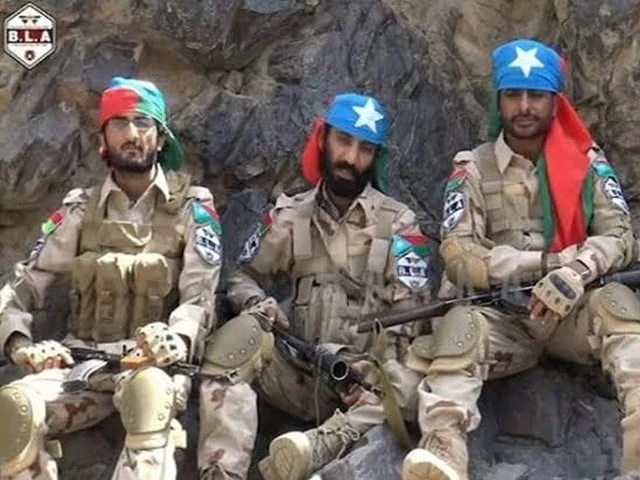
“BLA does not represent Balochistan. This is weaponizing the deprivations of Balochistan.
ISLAMABAD:
I belong to Balochistan. I have spent my political life in its dust, in its mountains and among its inhabitants. I have listened to mothers who did not know where their sons had gone and sat across from grieving families of children who had been recruited, radicalized and destroyed by an organization that did not care about the rights of the Baloch; he cares about chaos. This organization is the Balochistan Liberation Army (BLA), and I have raised my voice against it in the Senate of Pakistan with a steadfastness that I will not relinquish, because the people whose lives are being destroyed deserve nothing less.
I write today not only as a senator but also as a Baloch woman who refuses to allow the suffering of her people to be exploited by a terrorist group whose leaders sit comfortably abroad while young Baloch men and women die in operations they never really understood they were going to join. The world must designate the BLA and its elite anti-suicide unit, the Majeed Brigade, under United Nations Security Council sanctions regime 1267. The Pakistan-China proposal was not accepted, with the 1267 Committee citing unmet technical thresholds, a decision that, although procedurally based, was not made in a geopolitical vacuum.
“The BLA does not represent Balochistan. It is weaponizing the deprivations of Balochistan.”
Balochistan is the largest province of Pakistan and one of the most underdeveloped; the multidimensional poverty index exceeds seventy percent. It is into this void that the BLA fits with deliberate precision. This is not opportunistic radicalization. It is the systematic weaponization of deprivation. Recruiters present themselves as champions of Baloch identity, using the language of nationalism to target young people between the ages of fifteen and twenty-five. Through encrypted platforms and sophisticated propaganda, they romanticize armed struggle, isolate recruits from their families and moderate voices, and condition adolescents to view violence as obligatory. Many of those who end up as Majeed Brigade suicide operatives entered this pipeline as boys who were told they were freedom fighters. This was not the case. They were the instruments of an organization whose leaders have never experienced the suffering they exploit. These are not statistics. These are the children of Balochistan, consumed by an organization that claims to be their liberator.
The scale of the violence should alarm any responsible government. According to the South Asia Terrorism Portal, Baloch insurgent groups carried out 938 attacks in 2024, an increase of 53% from 2023, with the death toll rising 80% to more than 1,002. The BLA alone claimed responsibility for 302 attacks and more than 580 deaths. In March 2025, he hijacked the Jaffar Express, killing at least thirty-one people and holding more than three hundred passengers hostage. The Majeed Brigade, its dedicated fidayeen unit, has carried out six major suicide missions in a single year, operating on a decentralized and networked model that makes it resilient in the face of conventional counterterrorism disruptions. These are not the numbers of a grievance movement. These are the numbers of an organized terrorist enterprise.
The BLA is not a national challenge. It is an instrument of regional destabilization with documented external sponsorship, including the case of Kulbhushan Jadhav, an Indian naval officer arrested in Balochistan in 2016, who confessed to financing and organizing Baloch militant groups on behalf of Indian intelligence services. Growing evidence of tactical cooperation between the BLA and the Tehreek-e-Taliban Pakistan, a transnational jihadist network, further dismantles any argument that it is a local separatist movement with no links to global terrorism.
“Baluch youth are not the perpetrators of these attacks. They are the raw material, processed through a radicalization pipeline and deployed by leaders who remain safe abroad.”
The United States, United Kingdom and Australia have each designated the BLA and the Majeed Brigade under their own national anti-terrorism laws. The United States went further, issuing a foreign terrorist organization designation in August 2025 and citing direct threats to U.S. national and economic interests. These interests are concrete: Washington has identified Balochistan’s vast reserves of copper, gold and rare earths as a strategic priority. A BLA emboldened by the absence of a UN list, free to cross borders, access financial systems and recruit internationally, poses a direct threat to any US commercial or strategic engagement in the region. The gap between America’s national FTO designation and its position on the UN 1267 Committee is one that American policymakers must close. The same moral contradiction also applies to London.
The danger to regional connectivity is no less serious. The China-Pakistan Economic Corridor, which represents tens of billions of dollars of infrastructure investment and Balochistan’s biggest development opportunity, is a declared target of the BLA. But this is not just a concern between Pakistan and China. Every attack on a road, port or energy pipeline is an attack on South Asia’s broader economic future and a signal to terrorist organizations around the world that critical infrastructure can be targeted with impunity. The international community cannot afford to send this signal.
The UN 1267 Sanctions Committee’s proposal was not accepted on the grounds that the regime targets Al-Qaeda and ISIL-affiliated groups, and that there was insufficient evidence of such affiliation. This threshold must be met, and Pakistan is determined to strengthen its evidence. But the broader legal obligation of UN Security Council Resolution 1373, which requires all member states to refuse to support any entity engaged in terrorism, regardless of ideology, has not been suspended. And reports that India played an active diplomatic role in maintaining the hold mean the UN’s counterterrorism architecture may have been shaped by regional rivalry rather than the merits of the threat.
I started where I must end, with the youth of Balochistan. The BLA claims to speak on their behalf. This is not the case. He speaks for armed leaders in comfortable exile who direct teenagers into suicide operations, and for external actors who view Baloch lives as expendable instruments of geopolitical strategy. Sustainable peace in Balochistan requires governance reform, political inclusion, economic investments and resolution of historical grievances. But designation is an essential part of the answer; it cuts funding, restricts leadership mobility, and removes the implicit legitimacy currently provided by the absence of a UN list. Every day that the world delays, another young person is recruited. Another family loses a child. The international community has the legal tools and the moral obligation to act. The question is whether it has the political will. I am a Baloch woman and a senator from Pakistan. I will keep asking this question until the answer is yes.
The writer is a senator


