
- Samsung Unveils Industry’s First UFS 5.0 Storage: A Single Fingernail-Sized Chip Reads Up to 10.8 GB/s
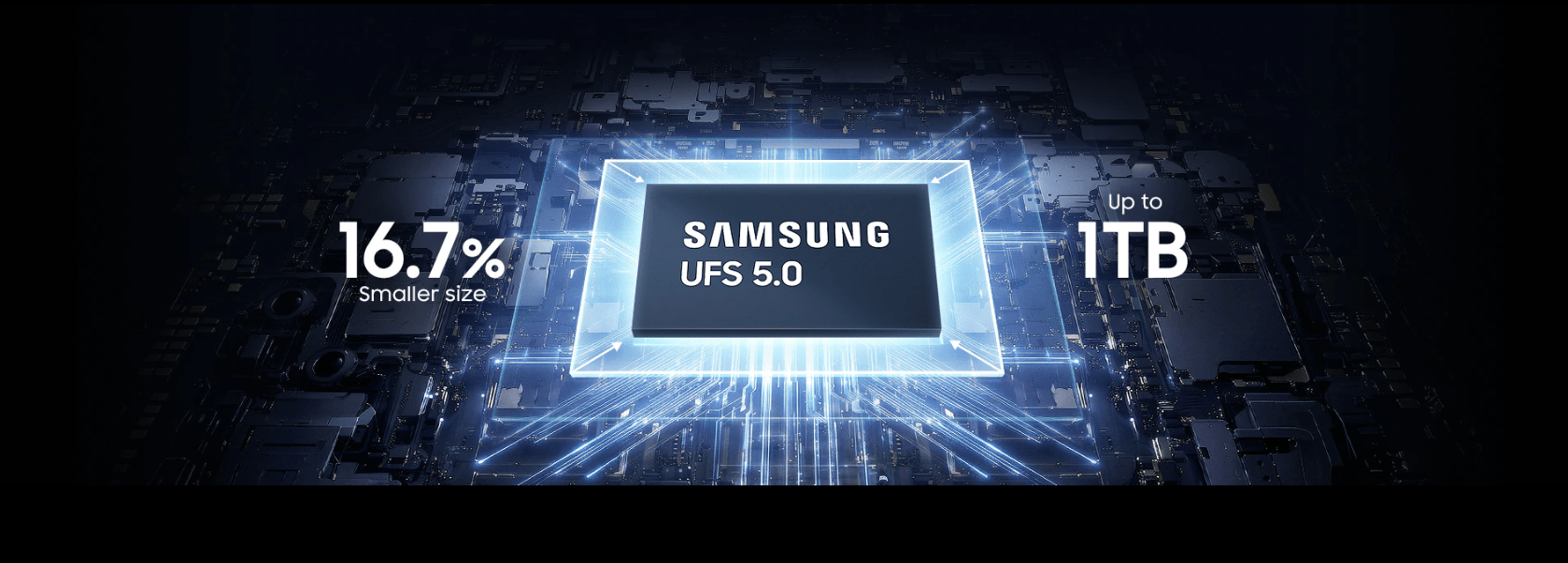
- With capacities up to 1TB, it makes a strong case for replacing existing M.2 drives in laptops, handhelds, and gaming consoles, among other hardware.
- The chip is also relevant to AI, providing a significant increase in read speeds for on-device AI solutions, with a 40% decrease in power consumption compared to UFS 4.1.
Samsung has unveiled what it says is the industry’s first look at UFS 5.0, a new storage standard for its customers.
The memory and storage giant unveiled its new storage chip on June 23 while positioning its embedded storage standard as an important advancement for localized or on-device AI solutions.
Samsung says its chips are based on the standard feature of up to 10.8 GB/s sequential read speed and up to 9.5 GB/s sequential write speed, making them more than twice as fast as the old UFS standard, which clocked at 4.2 GB/s and 2.8 GB/s respectively.

Faster, less power-hungry flash in a more compact package
Samsung’s latest offering isn’t just an iterative upgrade in raw speeds over previous generations; This paves the way for devices yet to arrive as the world grapples with the need for on-device AI solutions, even as demand for more localized solutions eclipses many manufacturers’ expectations.
While generative AI often uses fast NAND flash as a substitute for relatively more expensive DRAM, even as smartphones and computers are increasingly impacted by the rising prices of both components, Samsung’s UFS 5.0-based offering fills an important gap for many of its OEM customers as well as its own line of smart devices.
“In the era of on-device AI, storage devices are becoming a key driver defining AI experiences,” noted Jangseok Choi, head of memory product planning at Samsung Electronics.
“As we successfully enter the development stage of the industry’s first UFS 5.0 solution, Samsung is setting a new standard in mobile storage and will continue to drive innovation for the next-generation mobile platform market.
As AI solutions range from hyperscalers to objects smaller than smartwatches, Samsung’s offering becomes even bigger. Its solution’s body is 16.7% smaller than the previous generation, measuring just 7.5mm x 13mm x 0.9mm, smaller than most people’s fingernails.
Samsung’s most important achievement, however, might be the 40% power efficiency it claims to offer compared to its new chip’s predecessor, while delivering speeds that effectively make its solution viable for most local models.
While Samsung touts 5x faster random read speeds, it’s clear that it’s aiming to position its upcoming UFS module as a de facto solution for downstream AI inference, and that could pose a very real threat to some of the most powerful NVMe SSDs on the market.

Follow TechRadar on Google News And add us as your favorite source to get our news, reviews and expert opinions in your feeds.


