
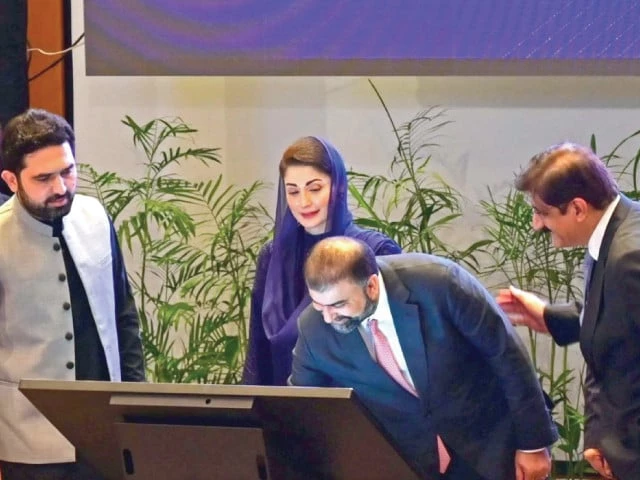
Four provincial chief ministers sign the Islamabad Declaration on prison reforms in Islamabad. PHOTO: IPP
ISLAMABAD:
A conference intended to examine Pakistan’s prison system instead saw politics take center stage on Thursday, as the chief ministers of Punjab and Khyber-Pakhtunkhwa used the Supreme Court forum to recount the plight of political prisoners rather than unveil concrete remedies for the thousands of inmates crammed into the country’s overcrowded jails.
Organized under the aegis of the National Judicial (Policy Making) Committee (NJPMC), the conference concluded with the four provincial governments supporting the Islamabad Declaration and committing to pursue coordinated reforms aimed at reducing overcrowding, improving prison conditions and strengthening rehabilitation across the country.
In his opening speech, Chief Justice of Pakistan Yahya Afridi observed that prisons reflect the true pulse of the criminal justice system and stressed that meaningful reform requires shared institutional responsibility and sustained leadership from the provinces.
He lauded the collective commitment of provincial governments to advance the NJPMC’s National Action Plan for Prison Reform through coordinated and practical reforms.
Although the chief justice managed to bring all four chief ministers under one roof, the conference ended without addressing concerns regarding political prisoners.
Khyber-Pakhtunkhwa Chief Minister Sohail Afridi in his speech highlighted the difficulties faced by former Prime Minister Imran Khan in jail and urged the Chief Justice to look into the matter.
Punjab Chief Minister Maryam Nawaz, meanwhile, spoke about her own imprisonment under the PTI government, recounting the ordeals she endured during her detention.
Notably, Federal Constitutional Court Chief Justice Aminuddin Khan and Islamabad High Court Chief Justice Sardar Sarfraz Dogar did not attend the conference.
Former federal minister Fawad Chaudhry, who himself spent several months in prison, said the so-called Islamabad Declaration on prison reform was largely a media exercise lacking seriousness and substance.
“It contains broad promises but no specific actions, timetables, responsibilities or implementation mechanisms.”
“Pakistan already has numerous prison reports, laws and regulations; the real problem is their poor application. Meaningful prison reform requires the implementation of existing laws, not another declaration or conference,” Chaudhry said.
In his speech, Khyber-Pakhtunkhwa Chief Minister Sohail Afridi said that while his provincial government was constructing waiting areas for visitors outside jails, similar arrangements should also be made at Adiala jail for visitors, including PTI workers.
He further insisted that water cannons should not be used against PTI founder Imran Khan’s sisters during their visits.
The chief minister expressed concern over Imran Khan’s “deteriorating health”, saying 85 per cent of the vision in one of his eyes had been affected. He asked the chief justice to ensure that the former prime minister has access to his personal doctors for treatment, that his family members are allowed to meet regularly and that he is allowed to speak to his sons via video link.
Afridi said that in line with the vision of its leaders, the Khyber-Pakhtunkhwa government was extending similar facilities to prisoners in the province’s jails.
He further said that Pakistan had a Constitution but it was not fully implemented, adding that the Constitution is the guarantor of national unity and should be respected.
The chief minister also criticized restrictions on public gatherings, saying that even though gatherings are allowed in a democracy, FIRs were being registered against participants, including terrorism charges against minor PTI supporters.
He concluded by saying that prison reforms should start with Adiala Prison.
Punjab Chief Minister Maryam Nawaz also spoke about her imprisonment, saying the experience had profoundly shaped her views on prison reform.
She said prison life taught her “the pain of separation in its cruelest form”, recalling that while she and her father were incarcerated, her mother became seriously ill.
“For days, none of us could talk to her. We couldn’t sit next to her, hold her hand or comfort her in her final moments. She left this world while we remained behind the prison walls,” she said.
Maryam said she is now not only the chief minister of Pakistan’s largest province, but also has had first-hand experience of incarceration.
“The reforms I’m going to talk about today come from my own personal experiences. I’ve lived them, I’ve experienced them personally, and that experience has changed me forever.”
She noted that Punjab operates one of the largest prison systems in the country, comprising 45 prisons housing more than 69,000 inmates with a licensed capacity of around 39,000.
She said overcrowding was only part of the problem, noting that nearly three-quarters of the detainees were undertrial prisoners.
“Prison reforms cannot be carried out in isolation; they must go hand in hand with broader criminal justice reforms. »
The chief minister said her government had introduced emergency call buttons and alarm systems in prison cells in Punjab.
“Every prison cell is now equipped with emergency systems so that no inmate is ever left without a way to call for immediate help,” she said, adding that rapid response to distress calls is essential because “human life cannot wait behind locked doors.”
Maryam also revealed that she was placed in solitary confinement during her imprisonment.
Islamabad Declaration
At the end of the conference, Law Minister Azam Nazeer Tarar read out the conference declaration, titled Islamabad Declaration.
“We, the Chief Ministers of the provinces of Pakistan, meeting under the auspices of the National Judicial (Policy) Committee, affirm our common commitment to a coordinated national effort to reform the provincial prison systems.
“We recognize that Pakistan’s prisons are under severe pressure, with overcrowding, a high proportion of undertrial prisoners, inadequate infrastructure, limited access to health and mental health services, and insufficient opportunities for rehabilitation, education and vocational training.
“We recognize that these challenges affect not only prison administration, but also access to justice, public safety, human dignity and the rule of law.
“We reaffirm that all persons deprived of their liberty retain their fundamental rights guaranteed by the Constitution of Pakistan, including the right to life, dignity, fair trial and humane treatment.
“We further recognize Pakistan’s obligations under international human rights standards, including those relating to the treatment of prisoners, women in detention, children in conflict with the law, persons with disabilities and the use of non-custodial measures.
“We recognize that meaningful and lasting prison reform requires coordinated action among the executive, judicial, and legislative branches, while respecting the constitutional roles of each branch of government.
“We further recognize that provincial governments bear primary responsibility for prison administration, resources and reform.
“Accordingly, all CMs are committed to reducing unnecessary incarceration, particularly of undertrial prisoners, by increasing access to bail, legal aid, probation, parole, diversion and other non-custodial alternatives, particularly for women, children, people with disabilities, people with mental health problems and those detained for minor, poverty-related or non-violent offenses.
“Second, review provincial laws, rules, policies and administrative practices governing arrest, detention, sentencing, prison management, probation, parole and rehabilitation, with a view to reducing overcrowding and aligning prison administration with constitutional and human rights standards.
“Third, improve conditions of detention through increased investments in infrastructure, sanitation, nutrition, health care, mental health services, recourse to complaints and safeguards against torture, ill-treatment and neglect.
“Fourth, promote rehabilitation and reintegration by expanding education, vocational training, psychosocial support, drug treatment, skills development and post-release support for those in detention.
“Fifth, strengthen coordination within the criminal justice system, including prison services, police, prosecution, probation and parole services, legal aid institutions, health and social care services and the judiciary, to support efficient case processing and timely access to justice.
“Sixth, establish provincial implementation mechanisms to develop time-bound reform plans, identify priority actions, allocate resources, collect data and monitor progress against agreed indicators.
“Seventh, report regularly on the implementation of the agreed national prison reform coordination mechanism, including progress in reducing overcrowding, improving prison conditions, expanding non-custodial alternatives and strengthening rehabilitation services.”
The four chief ministers concluded by saying that prison reform is not just an administrative necessity but “a constitutional, humanitarian and public security imperative.” We are committed to working together to build a prison system that is legal, humane, rehabilitative and consistent with the dignity of every person.”


