
The armed forces are fully aware of state-sponsored attempts to destabilize Pakistan carried out by hostile intelligence agencies.
Chief of Defense Force (CDF) and Chief of Army Staff Field Marshal Asim Munir on Wednesday reiterated that cross-border terrorism would be crushed with full force and those providing sanctuary and facilitating militancy would be completely dismantled.
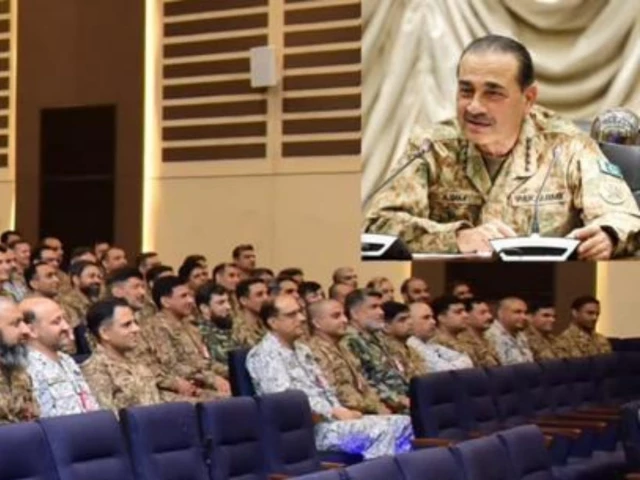
These remarks were made during CDF Munir’s visit to the National Defense University (NDU) in Islamabad, where he addressed the graduating officers of the National Security and Warfare course comprising participants from all services, the Army’s media wing said in a statement.
According to the Inter-Services Public Relations (ISPR), CDF Munir addressed the country’s security situation and “reiterated that terrorism emanating from across the borders will be crushed with all the might of the state.” “The armed forces, with the support of the nation, will ensure that the terrorist sanctuaries of these proxies and their enablers are completely dismantled,” he added.
CDF Munir noted that the armed forces were “fully aware of the attempts sponsored by the state and hostile intelligence agencies to destabilize Pakistan”, adding that the efforts of these proxies and networks, “which operate under the tutelage of hostile intelligence agencies, are futile and will not be allowed to undermine the internal security and economic prosperity of Pakistan”.
He highlighted the evolving nature of warfare and emphasized the centrality of strategic clarity and institutional professionalism to resolving complex strategic issues.
The statement further added that the Marshal also stressed that the army was recalibrating its employment and development strategies according to the evolved nature of the war. “The marshal noted that wars are not won by media rhetoric or political slogans but by faith, unity and discipline,” the statement said.
He also praised the role of institutions such as the NDU in “developing future military-civilian leadership capable of mitigating hybrid, conventional and sub-conventional threats with foresight, confidence and determination”.
Chief of Army Staff and Chief of Defense Forces Field Marshal Syed Asim Munir, while addressing the graduating officers of the National Defense University, reaffirmed the determination of the Pakistan Armed Forces to defeat terrorism and dismantle hostile proxy networks. Highlighting the changing nature of… pic.twitter.com/aJAPGnouX2
– Pakistan Television (@PakTVGlobal) July 8, 2026
Learn more: 11 soldiers martyred, 14 terrorists killed in attack on military convoy in Bela-Winder in Balochistan
CDF Munir concluded by expressing “full confidence in the professionalism, morale and operational readiness of the seasoned armed forces of Pakistan and urged the graduating officers to conscientiously adhere to the values of integrity, selfless service and unwavering commitment to the nation.”
Earlier, addressing a press briefing, ISPR Director General Lt Gen Ahmed Sharif Chaudhry said that India, along with hostile elements, was involved in terrorism inside Pakistan and could not tolerate the stability and progress of the country.
“They are using the territories under the control of this illegitimate Afghan Taliban regime as a base of operations. And the majority of the population, once we engaged them, turned out to be Afghans,” he said.
He also spoke about the recent terrorist attack on a Rangers camp in Karachi, saying there were four attackers, including three Afghans.
“All the planning, all the equipment, everything was done from Afghanistan,” he added.
DG ISPR said that there was a scheme, mastermind, intention, logistics and operational sequence behind the recent terrorist activities in Balochistan.
“The facilitation is provided by the Afghan Taliban regime. They are providing manpower. Because they have a problem with the dignity and development of Pakistan,” he said.
He added that these elements had a problem with the stability of the Pakistani people and did not want Balochistan to prosper because, according to him, “Balochistan was the life, pride and glory of Pakistan”.
DG ISPR said the armed forces, under the leadership of Field Marshal Asim Munir, had absolute clarity on the threat and were acting under the political direction of the government.
“We will confront all terrorists, their enablers, those who harbor them, those who supply them, those who provide them with a base, wherever they are, without any distinction. Do not expect any kind of rationality and proportionality from us,” he promised.
Pakistan’s allegations against Afghanistan and India for supporting terrorism
Pakistan has repeatedly highlighted an Afghanistan-India nexus behind terrorism in the country.
In November 2024, DG ISPR had issued a warning that the Afghan regime posed a threat not only to Pakistan but to the entire region and the world, citing the abandonment of $7.2 billion worth of US military hardware during the US withdrawal.
Chaudhry reiterated that the Afghan regime harbored “non-state actors” who posed a threat to various countries in the region, highlighting the Taliban’s failure to establish an inclusive state and government after 2021. He stressed that Pakistan’s problem was with the Afghan Taliban regime and not the Afghan people.
Learn more: Afghan regime poses threat to region and world (DG ISPR)
After the conflict with India in May 2025, CDF Munir had said that Pakistan would never be coerced and that all hostile plans to derail the country’s counter-terrorism efforts would be “completely defeated”.
He said the Pakistan Army remained ready to respond to the full spectrum of conflicts. He was particularly critical of India’s growing tendency to resort to unprovoked military aggression, warning that strategic stability in South Asia was increasingly fragile and dependent on justice, particularly in Kashmir.
In 2023, a UN report also revealed that the banned group Tehreek-e-Taliban Pakistan (TTP) had established a new base in KP in mid-2023. The report highlights the close ties not only between the TTP and the Afghan Taliban, but also with anti-Pakistan groups and Al-Qaeda.
Read this: The breeding ground of terrorism
The report further reveals that some Taliban members have also joined the TTP, seeing it as a religious obligation to provide support.
Interlocutors reported that TTP members and their families regularly received aid from the Taliban.
Importantly, the UN report noted a significant increase in the number of Afghan nationals in the ranks of the TTP. This supports Pakistan’s position that an increasing number of Afghan nationals are involved in suicide attacks in the country.


