
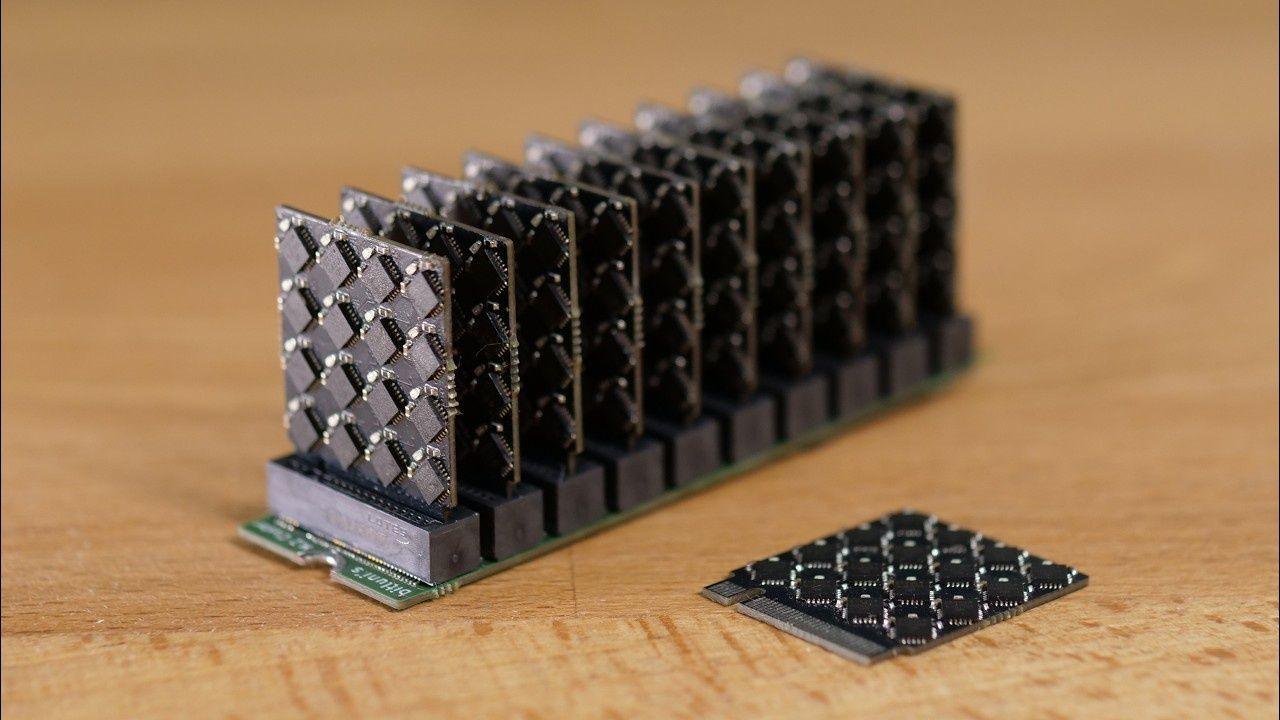
- YouTuber bitluni revealed a DIY RISC-V graphics processing unit
- Builder has a library of insane DIY projects on his YouTube channel
- RISC-V microcontrollers come from AliExpress
YouTuber bitluni has revealed his latest project, which could put all your worries about GPU pricing into context. The German tinkerer, who has built a strong following through his selection of intriguing and offbeat projects, assembled a GPU using a large collection of affordable RISC-V microcontrollers (MCUs).
While the results are impressive for a DIY build, the GPU is unfortunately quite modest and would likely have been discontinued long before had a PCB design company not reached out to explore a partnership on the build.
During a demonstration of the project on his channel, bitluni – real name Matthias Balwierz – expressed how difficult the build was and how it almost drove him crazy.

Output of over 8,000 RISC-V microcontrollers at 320 x 200 resolution
In its latest video, bitluni recalls a previous attempt to build a GPU in late 2025 that led to PCB designers Altium getting involved, explaining: “The clusters I had created before were already challenging my sanity. I thought I was done with the subject, but the budget and these tools would allow for a cluster of a different scale to be created, and the scale I had in mind was simply insane.”
Taking things to the next level is a hallmark of bitluni’s videos, and the final version includes an incredible 8,192 RISC-V CH570 microcontrollers, each running at 100 MHz, with 12 KB of SRAM. These are mounted on blades which have undergone several revisions because the PCB company declared them “too complicated”.
Each CH570 is equipped with an array of mounted LEDs, which correspond to each MCU and the equivalent QVGA pixel. With 8,192 MCUs, the result of 320 x 200 may seem modest, but bitluni is already planning a more powerful version with 32,000 MCUs.
Graphs or hashing?
The spike in GPU prices before the AI boom was due to industrial-scale cryptocurrency hashing, for which graphics cards are particularly suited. It’s this relationship between hashing and graphics that gives the bitluni project hope beyond displaying images and videos.
Identifying the serial port as the bottleneck to the project’s success as a working (albeit heavy) GPU, bitluni enlisted the help of its community of viewers to find a workaround, but that didn’t end the project.
Changing tactics, he used the microcontrollers for hashing and found that it outperformed his PC’s 8-core processor, with a low power consumption of 4 watts, so perhaps this approach has a use after all.

Follow TechRadar on Google News And add us as your favorite source to get our news, reviews and expert opinions in your feeds.


