
KARACHI:
Police said on Tuesday that “the mastermind behind the attack on a Karachi Rangers camp, identified as Qari Bashir”, had been arrested and confessed to his role in the attack during interrogation.
The investigation follows an attack on a Pakistan Rangers (Sindh) camp in Karachi on June 27, when armed terrorists attempted to storm the facility after detonating explosives at the main entrance. According to military media, Ranger personnel repelled the assault, killing three of the attackers and capturing a wounded fourth.
The Inter-Services Public Relations (ISPR) said three Rangers personnel were killed and four others injured in the exchange of fire. He identified the attackers as members of Jamaat-ul-Ahrar and said one of the captured terrorists was an Afghan national.
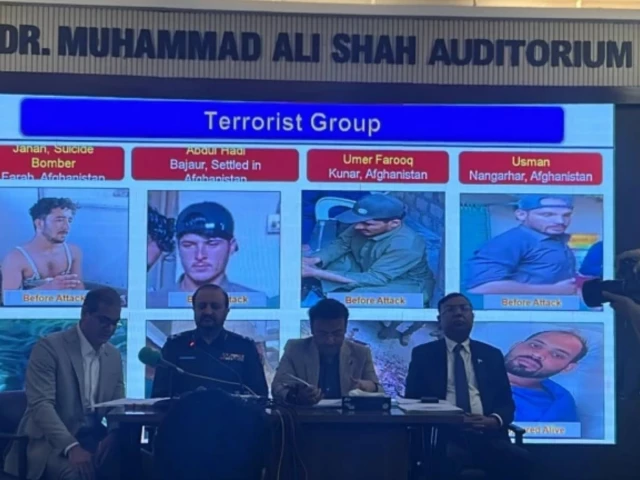
Speaking at a joint press conference alongside Sindh Inspector General of Police Javed Alam Odho and Interior Minister Zia-ul-Hassan Lanjar, Anti-Terrorism Department (CTD) Senior Superintendent of Police (SSP) Irfan Bahadur said the operation had four stages: planning in Afghanistan, moving terrorists to Pakistan, arranging local logistical support and supplying arms and suicide vests before leading the attack from Afghanistan.
“One of the attackers, identified as Janan, was an Afghan national and a suicide bomber, while another was from Bajaur. A third suspect, Umar Farooq, was from Afghanistan’s Kunar province, and the fourth attacker, identified as Usman, was captured alive after being injured during the operation,” he said.
Read: Terrorists should not be called ‘militants’: Tarar
According to Bahadur, Qari Bashir was called from Pakistan to Afghanistan to coordinate the operation before later returning to Karachi. He said Rangers then arrested Bashir, who confessed to his role during interrogation.
Video footage of Bashir’s alleged confession was shown during the press conference.
Bahadur said investigators believe 13 people were involved in the operation. He said the weapons were supplied through a network involving Saeed Shah, Ahsanullah, Liaqat and others, while another group of six members, including Rahim Afridi, were accused of facilitating arms smuggling.
He added that the terrorists entered Pakistan via Balochistan before reaching Hub, from where they traveled by car to Karachi and were accommodated in rented accommodation.
The CTD official said investigators recovered videos from Qari Bashir’s mobile phone, allegedly showing preparations for the attack, including the terrorists leaving for the operation. He also claimed that Bashir rented accommodation for the attackers and filmed them before they left.
Lanjar said four terrorists attacked a Rangers Transport Company Karachi on June 27 with the intention of taking hostages and causing mass casualties.
He said three of the attackers were Afghan nationals, while the fourth was from Bajaur and had been living in Afghanistan for around 20 years. According to the minister, all those responsible for the attackers were based in Afghanistan and directed the operation from there.
Lanjar said the attack was foiled by an operation by Sindh Rangers in which three terrorists were killed and one was arrested after being injured. He added that investigators have since dismantled the network of alleged facilitators involved in the attack.
Learn more: Rangers foil Karachi camp attack, three soldiers martyred: ISPR
He said the captured suspect, Usman, told investigators he was recruited from a religious seminary in Afghanistan and trained in two terrorist camps before being sent to Pakistan. A recording of his alleged confession was also played during the briefing.
Responding to questions from reporters, IG Sindh said there have been seven terrorist incidents in Sindh so far this year, compared to 37 during the same period last year. He said around 75 suspected terrorists were arrested, while others were killed during security operations.
Another IG CTD, Zulfiqar Lark, said all those directly involved in the Karachi attack had been apprehended or killed and investigators were now working to dismantle associated networks.


