
In response to child sexual abuse case, case falls entirely to UK authorities
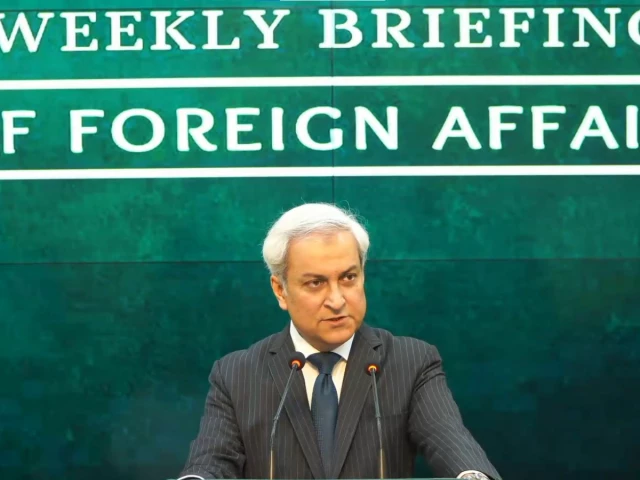
Foreign Ministry spokesperson Tahir Hussain Andrabi speaking at FO’s weekly press briefing. SCREENSHOT
Pakistan on Thursday renewed its call for restraint in the face of ongoing tensions between the United States and Iran, warning that further escalation would harm regional stability and insisting that “there is no alternative to sustained engagement, dialogue and diplomacy.”
Speaking at the Foreign Ministry’s weekly press conference, spokesperson Tahir Andrabi said Pakistan remained “deeply concerned” about the latest developments in the region and had been actively engaging with regional partners to support de-escalation.
“We stressed that a resumption of conflict serves no one’s interests” and urged all parties to avoid any action that could further inflame the situation.
🔴LIVE: Weekly Press Briefing by the Spokesperson 16-07-2026 at the Ministry of Foreign Affairs, Islamabad
– Ministry of Foreign Affairs – Pakistan (@ForeignOfficePk) July 16, 2026
“There is no alternative to sustained engagement, dialogue and diplomacy,” Andrabi said, adding that differences could only be resolved “through dialogue at the negotiating tables.”
He said Pakistan would continue to encourage all parties to resume negotiations at the technical level within the framework of the Islamabad Memorandum of Understanding and the June 22 Pakistan-Qatar Joint Statement.
Andrabi said current tensions were already affecting countries beyond the region, particularly those in the South, citing concerns over trade, food security and global energy supplies. He also expressed hope for a rapid return to normalcy in the Strait of Hormuz, stressing the importance of protecting freedom of maritime navigation.
The spokesperson said Pakistan had remained actively engaged with regional leaders over the past week in an effort to support de-escalation.
He said Prime Minister Shehbaz Sharif, in separate telephone conversations with Qatar’s Emir Sheikh Tamim bin Hamad Al Thani and Iranian President Masoud Pezeshkian, emphasized restraint and the need to preserve the fragile peace achieved in recent weeks.
According to Andrabi, the Qatari leader thanked Pakistan for playing “an active role, a leading role for peace in the region”, while President Pezeshkian reaffirmed Iran’s commitment to peace and appreciated Islamabad’s “constructive support” for regional stability.
Deputy Prime Minister and Foreign Minister Ishaq Dar also had separate calls with Saudi Foreign Minister Prince Faisal bin Farhan and Iranian Foreign Minister Abbas Araghchi, during which they discussed recent developments and agreed to remain in close contact.
Read: Iran ‘will neutralize US interventions in region,’ military spokesperson says
Moving on to other diplomatic engagements, Andrabi confirmed that Dar had left for Shanghai, where he will sign the founding instrument of the World Artificial Intelligence Cooperation Organization (WAICO) on behalf of Pakistan.
He said Pakistan would join the China-backed body as a founding member and Dar would also attend the 2026 World Conference on Artificial Intelligence and hold a series of bilateral meetings on the sidelines.
Andrabi also highlighted a number of recent diplomatic engagements, including Croatian Foreign Minister Gordan Grlić Radman’s visit to Islamabad, annual bilateral consultations with Portugal, and President Asif Ali Zardari’s visit to Kyrgyzstan – the first by a Pakistani president to the Central Asian country in over two decades.
He said Pakistan also hosted the 9th OIC Ministerial Conference on Women, attended by delegates from all 57 member states of the organization, and submitted its seventh national report under UN Security Council Resolution 1540, which he said reflected Pakistan’s commitment to international non-proliferation obligations.
During the question-and-answer session, Andrabi dismissed India’s latest indictment against six leaders of the All Parties Hurriyat Conference, including the late Syed Ali Geelani, describing it as yet another attempt to use “fictitious legal procedures” against Kashmiri leaders.
He said the reopening of a case dating back nearly three decades demonstrated how Indian legal institutions were being used “to advance a political agenda” and argued that such actions could not alter “the internationally recognized disputed status of Jammu and Kashmir.”
Andrabi also dismissed India’s allegations linking Pakistan to the Pahalgam attack, calling them “baseless and politically motivated”. He said Pakistan continued to seek an “independent, transparent and credible investigation”, arguing that India had yet to produce credible evidence to support its claims.
Responding to a question about a child sex abuse case in the UK, Andrabi condemned child sex abuse “in the strongest possible terms” and said offenders should face the full force of the law.
He said the matter fell entirely within the jurisdiction of British authorities, emphasizing that the individual concerned was a British national convicted by a British court. Pakistan, he added, has “no connection to this case” and has no role in decisions regarding the individual’s release or legal status.


