
Warns of harmful effects of tensions on economy, seeks ‘comprehensive strategy’ for rapid response
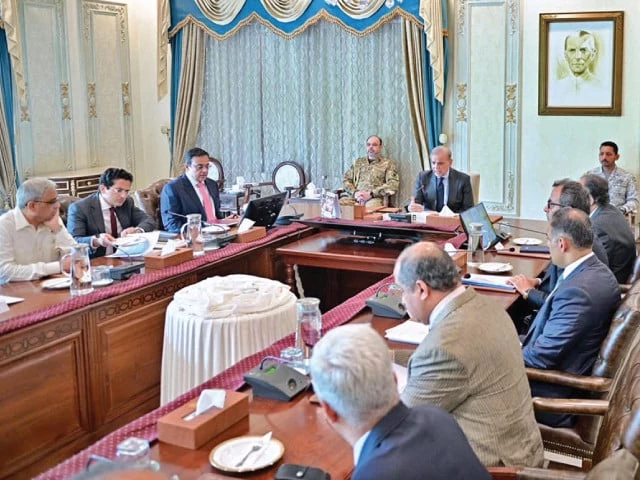
Prime Minister Shehbaz Sharif chairs a meeting in Islamabad to review austerity measures amid changing economic backdrop. Photo: APP
ISLAMABAD:
Prime Minister Shehbaz Sharif on Thursday directed the authorities concerned, in coordination with provincial governments, to take strict action against those responsible for creating artificial shortage of petroleum products in the market.
Chairing a high-level meeting on the economic impact of regional tensions, the prime minister said Pakistan’s economy remained stable, but stressed the need to develop a comprehensive strategy to enable a rapid response to any potential challenges.
He warned that escalating regional tensions could harm the country’s economic prospects and stressed the need for all relevant institutions to remain vigilant.
He called on relevant authorities to remain fully prepared to address any potential challenges arising from the current regional uncertainty and commended the public for their support for the government’s austerity and fuel-saving measures.
The meeting was informed that the country currently has sufficient reserves of petroleum products to meet national needs and measures have been put in place to ensure their continued supply in the future.
Meanwhile, amid fears of oil shortage due to recent US strikes on Iran, oil consumers may face an increase in prices of petroleum products by up to Rs 40 per liter starting next week.
Sources said petrol prices may increase by up to Rs 10 per litre, while high speed diesel (HSD) may become more expensive by up to Rs 40 per litre.
The government increased prices of petrol and HSD by nearly Rs 14 per liter last week after reducing fuel prices for two consecutive fortnights, a move made possible by the decline in international oil prices following the Islamabad MoU.
The free on board (FOB) price of diesel soared to $138 per barrel, while gasoline was trading at around $100 per barrel in the international market, a trend expected to put upward pressure on domestic fuel prices.
However, the government failed to implement the prescribed fuel pricing formula, which affected the financial viability of the oil industry.
The oil industry had also expressed serious reservations to the government over the continued changes in the oil pricing formula.
Meanwhile, the National Coordination and Management Council (NCMC) held a meeting on Thursday to review the availability of petroleum products across the country.
The meeting was attended by Minister of Petroleum Ali Pervaiz Malik and members of NCMC, representatives of Oil Companies Advisory Council (OCAC), FBR Member Customs, OGR and other relevant stakeholders. The committee noted that stocks of petroleum products are sufficient in the country to meet current demand.
During the meeting, supply-side challenges highlighted by OCAC representatives were discussed and addressed.
The commission observed that the concerns raised by OCAC mainly stem from an abnormal increase in sales of petroleum products during the first 15 days of July. The analysis presented by OGRA also indicated the possibility of hoarding in anticipation of a possible increase in prices.
The NCMC stressed that the OGRA enforcement mechanism should play a more proactive role and urged the provincial governments to ensure that there is no hoarding and that petroleum products remain easily accessible to the general public without any inconvenience.
The committee reiterated that the country’s stocks of petroleum products are sufficient and requested all relevant stakeholders to ensure uninterrupted supply of fuel across the country.
The committee met to review the oil supply security situation, with the aim of ensuring oil supplies amid ongoing tensions in the Gulf region.
On Wednesday, OCAC drew the attention of the federal government to the “imminent oil crisis”.
In a letter to the oil minister, OCAC warned of a looming gasoline shortage in Pakistan, saying the country’s immediately salable fuel stocks had fallen to critically low levels.
Currently, there is only about 15 days of inventory (370 KT) available, and incoming critical cargoes are facing severe customs clearance bottlenecks through the WEBOC system, the letter said, adding that the supply strain is further compounded by the previous rejection of a scheduled import cargo in June and a sharp increase in consumer demand triggered by expected global price hikes.
In addition to these operational problems, oil marketing companies (OMCs) are facing severe liquidity crises due to the government’s inability to release Rs. 66.7 billion outstanding price discrepancy claims (PDC), notes the letter.
OCAC has sought government intervention to release these pending funds, expedite customs clearance of imported fuel and provide the necessary support to ensure uninterrupted flow of petroleum products nationally.


