
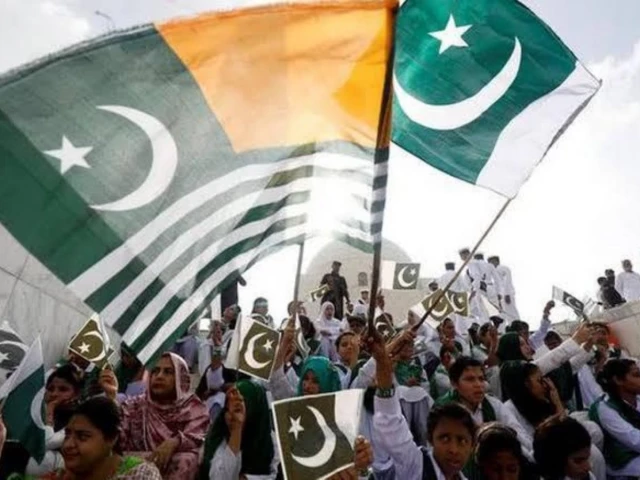
The 78th day of accession of Kashmir (Youm-e-Ilhaq-e-Pakistan) The visit to Pakistan was celebrated across the country on Sunday to commemorate the historic resolution passed by the All Jammu and Kashmir Muslim Conference on July 19, 1947, calling for the accession of the princely state of Jammu and Kashmir to Pakistan.
The day was celebrated across Pakistan, Azad Jammu and Kashmir (AJK), as well as among the Kashmiri diaspora who reiterated their stand on the occasion.
Various activities took place, including public rallies, seminars, conferences and public rallies.
Cities and towns were decorated with Pakistani and Kashmiri flags, while political parties, civil society organizations and student groups organized events reaffirming their commitment to the 1947 resolution and the implementation of UN resolutions on Jammu and Kashmir.
President Asif Ali Zardari and Prime Minister Shehbaz Sharif reaffirmed Pakistan’s unwavering support to the people of Jammu and Kashmir on the occasion of Kashmir’s Accession to Pakistan Day and urged the international community and the United Nations to play a more active role in ensuring implementation of UN resolutions.
In separate messages, the country’s top leaders said the day symbolized the historic aspirations of the people of Jammu and Kashmir and reiterated Islamabad’s long-standing position on the dispute.
President Zardari said Pakistan had “consistently advocated for a peaceful and just resolution of the Jammu and Kashmir conflict, in accordance with the relevant United Nations Security Council resolutions and the aspirations of the Kashmiri people.”
“Pakistan has always advocated a peaceful and just resolution of the Jammu and Kashmir dispute, in accordance with the relevant United Nations Security Council resolutions and the aspirations of the Kashmiri people. We urge the international community, in particular… pic.twitter.com/ficHa4SU6r
– The President of Pakistan (@PresOfPakistan) July 19, 2026
“We urge the international community, especially the United Nations, to shoulder their responsibility in supporting efforts to ensure the realization of the Kashmiri people’s inalienable right to self-determination,” he said.
Prime Minister Shehbaz said Youm-e-Ilhaq-e-Pakistan commemorates the historic resolution passed by the All Jammu and Kashmir Muslim Conference during its session in Srinagar on July 19, 1947, describing it as a defining moment in the political history of the region.
Message from Prime Minister Muhammad Shehbaz Sharif on the occasion of Youm-e-Ilhaq-e-Pakistan (Kashmir’s Accession to Pakistan Day), July 19, 2026.
Youm-e-Ilhaq-e-Pakistan (Accession of Kashmir to Pakistan Day) is observed every year to commemorate the historic resolution adopted by…
– Prime Minister’s Office (@PakPMO) July 18, 2026
He said the unanimously adopted resolution “reflects the collective political aspirations of the Muslims of Jammu and Kashmir” and expresses their desire for the state’s accession to Pakistan while calling on the Dogra leaders to respect “the will of the people”.
“The resolution remains an important historic step in the political struggle of the people of Jammu and Kashmir,” the Prime Minister said.
Prime Minister Shehbaz added that the occasion served as a “reminder of the enduring bonds that bind the people of Pakistan and Jammu and Kashmir” based on “shared history, faith, culture, geography and long-standing ties.”
Read: UN rights chief calls for calm and dialogue amid unrest in AJK
“Above all, it underlines the central importance of respecting the freely expressed will of the Kashmiri people,” he said.
Reaffirming Pakistan’s position on the dispute, the prime minister said the country remained “firm in its principled support for the inalienable right to self-determination of the people of Jammu and Kashmir, as enshrined in the relevant United Nations Security Council resolutions.”
He said the unresolved dispute continued to have “profound implications for regional peace and security.”
“A lasting peace in South Asia requires a peaceful resolution in accordance with the relevant United Nations Security Council resolutions and the aspirations of the Kashmiri people,” he said.
Paying tribute to the people of Indian Illegally Occupied Jammu and Kashmir (IIOJK), Prime Minister Shehbaz said the government and people of Pakistan “salute the courage, resilience and steadfastness” of the Kashmiris in what he described as their “just struggle for the realization of their fundamental rights”.
He reiterated that Pakistan would continue to extend its “unwavering diplomatic, political and moral support” until the people of Jammu and Kashmir are able to exercise their “inalienable right to self-determination”.
It was on July 19, 1947 that the genuine representatives of Kashmiris unanimously adopted the resolution of accession of Kashmir to Pakistan at a meeting of the All Jammu and Kashmir Muslim Conference at the residence of Sardar Muhammad Ibrahim Khan in Aabi Guzar area of Srinagar.
Learn more: Leaders salute Kashmir Martyrs’ Day
The historic resolution called for the accession of the state of Jammu and Kashmir to Pakistan, considering its religious, geographical, cultural and economic proximity to Pakistan and the aspirations of millions of Kashmiri Muslims.
This development took place almost a month before the creation of the two sovereign states of Pakistan and India under the partition plan of the British Indian colony, on August 14 and 15 of the same year.
According to the resolution, around 80 percent Muslim population, rivers flowing through Kashmir, language, culture and the state’s relations with Pakistan were the factors making accession to Pakistan inevitable.
United Nations Security Council Resolutions Nos. 47, 51, 80, 96, 98, 122 and 126 also declared that the fate of Jammu and Kashmir would be decided according to the wishes of the Kashmiri people through self-determination.
The Indian government had also committed to the UN to grant the right of self-determination to Kashmiris, but later retracted. Regarding the granting of the right to self-determination, the Indian authorities further implemented the revocation of Articles 370 and 35A, which granted special status to Kashmir.


