
Monsoon-related death toll rises in province as authorities issue new landslide alerts
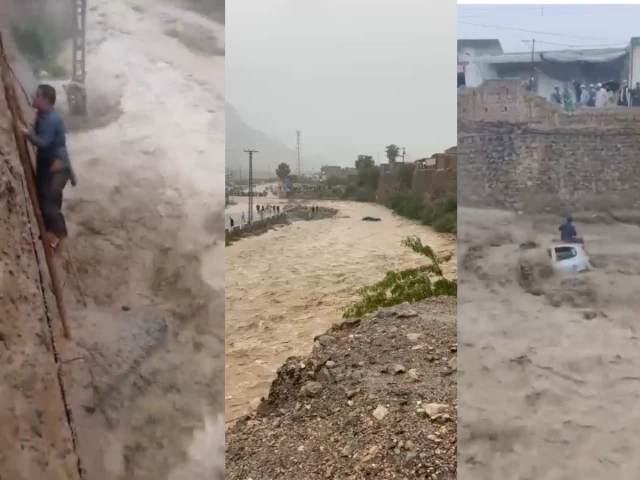
Three people die in Khyber flash floods amid widespread monsoon rains across Khyber-Pakhtunkhwa. PHOTO: EXPRESS
PESHAWAR:
Three people died after being swept away by flash floods triggered by heavy monsoon rains in Khyber district on Monday, as widespread downpours led to fresh flooding and landslide warnings across much of Khyber-Pakhtunkhwa (KP).
A spokesperson for Rescue 1122 said the death toll from Landi Kotal flash floods rose to three after the bodies of a woman, a man and a child were found during search operations. The woman and man were found in Jabba Khwar area of Jamrud, while the child’s body was found in Parang Sam area with the help of locals.
According to the spokesperson, divers and local volunteers carried out a joint search operation before handing over the bodies found to the competent authorities for legal formalities. The rescue service urged the public to avoid rivers, streams and seasonal waterways during heavy rain and to call 1122 in an emergency.
The floods followed torrential rains that lashed Landi Kotal and other upper parts of Khyber district, causing seasonal rivers to overflow and washing away several vehicles. Authorities said no additional casualties were reported in the incidents.
Elsewhere in KP, heavy rains were reported in Peshawar and Nowshera, where dark clouds gave way to regular showers, significantly lowering temperatures and making the weather more pleasant.
Read: PDMA warns of flooding of Punjab rivers as monsoon rains intensify
The Pakistan Meteorological Department (PMD) said partly cloudy, hot and humid conditions would prevail over much of the province, with rains accompanied by strong winds and thunderstorms expected in Chitral, Upper and Lower Dir, Swat, Shangla, Buner, Malakand, Upper and Lower Kohistan, Battagram, Mansehra, Abbottabad, Bajaur, Mohmand, Mardan, Swabi, Nowshera, Charsadda, Peshawar, Kohat, Karak, Hangu, Lakki Marwat, Bannu, Dera Ismail Khan, Tank, Kurram, Orakzai and North and South Waziristan.
Isolated heavy rain and hailstorms are also possible in some areas.
The department warned that heavy rains could trigger landslides in vulnerable mountainous areas, while low-lying areas of Peshawar, Nowshera, Charsadda, Mardan and Swabi remain at risk of urban flooding. It also warned that high winds and lightning could damage vulnerable infrastructure, including solar panels, utility poles and billboards.
In a statement, Rescue 1122 said it had placed all emergency services in the district on high alert as monsoon rains continue in the province, ordering emergency teams to remain fully prepared for possible flooding and other weather-related incidents.
During an online emergency meeting, Director General Relief 1122 Shah Fahad directed all district emergency officers, especially those in flood-prone and vulnerable districts, to ensure that emergency response operations are carried out in accordance with the KP’s pre-approved contingency plans for monsoon.
At least 38 people have been killed and 120 injured since the start of the monsoon season on June 26, with KP recording the highest death toll at 23, according to the latest daily situation report of the National Disaster Management Authority (NDMA) released last week.
The NDMA said house collapses remained the leading cause of monsoon-related deaths, accounting for 65.8% of all deaths. Lightning strikes were responsible for 15.8% of deaths, followed by flash floods at 7.9%. Incidents involving solar panels and drowning each accounted for 2.6% of deaths, while falling trees and electrocution were responsible for 2.6% each.
Meanwhile, the PMD warned that monsoon activity is expected to intensify in large parts of the country from July 18, with widespread rain, storms and thunderstorms forecast until July 25, increasing the risk of flash floods, urban flooding and landslides.
The PMD said windstorms and lightning “could damage weak structures (solar panels, utility poles, billboards, etc.)” during the forecast period. He also warned that landslides may occur in vulnerable areas of upper KP, Murree, Galiyat and Kashmir, while flash floods are likely in local rivers and nullahs of KP, northeast Punjab, Islamabad, GB, torrents of Dera Ghazi Khan and northeast Balochistan during periods of heavy rains.
Learn more: Rain-related incidents leave nine dead, 28 injured in Punjab’s KP
Last year’s monsoon caused widespread damage across Pakistan, killing more than 1,000 people and causing damage estimated at 822 billion rupees (about $2.9 billion), according to the government’s assessment. According to Planning Minister Ahsan Iqbal, the agricultural sector suffered the heaviest losses, estimated at 430 billion rupees, while damage to infrastructure amounted to 307 billion rupees.
More than 312,000 households were affected across the country, with Punjab accounting for the vast majority. The floods also damaged 2,811 kilometers of roads, more than 2,200 educational institutions and 250 health facilities, while 866 water systems were affected.
The disaster also dealt a major blow to the agricultural sector, killing more than 2,200 livestock and destroying millions of tons of crops, including cotton, rice and sugarcane.
This is not unprecedented. The 2022 floods caused economic losses worth $30 billion and required $16.3 billion for reconstruction. A World Bank assessment found that 82% of the losses were agricultural, affecting 4.4 million acres of farmland and 800,000 head of livestock. Sindh was then hardest hit, accounting for almost 70% of the damage, while Balochistan and KP also suffered deeply.


