
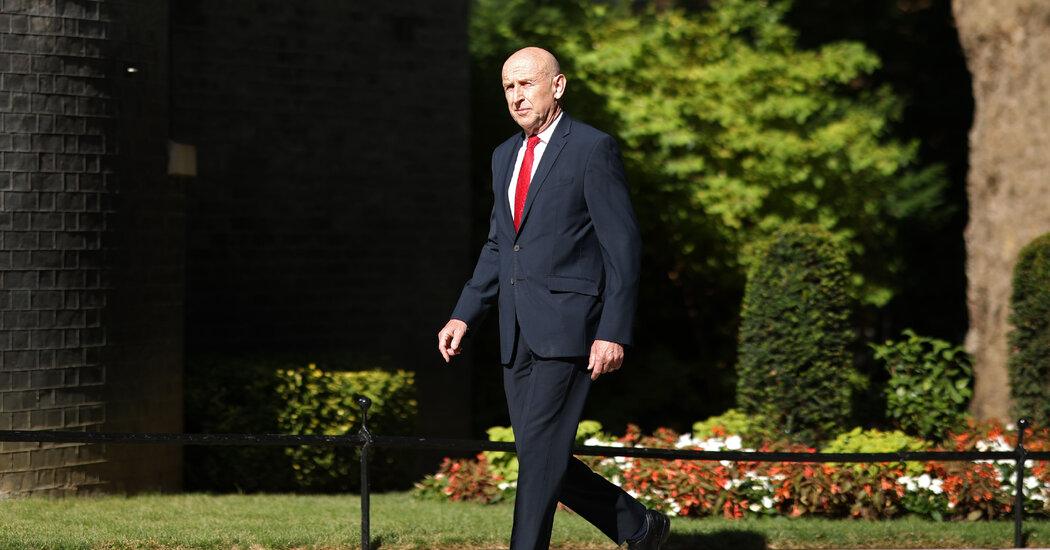
Andy Burnham, Britain’s new Prime Minister, on Monday appointed John Healey as Chancellor of the Exchequer, a crucial cabinet post that oversees the country’s finances and helps deliver its vision of spreading economic growth across the country.
Mr Healey was most recently defense secretary under the previous government, although he resigned last month because he said the Treasury had not sufficiently funded the military. Although little is known about Mr Healey’s latest broad economic views, the role of chancellor is one of the most important in the British government, controlling the amount of money other departments are allowed to spend and invest. The office and official residence are at No. 11 Downing Street, next to that of the Prime Minister.
Nonetheless, Mr Burnham said he intended to set the policy direction and ensure other ministers followed his lead. This choice will come as a surprise to many, as Mr Healey was not considered a recent favorite, but as a long-serving MP, Mr Healey is considered a well-respected political figure.
Mr Burnham, who was named leader of the Labor Party on Friday, has yet to give details of his economic plans, but he has promised to break with the policies of the past four decades. He said he wanted to give more power to local authorities to boost growth across the country. Mr Burnham also wants to put water, housing, energy and transport under more public control. He is expected to take swift action to ease the high cost of living, with the first announcements expected on Tuesday.
Since the 1980s, when then-Prime Minister Margaret Thatcher privatized most public services, Mr. Burnham said, the economy has not worked for most people.
“In the 1980s, Britain took some wrong turns,” he said on Monday. “Political power has been centralized, economic power privatized. Large parts of the country have deindustrialized and still have not recovered.”
The ambitions of Mr Burnham’s government will face formidable and long-term economic challenges. Britain has suffered sluggish growth since the 2008 financial crisis, wide regional disparities in prosperity, stubbornly high inflation and a heavy debt burden that directs much of the money towards interest payments.
Burnham and Healey will also have to deal with the consequences of the war in the Middle East, which has clouded the economic outlook. In recent months, rising energy prices have driven up household energy bills and dashed expectations that interest rates set by the central bank would fall this year.
Mr Healey, 66, has been an MP since 1997 and represents a constituency in the north of England. From his early days in office, he gained experience at the Treasury, serving under Gordon Brown when he was chancellor in the late 1990s, then as a junior minister.
When Labor returned to power in 2024, after 14 years in opposition, Mr Healey was appointed Defense Secretary. But he has become increasingly critical of the funding available to the military. Mr Starmer had pledged to sharply increase spending, but Mr Healey said the money spent on defense was not enough to deliver on that promise. His resignation was a blow to Mr Starmer, who was already facing calls to resign from many in the Labor Party.
As Britain’s economy has been rocked by a series of shocks over the past decade, including Brexit and the war between Russia and Ukraine, political turmoil has added to the challenges. Mr Healey is the ninth chancellor since Britain voted in 2016 to leave the European Union.
One thing Britain badly needs is more consistency, economists say. And that’s the lesson of Manchester, where Mr. Burnham was mayor for almost a decade, said Diane Coyle, a professor of public policy at the University of Cambridge. The northern city has seen impressive growth during Mr. Burnham’s tenure, although the foundations for that success began before Mr. Burnham arrived.
“It takes a long time to turn things around, and it takes that consistency in policy and leadership, and that’s one of the big lessons I’m taking from Manchester,” Ms Coyle said.
Open questions about Mr Burnham’s economic policies include: what does he mean in practice by “business-friendly socialism”, the term he has used to describe his policies in Manchester? How will increased housing construction by local authorities be financed? Will Mr Burnham introduce a wealth tax? And how will he finance more social services, a subject that has concerned him since he started in government twenty years ago.
For Mr Healey, the role of chancellor is rarely a path to popularity. Rachel Reeves, the former chancellor, focused on restoring stability to Britain’s public finances and rebuilding the country’s credibility in the bond markets. But she imposed strict budget rules aimed at reducing debt, including requiring tax revenues to cover daily expenses, which led to difficult and sometimes unpopular choices. Early decisions to reduce winter fuel payments for retirees and limit social spending provoked revolts within the party and ended in reversals.
The new chancellor will also have to deal with many of these problems. Social spending remains too high and Britain has pledged to increase its military spending. Mr Burnham has already promised to stick to Ms Reeves’ budget rules, which also binds his new chancellor to them. However, he said he would use any “flexibility” under the rules, which have pushed the yield on 10-year UK government bonds above 5% for the first time in around two months.


