
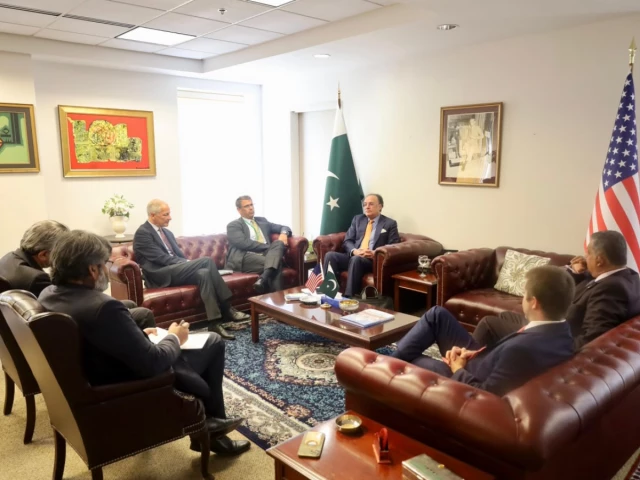
Discuss the potential to improve the country’s domestic refining capacity and reduce dependence on imported petroleum products
Finance Minister Muhammad Aurangzeb met a delegation of Honeywell Technologies led by its Vice Chairman and Managing Director Barry Glickman in Washington DC. PHOTO:
Finance Minister Muhammad Aurangzeb on Tuesday met a delegation from Honeywell Technologies in Washington, DC, where discussions focused on the proposed modernization and expansion of Pakistan’s refinery sector, according to the Finance Ministry.
The ministry said the finance minister welcomed the proposal as it could “enhance the country’s domestic refining capacity and reduce dependence on imported petroleum products.”
Finance Minister meets Honeywell Technologies delegation, discusses refinery modernization and energy security
Federal Minister for Finance and Revenue, Senator Muhammad Aurangzeb, met a delegation of Honeywell Technologies led by its Vice Chairman and Managing Director, Mr.… pic.twitter.com/N9DAlMZcra
– Ministry of Finance, Government of Pakistan (@Financegovpk) July 20, 2026
According to the ministry, the two sides discussed “Honeywell’s technology and equipment solutions” as well as “potential financing through the US EXIM Bank, the US International Development Finance Corporation (DFC), export credit agencies and major international banks.”
The ministry said the finance minister told the delegation that the proposed initiative would “support Pakistan’s energy security, industrial development and sustainable economic growth.”
The Honeywell delegation was led by its vice president and general manager, Barry Glickman.
The round of negotiations comes as Islamabad and Washington seek to deepen economic engagement through trade, investment and business partnerships.
The United States remains Pakistan’s top export destination, while the two countries have recently expanded cooperation in areas such as investment promotion and essential minerals.
According to the Office of the U.S. Trade Representative, total U.S. trade in goods and services with Pakistan was estimated at $10.1 billion in 2024. U.S. merchandise trade reached $8.7 billion in 2025, with U.S. exports to Pakistan reaching $3.3 billion and imports from Pakistan reaching $5.4 billion.
Read: Pakistan-US trade talks move forward (FO)
Business leaders welcomed progress in negotiations, saying a reciprocal trade deal could improve Pakistani exporters’ access to the U.S. market.
The negotiations also come against the backdrop of evolving US tariff measures affecting Pakistani exports. Earlier this year, the Trump administration proposed a 29% tariff on Pakistani goods before reducing it to 19% following negotiations with Pakistani officials.
Subsequently, the United States Supreme Court ruled that the International Emergency Economic Powers Act did not authorize the president to impose broad tariffs under emergency powers. The administration then invoked Section 122 of the Commerce Act of 1974 to impose a temporary global tariff of 10% for up to 150 days.
Pakistan is also among the countries that responded to a Section 301 investigation by the Office of the U.S. Trade Representative into alleged trade practices linked to forced labor. Islamabad submitted detailed responses to US authorities, including a supplemental response before the latest round of negotiations.
The Foreign Ministry said on July 12 that Pakistan and the United States had made significant progress towards a reciprocal trade agreement after two days of negotiations in Washington, with both sides narrowing their differences and reaching consensus for an early conclusion of the deal.
Foreign Ministry spokesperson Tahir Andrabi said negotiations on the reciprocal trade agreement between Pakistan and the United States took place on July 9-10 in Washington in an atmosphere he described as cordial.
The negotiations focused on strengthening bilateral trade, facilitating greater trade cooperation and expanding existing trade between the two countries.
Photographs shared by the Foreign Office showed officials from both sides posing after the talks. In one image, Paul presented a Pakistan-made soccer ball to a U.S. official, highlighting one of Pakistan’s major export industries.


