
Reiterates Pakistan’s unwavering support for the security, sovereignty, territorial integrity and prosperity of the Kingdom
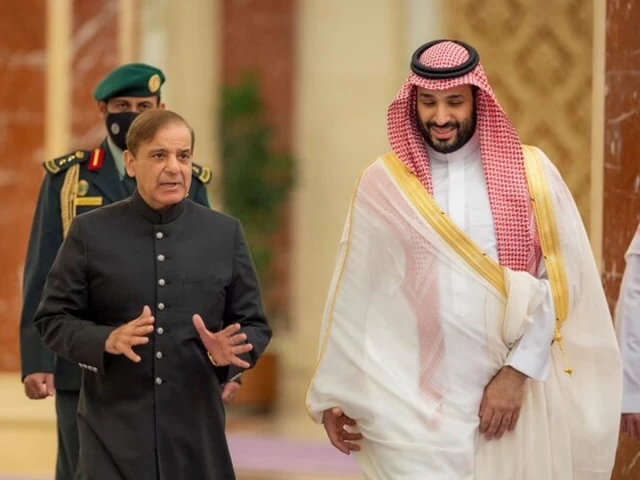
Saudi Crown Prince Mohammed bin Salman meets Prime Minister Shehbaz Sharif upon his arrival in Jeddah, Saudi Arabia, April 29, 2022. Photo: Reuters
Prime Minister Shehbaz Sharif on Thursday condemned attacks by Houthi militia on Saudi oil tankers in the Red Sea in a phone call with Saudi Crown Prince Mohammed bin Salman (MBS) and assured Riyadh of Pakistan’s full support.
“The Prime Minister expressed Pakistan’s condemnation, in the strongest possible terms, of the dastardly attacks carried out by the Houthi militia against Saudi oil tankers in the Red Sea, saying that such actions were completely unacceptable, constituted a blatant violation of international law, threatened freedom of navigation and commercial transportation and undermined regional peace, security and stability,” said a statement issued by the Prime Minister’s Office (PMO).
The statement came hours after the Houthis struck two Saudi oil tankers in what the group described as a naval blockade against Saudi Arabia. The Houthis control areas near the Bab el-Mandeb Strait, a strategic waterway linking the Red Sea and the Gulf of Aden. The group announced a naval blockade targeting Saudi Arabia, a move some analysts described as an attempt to increase pressure amid broader regional tensions.
The PMO statement further said that Prime Minister Shehbaz reaffirmed Pakistan’s full solidarity with the Kingdom of Saudi Arabia and said that “he, along with the Chief of Defense Forces and Chief of Army Staff, Field Marshal Asim Munir, and the entire Pakistani nation, stands firmly and resolutely with the Saudi leadership and the brotherly people of the Kingdom at this critical time.”
The Prime Minister reiterated Pakistan’s unwavering support for the security, sovereignty, territorial integrity and prosperity of Saudi Arabia.
“The Prime Minister assured MBS that Pakistan would continue to work very closely with the Kingdom, as well as the international community, towards peace, security, stability and the uninterrupted flow of legal maritime commerce in the Red Sea, the Strait of Hormuz and the wider region,” the statement said.
According to the Prime Minister’s Office, the crown prince appreciated Pakistan’s unwavering support and the close fraternal ties between the two countries.
“Taking advantage of this opportunity, the Prime Minister conveyed his warm greetings and best wishes to the Custodian of the Two Holy Mosques King Salman bin Abdulaziz Al Saud,” the statement added.
I had a telephone conversation this morning with my dear brother, His Royal Highness Prince Mohammed bin Salman bin Abdulaziz Al Saud, Crown Prince and Prime Minister of the Kingdom of Saudi Arabia.
I condemned, in the strongest terms, the attacks by the Houthi militias…
– Shehbaz Sharif (@CMShehbaz) July 23, 2026
The phone conversation took place amid heightened regional tensions following attacks on commercial shipping in the Red Sea, a key global trade route.
The Foreign Ministry also issued a statement on Wednesday “unequivocally” condemning ongoing threats by the Houthi militia against the Kingdom of Saudi Arabia and commercial shipping in the Red Sea, warning that such actions jeopardize global trade and regional security.
Read: Houthis claim to have attacked Saudi oil tankers in the Red Sea as US concludes 12th day of strikes on Iran
Five tankers changed course in the Red Sea to avoid the Bab el-Mandeb Strait on Wednesday, and three tankers loaded with Saudi oil destined for China and India turned back on Tuesday.
Houthis strike Saudi oil tankers
Earlier in the day, the Houthis said their forces had carried out missile and drone strikes on two Saudi oil tankers in the Red Sea, identifying them as the Encelia and the Layla. Saudi State News Agency SPA cited an official source as saying the Encelia had been struck, causing a fire at the bow. The attack on the Layla is not confirmed.
A maritime security source said Encelia transmitted a distress call, reporting that she had been hit by a missile near the Saudi Red Sea port of Jizan on Wednesday evening. Millions of barrels of Saudi oil per day are heading to the Red Sea port of Yanbu to avoid the Strait of Hormuz. If shipments cannot pass through the southern strait of the Red Sea, they only have to take the northern route via the Suez Canal, adding weeks and costs to the journey.
Learn more: FO condemns Houthi threats against Saudi Arabia and Red Sea shipping
The Houthis’ threat to impose a naval blockade on Saudi Arabia could significantly widen the war and strain the U.S. military, current and former U.S. officials said. Two very large Chinese oil carriers carrying a total of 4 million barrels of Saudi oil were heading to the Bab el-Mandeb Strait on Thursday, according to shipping data.
Completely closing the Bab el-Mandeb Strait, the southern gateway to the Red Sea, would halt Saudi oil exports to Asia and could reduce global oil supplies by 7%.
The war in Iran has “already” reduced global supply by 10%.
“The question now is whether they will start targeting ships heading to Saudi ports. At this point, there is no clear answer,” said Mohammed Albasha, a Yemeni analyst and founder of Basha Report, a Washington-based risk consultancy.
“Even if no ships are attacked, the announcement alone is likely to disrupt shipping and create uncertainty for Saudi ports. The crucial question remains whether the Houthis move from threats to direct action,” he said.
The group fired missiles at Saudi Arabia last week after accusing the kingdom of bombing an airport under its control, breaking a four-year truce in the conflict between the kingdom and the Iran-aligned group.


