
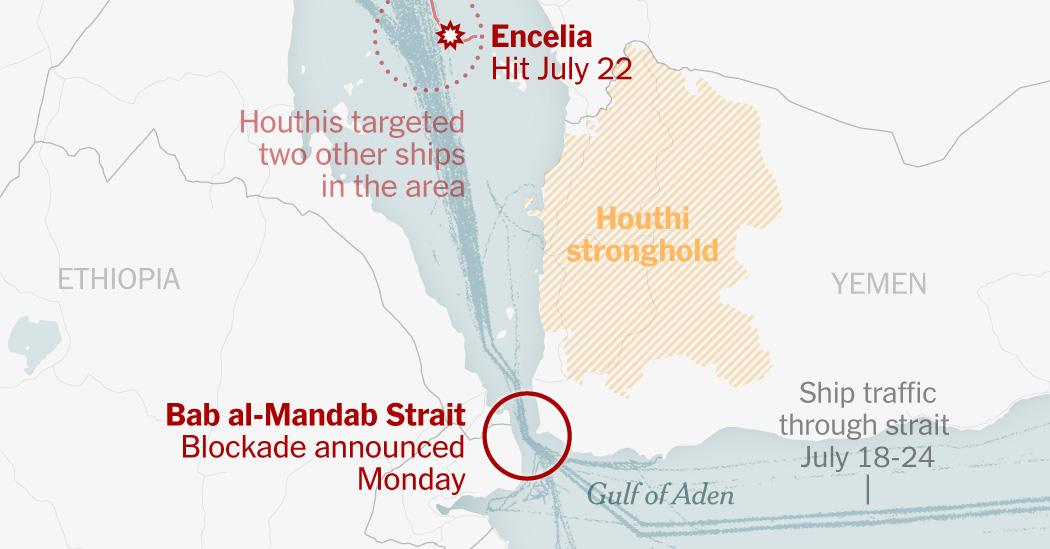
Days after the Iran-backed Houthi militia announced a blockade of a vital maritime passage across the Red Sea, dozens of ships continue to make the journey, according to a study of maritime data.
But with every hour that passes, uncertainty about the safety of the trip grows. Ships have turned around, in some cases reversing course on voyages meant to extend to India, China and other parts of the world. In at least three cases this week, oil tankers have been attacked in the Red Sea, including one attack reported Friday evening.
If the blockade succeeds in hampering maritime activity, it will be a new blow to world trade already damaged by the worsening conflict in the Middle East. As the United States and Iran intensify their attacks in a war now in its fifth month, the Strait of Hormuz, the narrow waterway next to Iran that has long been the conduit for a fifth of the world’s oil supply, has remained largely cut off.
In recent months, Saudi Arabia has shipped millions of barrels of oil per day through a pipeline stretching from the Persian Gulf to the Red Sea. Most of this oil exits the region through the Bab al-Mandab Strait, off the coast of Yemen and close to territory controlled by the Houthis.
That path was compromised on Monday, when the militia announced it would block ship activity from Saudi Arabia, the world’s largest oil exporter.
Nearly a dozen ships – either attempting to leave the Red Sea or enter the area – have since turned back through the strait, according to Kpler, a maritime data company.
It is difficult to get a complete picture of maritime traffic in the region, with more and more ships turning off their tracking transponders to hide their positions from the Houthis, said Michelle Wiese Bockmann, an analyst at Windward, a maritime intelligence firm.
And some data suggests that activity in the Bab al-Mandab Strait increased this week despite Houthi aggression. On Thursday, Kpler found, 43 ships crossed the strait, compared to 35 the day before, when the Houthis claimed to have targeted two Saudi oil tankers with missiles and drones.
The hull of a Saudi ship was damaged after being targeted in the Red Sea on Friday, Saudi officials said. The ship and crew were unharmed and the ship appeared to continue traveling.
This is not the first time that the Houthis have disrupted activities in the Red Sea. In 2024, they regularly attacked ships there with ties to Israel in what the militia described as an effort to force Israel to end its bombing of Gaza.
Now, looking for an alternative, some shippers are heading north toward the Suez Canal, Kpler said. But this route to Asia – which buys much of the region’s oil – is much more expensive and longer. And the canal is too shallow for fully loaded supertankers, so oil must be transferred to a pipeline before returning to tankers or carried on smaller ships, straining the availability of these types of ships.
Due to growing tensions in the Red Sea, in addition to diminishing activity around the Strait of Hormuz and elsewhere, around 25 percent of the world’s oil supply is now at risk, Wiese Bockmann said. “It’s a pretty volatile situation,” she said.
This week, prices of Brent crude oil, the international benchmark, jumped to around $100 a barrel – a level not seen in about two months.


