
Ali Pervaiz Malik says daily reviews curb supply manipulation as senators criticize system, rising fuel prices
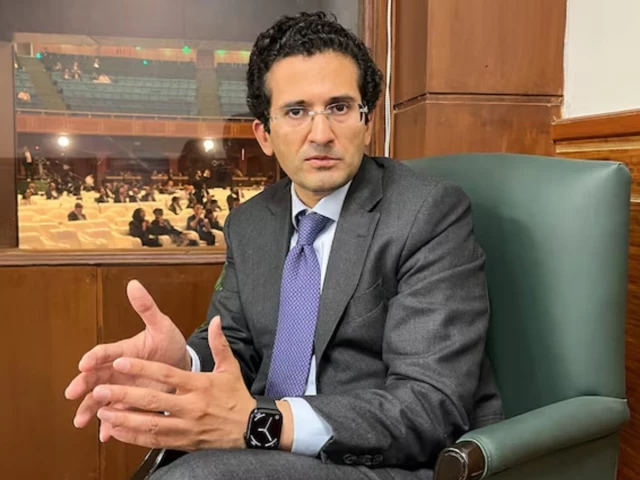
Minister of Petroleum and Natural Resources Ali Pervaiz Malik speaks during an interview with Reuters, during the Pakistan Minerals Investment Forum 2025, in Islamabad, Pakistan, April 8, 2025. Photo: Reuters
ISLAMABAD:
Oil Minister Ali Pervaiz Malik on Thursday defended the government’s daily fuel pricing mechanism, saying it had ended the practice of oil companies limiting gasoline supplies in anticipation of price revisions under the previous system.
The federal government announced on July 17 that prices of petroleum products will now be reviewed and notified daily, replacing the weekly pricing mechanism, as renewed tensions between the United States and Iran continue to fuel volatility in global oil markets and spark concerns over fuel supplies.
This decision was taken after the government moved from a fortnightly to a weekly review of fuel prices, following the first phase of the US-Iran conflict.
The move, however, drew criticism from carriers, businesses and opposition MPs, who argued that frequent price reviews would create uncertainty, increase transport and freight costs and make it difficult for businesses and consumers to plan spending. Petrol pump owners also threatened a nationwide strike before calling off the protest after the government assured them their concerns would be addressed.
Speaking at a meeting of the National Assembly’s Standing Committee on Petroleum, chaired by Umar Farooq, Malik said prices of petrol and diesel continue to be calculated based on a seven-day rolling average of international market prices, although they are now revised daily instead of fortnightly.
He said the government had delegated the authority to determine prices of petroleum products to the Oil and Gas Regulatory Authority (Ogra), which is responsible for bringing together all stakeholders before finalizing prices.
Malik said the pricing methodology and the benchmark used for calculations are already available on the Ogra website, adding that Prime Minister Shehbaz Sharif had ordered the regulator to publish the formula in Urdu to improve transparency.
Learn more: Daily fuel price leads to increased freight
Explaining the new system, the minister said international benchmark prices come from Platts before government taxes and oil company margins are added to determine domestic retail prices.
He argued that the move to daily pricing had corrected a major flaw in the previous mechanism. “When prices were revised weekly, companies would see the three-day average emerge and reduce their gasoline supplies accordingly,” Malik said. “Now prices are determined daily using the seven-day average.”
The new mechanism, however, faced strong criticism from committee members, including Senator Saifullah Abro, who called it a “slow poison” for consumers. “The public doesn’t know what the price is today or what the price will be tomorrow,” he said. “People receive a slow poison every day: they can neither live nor die.”
Questioning the recent price increases, Abro noted that international crude oil prices rose from $76 per barrel on July 11 to $82 on July 17, wondering how domestic fuel prices increased by Rs 30 during the same period.
Malik responded that the comparison was misleading because domestic prices of gasoline and diesel are based on refined petroleum products rather than crude oil.
The minister also defended the current tax structure, saying the oil tax was lower than the level imposed during the war period. He added that it would be difficult to reduce the levy because the International Monetary Fund would not agree, although an alternative source of revenue could allow such a reduction.
The committee also heard from Ogra officials, who defended the new pricing mechanism.
Ogra Acting Chairman Nabeel Ahmed Awan said daily prices continue to be calculated using the seven-day average of international market prices. If global oil prices fall, he explained, the drop will be gradually passed on to consumers over a seven-day period. Likewise, any increase in international prices is reflected over the same period.
He argued that the new system benefits consumers by eliminating short-term profit opportunities. “Those who created a false impression in the market to make money will no longer be able to do so,” he said.
Read also: Government shifts to daily POL pricing amid global headwinds
Ogra officials also informed the committee that the current customs duty on petrol stands at Rs 18.11 per litre.
The hearing briefly became tense when committee members questioned why they had not received the working document before the meeting.
When the acting president of Ogra responded by asking: “What is a working document?” “, Senator Abro chastised him saying: “You don’t even know what a working paper is? Did you come from another planet?
Earlier in the meeting, Malik said the process of appointing a permanent Ogra chairman had been initiated on time. However, interviews failed to find a suitable candidate and the appointment process has since resumed.
The federal government reshuffled Ogra’s leadership in April, removing Shahzad Iqbal, then acting president, and appointing Nabeel Ahmed Awan, a BS-22 officer in the Pakistan Administrative Service and secretary of the Establishment Division, as acting president for an initial term of three months, while the search for a permanent president continues.


