
Islamabad:
Friday, the army retraced a strong link between India, the terrorist group and its managers operating in Afghanistan via satellite phones behind the diversion of Jaffer Express.
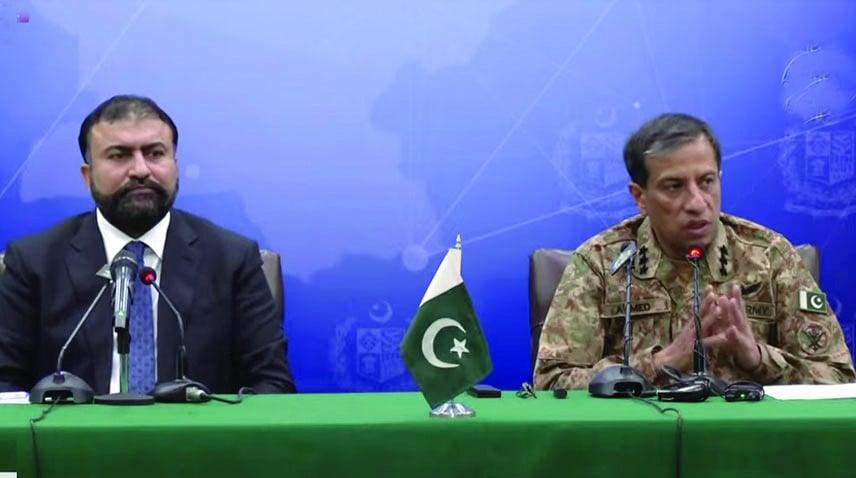
Lieutenant-general Ahmed Sharif Chaudhry, the military spokesman, shared the details of the train incident at a press conference alongside the chief minister of Balutchistan, Sarfraz Bugti.
The Director General of Inter-Services Public Relations (ISPR) projected several video clips generated by AI AI which were disseminated by the traditional media of India, mainly provided by an internationally recognized terrorist group, to glorify the diversion and build an anti-Pakistan story by distributing disinformation.
He also informed the media of the difficult and mountainous land surrounding the incident site near Sibi, using a card slide, and the operation carried out by the security forces, following which the air pirates were killed and the hostages were saved in a precise and successful operation.
According to the ISPR DG, 354 Jaffar Express passengers were rescued. Twenty-six people were martyred, while 37 were injured. No passengers remain in captivity of terrorists.
He said that it was accidental field, kilometers away from the road and the population, without mobile coverage, where the site physically reaches was a very difficult task.
However, the CEO ISPR said that FC and army staff responded to terrorist activity without any excessive delay after air hackers exploded a railroad with an IED and three martyred soldiers during an FC stake before diverting the train on March 11.
Lieutenant-General Ahmed Sharif said the terrorists were divided into several groups and had heard the heights, taking a group of hostage passengers inside the train while the others were held outside.
He added that at the same time, a information war campaign was underway, led by the Indian media to glorify the incident, which was inhuman, because innocent people were made hostages and targeted.
He informed that the terrorists had published a group of hostages selected on the basis of ethnic profiling, adding that the terrorists have nothing to do with humanity, neither with Pakistan, nor with Islam.
On the morning of March 12, he said that FC and army staff first hired the terrorists with snipers on the ground and released them, which gave some of the hostages to sneak in captivity. “When terrorists were engaged, a group has a chance and they started running towards several directions. Indeed, the snipers engage them,” he added.
At noon, said the ISPR DG, the Zaraar company of the special service group, was set up which has carried out their planning and their situational assessment, differentiating between passengers and terrorists, including the suicide bomber before engaging them.
“”[…] They first clean the engine, then the terrorists, who met them, they started to remove them. And then, Bogey by Bogey, they cleaned the train. This is how it has been slowly and gradually transformed into a successful operation, “he said, adding no victim did not occur in the hostages during this customs clearance operation.
He said the security forces had successfully combated a very complex and meticulously planned terrorism in the 36 hours with professionalism, an area where suicide bomber was present.
He underlined that the operation was carried out with the greatest professionalism, planning and the unshakable courage of the Pakistani army, Pakistan Air Force, the border body (FC) and the Special Services Group (SSG), the prayers of the nation contributing to its success.
He also revealed that links with the terrorist incident were traced in Afghanistan. “We have credible information confirming that the networks orchestrating these attacks operate on the other side of the border in Afghanistan,” he said.
The CEO of the ISPR revealed that among the people involved was a key figure that previously served in the Afghan army and is now actively engaged in terrorist activities against Pakistan. “The whole chain of events points to an external involvement, in particular from elements based in Afghanistan,” he added.
He praised the bravery and professionalism of the forces that risked their lives to save innocent civilians from an imminent threat. “We are grateful to Allah and welcome our courageous son who, with their detailed planning, their foresight, their courage and their devotion, saved a precious life in an extremely dangerous and difficult environment,” he said.
He recalled that after 2004, a national consensus was built against terrorism, which led to the formulation of a complete national action plan (NAP). “All political and stakeholders were sitting together and developed this consensus, which has become the foundation of the national action plan. The previous government examined and revised it, which led to a renewed commitment to the fight against terrorism,” he said.
He explained that the revised NAP includes 14 critical points which in depth address the deep causes and the mechanisms of terrorism. “If we focus on the implementation of these 14 points in the letter and the mind, I believe that terrorism can be eradicated,” he said.
Responding to a question concerning the recent increase in terrorist activities, the ISPR DG said: “Without any hesitation, I would say that these 14 points are not fully implemented, it will be difficult to reach a lasting peace.”
He urged all stakeholders, including political parties, institutions and the public, to play their role in the implementation of the nap, stressing that national unity and consensus remain essential to overcome the threat of terrorism.
Asked about the reason why there was an increase in terrorism, he declared that the pace of implementation of the 14 points of the National Action Plan was to be considered first.
He said that the law enforcement organizations had led 59,775 intelligence -based operations, both major and minor, in 2024. Until now, in 2025, 11,654 IBOs have been carried out.
“This year, we are on average 180 IBO per day,” he added. Meanwhile, around 1,250 terrorists were “sent to hell” in 2024 and 2025, while 563 members of the security personnel were martyred in the exercise of their functions, he said.
Responding to a question concerning the increase in terrorist activities, the ISPR DG said: “Each moment, the security forces are engaged in efforts to combat terrorism. Sacrifices are being completed daily – soldiers, police and even civilians lose their lives to safeguard the future of Pakistan. The children are orphans because of this fight.”
He also underlined the continuous threat emanating from Afghanistan, said: “We have irrefutable evidence that terrorist groups, in particular Khawarij and other factions, have established their leadership, recruitment networks and training centers within Afghanistan. Terrorists targeting Pakist. “
He highlighted the dangerous effects of overflow after the withdrawal of Afghanistan’s international forces. “A large amount of advanced military equipment, including night vision devices, has found its way in the hands of these terrorist organizations. This has improved their operational capacities,” he said.
He also underlined the firm position of Pakistan against illegal activities fueling instability in the region. “Pakistan takes decisive measures against a wide range of illegal specters, including drug trafficking, smuggling, non-personalized vehicles and massive mafias benefiting from the smuggling of Iranian petrol and diesel,” he said.
“These mafias, which have long worked freely and undermined the economic and social stability of Pakistan, are now confronted,” he added. “They are resisting all the efforts that threaten their acquired interests. But for Pakistan to achieve its true potential and overcome its challenges, the State and its people must be united.”
He said that the commission of inquiry on forced disappearances is already there, which has been working since 2011. The one who has made a complaint concerning the mission has the right to go to this commission which is chaired by leaders of the judiciary.
He declared that, out of a total of 10,405 cases registered with this commission, up to 8,144 cases had been resolved while 2,261 were the subject of an investigation and if we speak specifically of Balutchistan, it was only 2,911 cases which reported by the province. Out of 2,911, only 452 are “in balance” because the rest of the cases have been resolved.
He said that the state has resolved the issue of people who have systematically, methodological and institutional disappeared.
However, there are questions from the state that should not have been unanswered. For example, the details of those involved in this atrocity in Bolan are still unknown. Who were and aren’t they missing people.
The list of those who are part of Fitna ul Khawarij and training in Afghanistan should be shared so that the public can know their identity. In Karachi, those who dressed on the trails had been buried by thousands. They were also one of the missing people.
The people have made a mission worldwide, including the United Kingdom and the United States, he said, asking if people from all countries have resorted to the construction of stories against their armies. Those who have become victims of terrorism in Pakistan are not among the missing people.
Residents of Pakistan need to understand the reasons for their story.
For a question, he said that Balutchistan represents 44% of Pakistan and that 58% of the province’s land is mountainous and that 20% is desert and not populated. It is a very difficult intelligence environment towards Balutchistan.
He said, the country, all the intelligence agencies worked day and night to find these conduits to make any potential incident thanks to preventive actions. There is no trunk that strikes in the work of intelligence and it is necessary to characterize these incidents as a failure of intelligence.


