
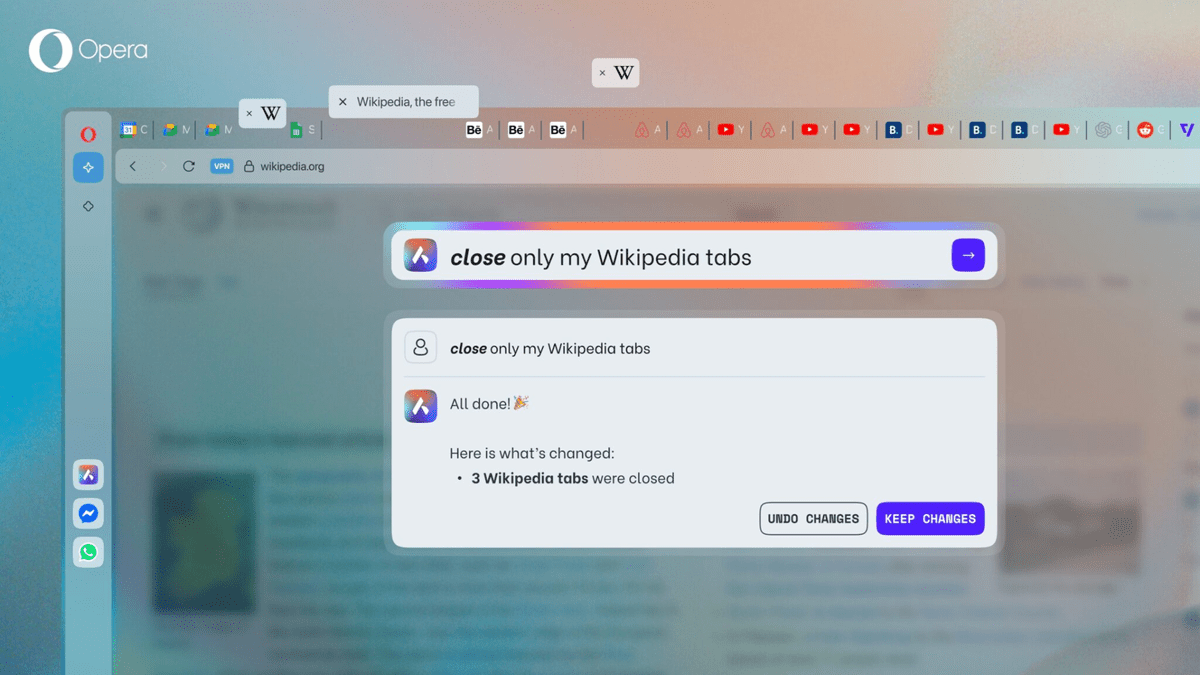
- The Opera One web browser has published a new AI tab functionality
- The tool allows the ARIA AI assistant to manage tabs using natural language prompts
- Users can ask Aria to group, close or organize tabs directly from the command line
Web Browser Opera One offers new hope to those of us with a hundred or more tabs open on a dozen subjects. New AI opera tab orders can simply take care of it with a few basic prompts.
As its name suggests, AI tab commands connect your requests to organize or close tabs in your browser depending on the subject or website. You can use it to “close all Wikipedia tabs” and see them all disappear or “group my PK Press Club tabs” and have all the items that you are excited to read.
The functionality uses the AI of the opera assistant ARIA, to manage requests. This is a new area for Aria, which has been kept in the form of a chatbot to answer questions so far.
Aria is now an “AI agent”, joining the growing number of AI tools capable of performing tasks instead of absorbing and sharing information. He completed the most complete operator agent published earlier this year by Openai.
It is a small change of theory, but which could feel enormous enough for all those who have ever found themselves swimming in a sea of half -read items, abandoned carts, open calculation sheets and at least a tab playing music that you cannot locate.
Aria not only recognizes specific websites; It understands the context. Tell him to bring together “all my work tabs”, and that will determine the tabs you meant to say. You no longer have to play the forensic detective to understand what you were doing before lunch.
You can try the AI tab commands via the integrated opera command line. Press CTRL + / on Windows or CMD + / on Mac, then type what you want to do with your tabs. If you have five or more open tabs, as do far too many people do, you can also right -click on one of them and click on the AI tab management in the drop -down menu.
“After being the first to introduce tabs 25 years ago, we continue to improve this main browser functionality,” said opera director of opera Joanna Czajka in a statement. “With this stage, we continue to push the border of what can be done with these new technologies in a web browser.”
To watch
Crescendo AI of the Opera
There is something deeply cathartic to unload your tab anxiety on an AI assistant, such as the hiring of a virtual Marie Kondo for your digital workspace. And if you worry about the privacy of your navigation story, you can relax.
The only information sent to opera servers is the text of your order. The list of open tabs and other details remains invisible on your device. So, unless you are strangely explicit by detailing everything you prefer not to share in your request, Aria will not know anything about it.
Many opera users are probably used to infusion of the company’s AI in all its browser. Over the past two years, the company has gradually deployed new tools for Aria. This includes the aforementioned operator agent, the creation of images, the vocal output and bringing it Aria to its mobile application.
Aria has also brought other upgrades to accompany orders from the AI tab, including a “writing mode” that lives in the command line, allowing users to write emails and other content without ever leaving the browser. You can also interact with Aria directly from a browser tab, not only via the sidebar or the command line.
This is part of the efforts of the opera to ensure that Aria feels like a native and integrated part of the experience rather than a separate thing that you should remember. AI training has also been upgraded to provide better answers on purchases, revenues and games.
These more subtle improvements and features all work together to make the crossing more without friction and can just be the thing for the opera to encourage more people to turn to them when they want to go online, or at least when they cannot bear as many tabs splashed on their screen.


